JACK IS BACK (Jack-In-The-Pulpit)

By Lorna Dielentheis

I originally published this piece last Spring, and instead of writing a whole new post on my favorite late-spring ephemeral, I present it to you again! This essay was so much fun to investigate and write. I hope you enjoy it, and more importantly, that it inspires you to go peer into a nearby Arisaema triphyllum.


note: I’ve included a small glossary of plant terminology at the end, and have also inserted some definitions along the way so you don’t have to interrupt your reading to scroll down. The words defined in the glossary are bolded where they first appear in the text.


Jack-in-the-pulpit is a peculiar plant. 

The hollow, hooded form is striking— it’s hard to resist making a closer inspection. As you examine the mysterious flower, you’ll undoubtedly find yourself lifting the striped mantle to reveal the smooth, elegant spadix within. 

The coloration of the spadix and striped spathe varies from a dark near-black to a pale, fleshy green. Sometimes when you peer beneath the spathe’s veil, the spadix trembles, bringing to mind a cloaked figure or a snake poised to strike. Three upright leaflets fan out behind the inflorescence, adding to the drama. 

Spathe: a single bract that surrounds the spadix— on jack-in-the-pulpit, this is the entire striped outer “pulpit” that encircles the “jack”

Spadix: a flowering spike, on jack-in-the-pulpit it’s the “jack,” which has many small flowers hidden at its base

Bract: a modified leaf

Inflorescence: the entire flowering structure of a plant— on jack-in-the-pulpit, the actual flowers are hidden inside the spathe at the base of the spadix. The entire structure pictured below (minus the leaf) is the inflorescence.

lifting the spathe’s hood to reveal the spadix

Jack’s bizarre shape is often compared to that of a pitcher plant. And although it is not carnivorous, it does trap the fungus gnats that pollinate it, which die inside the spathe after futile attempts to escape. Let’s back up for a second though. 

Jack-in-the-pulpit is dioecious, a word stemming from the ancient Greek dioikía, which translates to “of two houses.” It means that the male flowers and female flowers are on separate plants, preventing self-pollination. This is uncommon in and of itself: only ~6% of flowering plants are dioecious. But Jack-in-the-pulpit takes its rare sexual expression one step further, possessing the ability to change sex from year to year.

Jacks start out as single leaves, absorbing nutrients and sunlight that will eventually help them bloom. When they first muster the energy to put out an inflorescence it’s male, with flowers that consist of stamens and pollen– this takes less energy than producing female flowers. After a couple more years, when the plant has stored up enough energy in its corm, it produces the female flowers that when pollinated create fruits and seeds. If the plant’s energy is depleted, for example if there’s poor conditions or if it used up its stores producing fruits, it can revert back to male the following year, and so on. 


Self-pollination: pollination in which a flower is pollinated by its own pollen or that of a flower on the same plant

Stamens: the male fertilizing organ of a flower, usually possesses pollen


Corm: a modified underground plant stem that serves as a storage organ

The females are often larger and sometimes have two leaves vs. the typical single compound leaf of males. The two sexes differ in another key characteristic– the males have a small hole in the base of the spathe that allows pollinators to exit the plant, while the females have no hole, trapping the pollinators that visit them.

The primary pollinators of Jack-in-the-pulpit are fungus gnats. They’re attracted to a scent the plant emits that mimics fungus. Don’t bother trying to get a whiff though— this scent is imperceptible to humans.

Compound Leaf: a leaf comprised of two or more distinct leaflets joined by a single stem (in the case of Jack-in-the-pulpit, each leaf has three leaflets)

note the three leaflets which make up each compound leaf

How it works: a gnat finds its way into the hollow spathe of a male plant and searches for fungus, bumping into the pollen-laden stamens along the way. The gnat, finding no fungus, decides to exit the plant. But if it tries to fly up and out the way it came in, it strikes the hood and falls back down to the bottom of the tube. It becomes disoriented; the hood also blocks the light which makes it hard for the gnat to navigate. The slippery walls prevent the gnat from crawling out. It might repeat its exit attempts any number of times, collecting more and more pollen, before eventually finding its way out of the small hole at the base of the spathe. 

Ideally, the gnat continues its search and is soon duped again– this time by a female plant. The gnat enters the plant the same way, bumping into the female flowers and depositing the pollen it collected earlier, pollinating the plant. But with no exit this time, the gnat eventually dies inside the spathe. The prevailing theory is that the female plants evolved this adaptation to force the gnats to stay inside them for as long as possible– increasing the chances of successful pollination.

While reminding myself of the details of this fascinating pollination process, I stumbled on a small mystery. All of the sources I found online maintain that Jack-in-the-pulpit is dioecious, as I described above. However, as I searched, I came across a few sources that mentioned that an individual plant can sometimes produce a combination of male and female flowers on a single spadix. The proportion of male to female flowers in that case determines the functional sex of the plant. These sourcesstate that despite Jack-in-the-pulpit’s ability to occasionally produce both sexes of flower on one spadix, it still cannot self pollinate because either the male or the female flowers on such a plant are inert. A couple sources went into greater detail, saying that when there are two sexes of flower on one individual, they mature at different times, making self-pollination impossible.

This raised so many questions: how commonly do Jacks actually produce both male and female flowers? When an individual does possess both male and female flowers, will it have the escape hatch typically found in unisexual males? What about the way these plants are categorized– if they have the ability to produce both male and female flowers on the same individual, are they truly dioecious? And does the staggered male vs female bloom timing ever effect cross-pollination?

I’m sure a botanist could answer these questions, but I don’t personally know any botanists. And besides, when presented with a puzzle I would almost always rather investigate myself— to the extent that that’s possible, anyway. 


Unisexual: when a plant only has the reproductive organs of one sex— dioecious plants are unisexual

Cross-pollination: pollination in which a flower is pollinated with pollen from a separate plant

a solitary female Jack, quite large, with two compound leaves 

Luckily, the opportunity to answer some of these questions arose spontaneously. I was out doing a natural community visit a few days ago (this time to a Mesic Clayplain Forest and a Sand-Over-Clay Forest– summary forthcoming), when I happened upon dozens of Jack-in-the-pulpits. This natural community provided the perfect conditions for them: moist, nutrient rich soil, with the right combination of shade and sunlight. I decided to do a quick survey and see how many were male, how many female, and whether I could find any possessing both male and female flowers.

I started looking around and quickly realized that there were far more male than female plants. I gently unfurled a few of the spathes and peered inside— the actual flowers are clustered at the base of the spadix. It’s really easy to tell the male flowers from the female flowers once you’ve seen them: the female flowers each have a bright green ovary and a fuzzy white stigma, while the males are pale cream to purple with teensy u-shaped stamens and pollen.

Stigma: the part of the flower that receives the pollen

left: female flowers, right: male flowers

I was able to see the male escape holes in-person for the first time too, and compare those to the corresponding area on the females. I’d always wondered what these “holes” looked like, and they weren’t what I was expecting. They were more like indentations than actual holes.

left: “escape hatch” on a male plant, right: the corresponding area lacking a hole on a female plant

After carefully examining several Jacks, I found what I was looking for: a plant that possessed both male and female flowers. Looking closely, it appeared that the male flowers were not producing pollen.

two individuals possessing BOTH male and female flowers

I walked around more and noticed a few patterns. Some of my observations confirmed what I already knew: the female flowers were larger and tended to have two compound leaves, while the males were smaller and greater in number. My exit hole question was answered— the few individuals I found that possessed both male and female flowers all lacked an escape hatch. Surprisingly though, as I examined more of them, I noticed that some of the male flowers on these individuals seemed to possess both pollen and fully formed female flowers. I say seemed because that’s how it appeared to me, but I can’t be sure, I am not an expert. Though even if the male flowers died before the female flowers matured, isn’t it likely there would still be plenty of pollen sitting in the bottom of the spathe, ready to be transferred to the female flowers by an unwitting gnat? 

I have more questions now than I did before I investigated. I’ve come to expect that both from nature and from self-study, though: the more you learn, the more you understand how much you don’t know. I am at the very least glad to have finally peered into the guts of these clever plants and seen the place where so many brave gnats have met their untimely ends. And when clusters of bright red berries appear amidst the lush forest floor in late summer, I’ll think about the sacrifice they required, the tiny green flowers they once were, and the years of stored energy it took to create them.

the bright red fruits of jack-in-the-pulpit


All illustrations and photos are my own.

Note: This is the fourteenth in a series of posts on spring ephemeral wildflowers.

Previous posts:

Subscribe to get a wildflower in your inbox 1-2 times a week from now through the end of May. And send this post to a friend who could use a wildflower today!


GLOSSARY

Spathe: a single bract that surrounds the spadix

Spadix: a flowering spike

Bract: a modified leaf, sometimes showier than petals

Inflorescence: the entire flowering structure of a plant

Dioecious: having male and female flowers on separate plants

Monoecious: having male and female flowers on the same plant

Self-pollination: pollination in which a flower is pollinated by its own pollen or that of a flower on the same plant

Cross-pollination: pollination in which a flower is pollinated with pollen from a separate plant

Stamens: the male fertilizing organ of a flower, usually possesses pollen

Stigma: the part of the flower that receives the pollen

Pistil: the female reproductive part of a flower

Corm: a modified underground plant stem that serves as a storage organ

Compound Leaf: a leaf comprised of two or more distinct leaflets joined by a single stem (in the case of jack-in-the-pulpit, each leaf has three leaflets)

Unisexual: when a plant only has the reproductive organs of one sex— dioecious plants are unisexual

This post was originally published here.
Yellow Trout Lily

Erythronium americanum

By Lorna Dielentheis

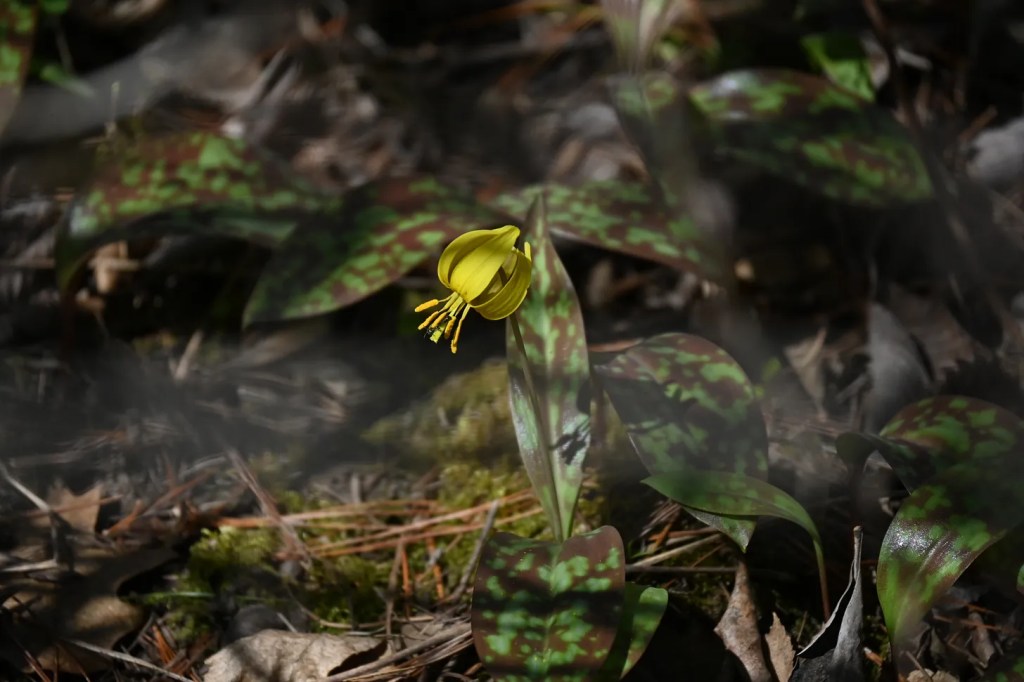
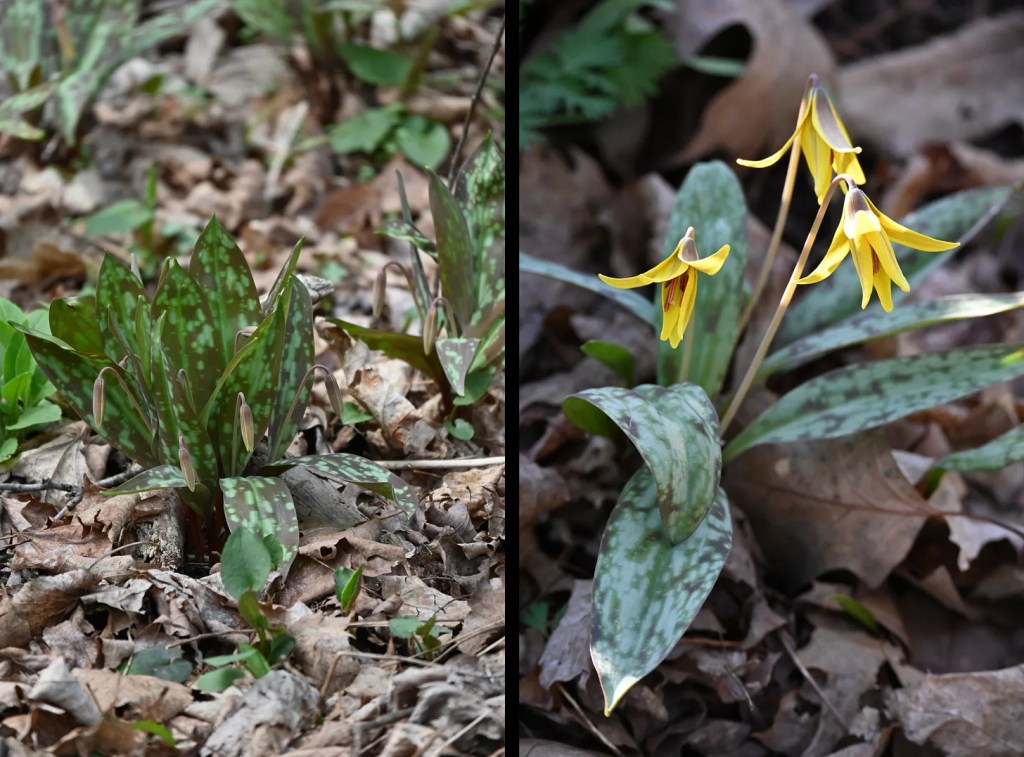
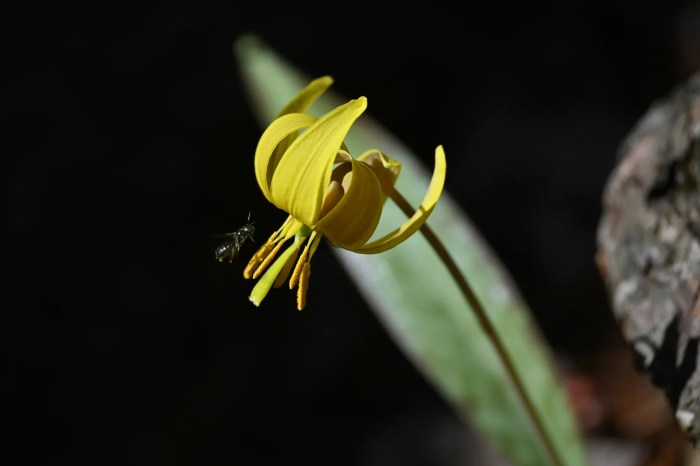
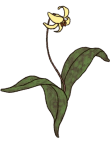
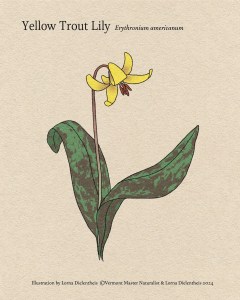
Yellow Trout Lily’s green and brown leaves, mottled like the brook trout the plant is named after, have emerged from the leaf litter. If you spot one, look around and you’ll undoubtedly see many more.

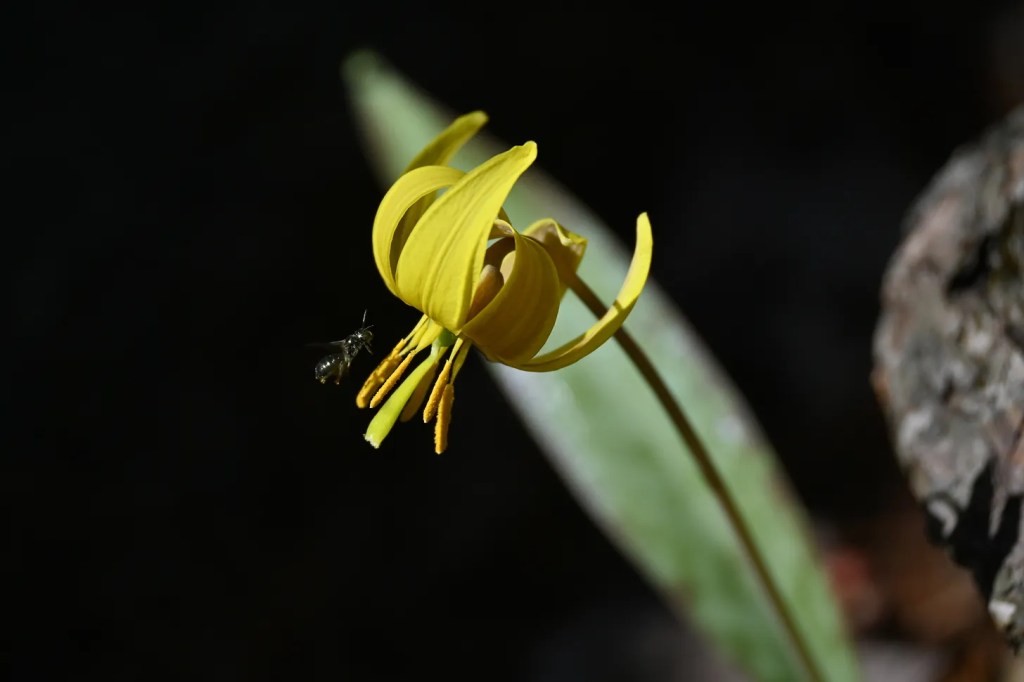
A Ceratina bee visiting a yellow trout lily

Trout lilies reproduce primarily asexually through shoots called stolons. These horizontal stems grow just along the soil surface, emerging from one bulb and reentering the soil to form a new plant. You’ll often see these stolons in the summertime, after the rest of the plant has died back. They look like little white worms snaking their way in and out of the forest floor.

One of my favorite trout lily colonies

Trout lilies can (and do) reproduce sexually too, their sexual reproduction just isn’t as successful: only about 10% of pollinated flowers develop seeds. Because of this, they tend to form large clonal colonies of genetically identical individuals. Like I said, where you see one trout lily, there are almost certainly going to be many more.

Within these large colonies, however, only a small percentage of individuals bloom each year— somewhere around 0.5%, or 1 in every 200 plants. It can take an individual seven years to bloom. You can tell if an individual will produce a flower that year by the leaves: plants that are going to flower produce two basal leaves, and plants that won’t have just one upright leaf. 

The few seeds that are produced are distributed through a mutualistic relationship with ants called myrmecochory— see my previous post on Hepatica for a description of this.

see the bee?

Yellow Trout Lily’s pollen, like that of all ephemerals, is an essential source of food for early pollinators. Their stamens range in color from yellow to a deep, rusty red. In my observation, all of the trout lilies in a colony will have the same color of stamen, I’m guessing because of them being mostly genetically identical.

Varying stamen/pollen colors (these are plants from two different locations)

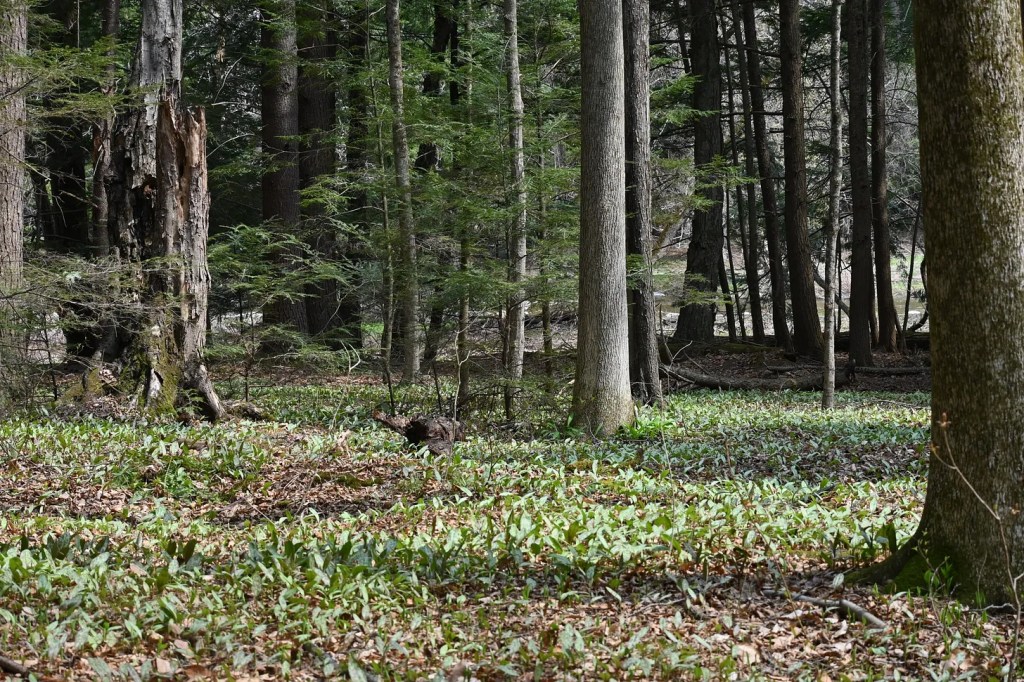
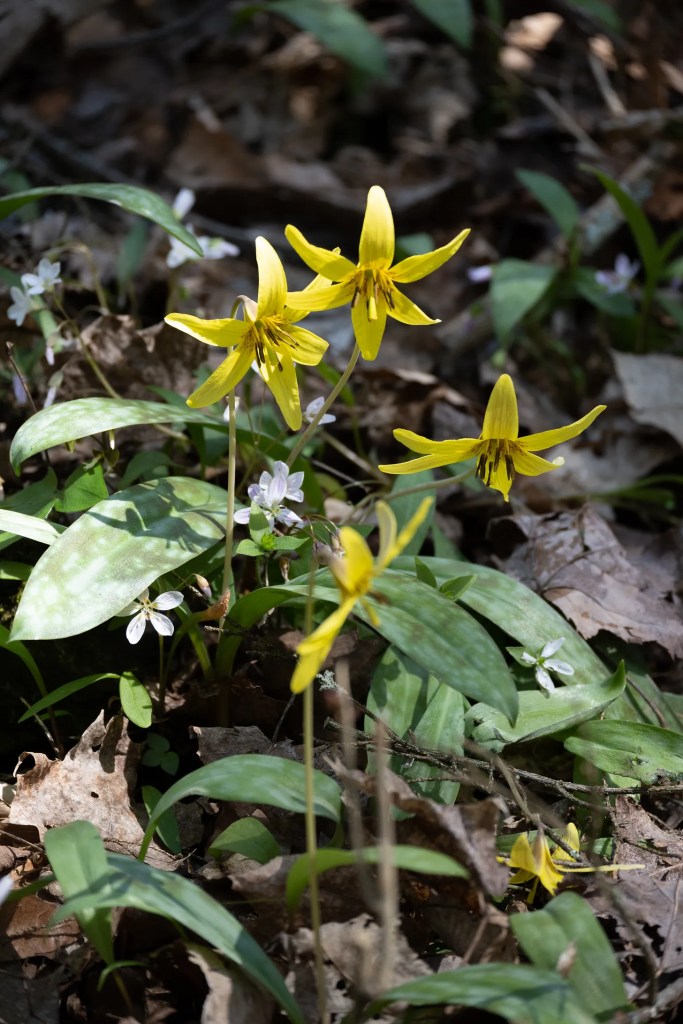
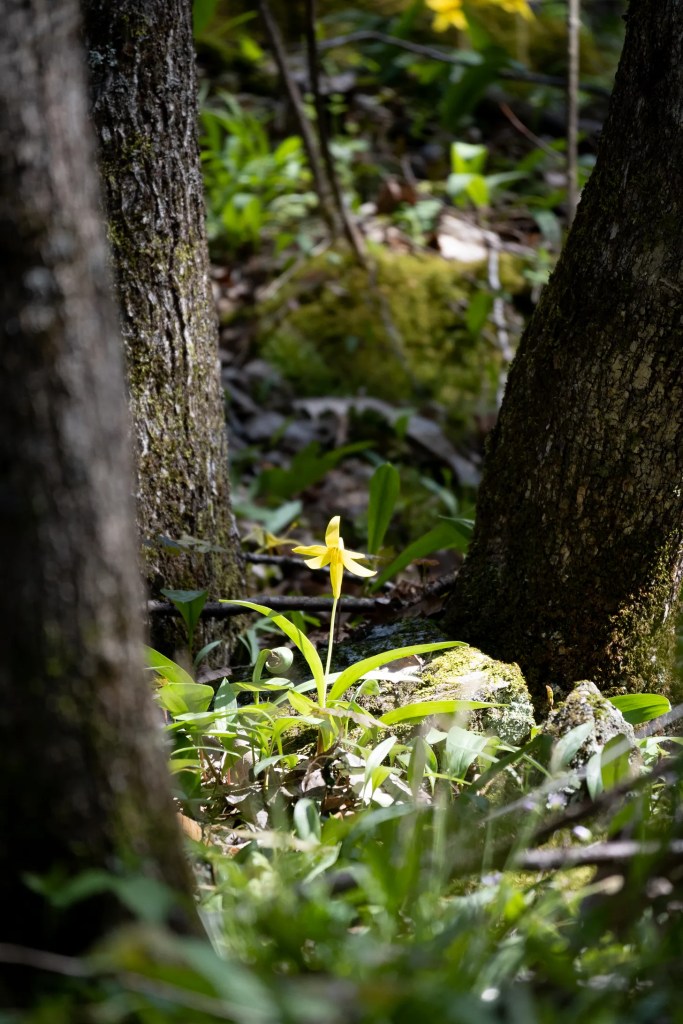
A yellow trout lily colony is a thing of beauty: the bright yellow flowers are a flash of color within the drab early spring landscape. The dappled leaves mimic the dappled sunlight that reaches them through the canopy’s still-bare branches. Their petals close in cooler weather and then, like magic, curl back— a golden crown embracing the sun. They take my breath away.

gosh is there anything more beautiful?

left: about to bloom, right: opening back up as the sun comes out


All photos and illustrations are my own.

Note: This is the sixth in a series of posts on spring ephemeral wildflowers. Previous posts:

This post was originally published here.
Flowers, frogs, and bees, oh my

By Leslie Spencer, VMN Lower Winooski participant 2024

As spring unfolds before our eyes, there is so much for us to tune into—moments of joy amidst the State Of The World. This week, it’s frogs, flowers, and BEES! Tuning into these happenings in the natural world gives me renewed energy to tackle what’s ahead.

This weekend, I had the pleasure, for the second to last time, to gather with my Vermont Master Naturalist cohort to learn about cultural geography in Vermont from Sam Ford. Think, quarries, barns, ancient land laws, etc. More on that later!

We made our way around Burlington, learning about hidden cultural stories on the landscape. And, as a group of twenty-some curious naturalists, we can never focus on one thing for too long. There is so much to pay attention to!

On our way to visit an abandoned quarry in Arms Forest – once an important source of building materials for our area and beyond – we couldn’t help but ask each other, “What’s that sound?” We could hear a white noise in the distance, neither the hum of cars on the beltline nor the chorus of spring peepers. What could it be?

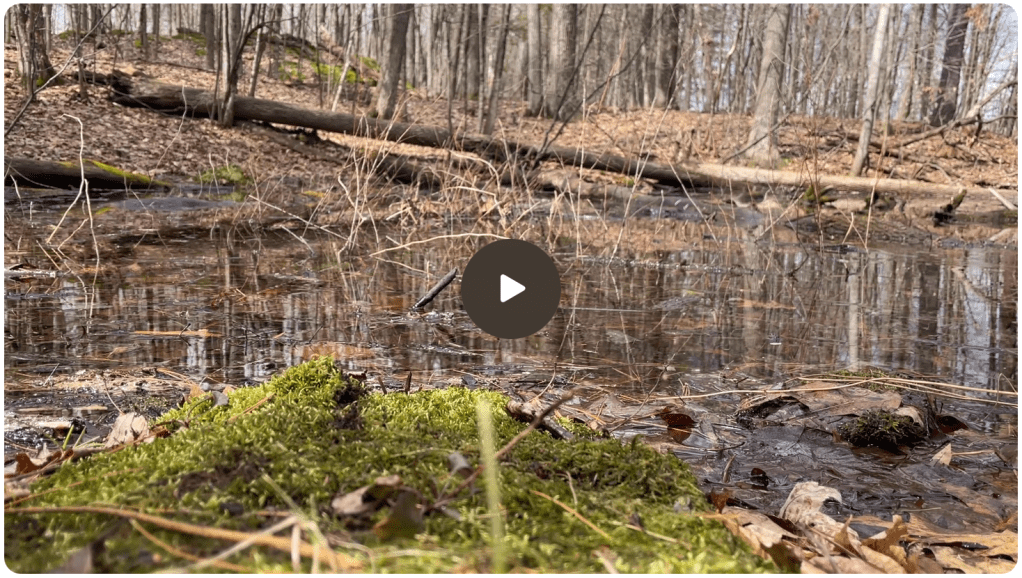
On our way back to the cars after the quarry visit, we wandered off the trail to a vernal pool – temporary, shallow pools that appear in the woods in the spring that serve as essential breeding sites for amphibians. As we approached the pool, the sound grew louder and louder, and our gaggle of chatty naturalists grew quieter and quieter.

Behold, the song of wood frogs:

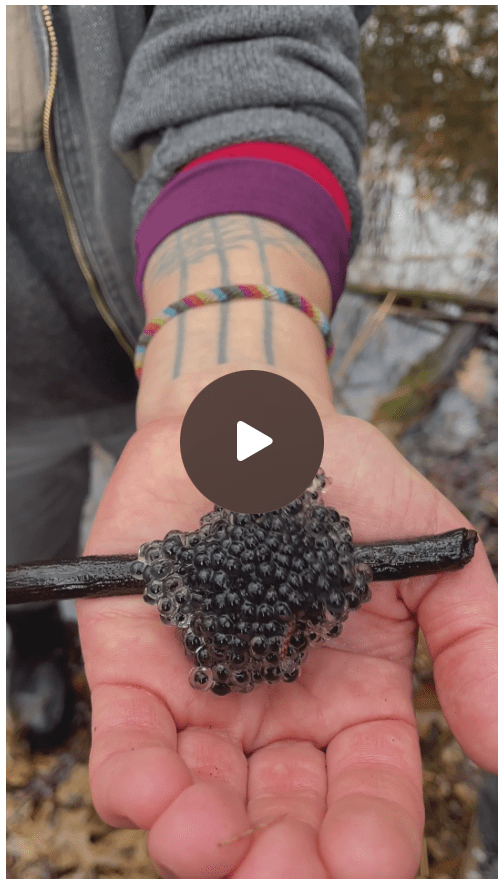
I crouched on a mossy log, took a few deep breaths, and started to lose track of time—until my bliss was interrupted by the sound of oohing and aahing off to the right. A friend in tall boots had ventured into the pool to scoop up some eggs for us to see up close.

More bliss. Behold, fresh wood frog eggs:

If jiggling a bunch of frog eggs does not ignite your child-like sense of wonder, I do not know what will.

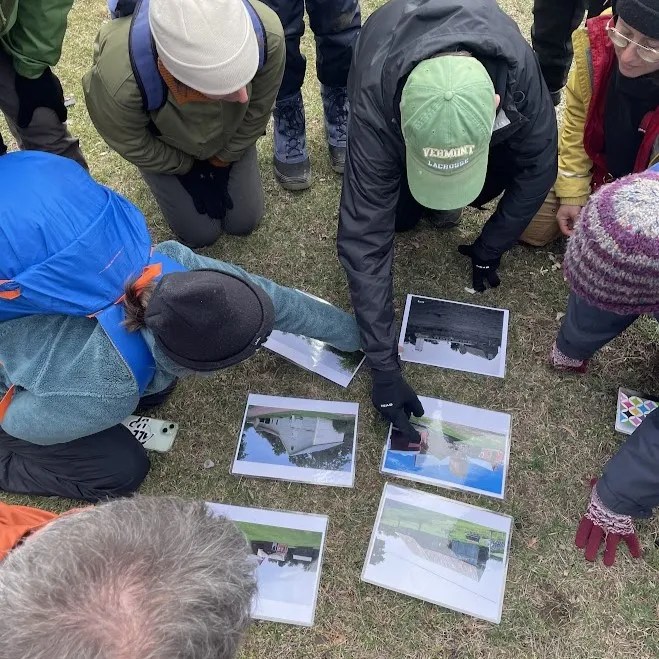
Later, we made our way across North Ave to Ethan Allen Park to learn more about the cultural history of Burlington. We started with an activity: given six photos of Vermont barns, we had to line them up from oldest to newest (a lesson on barn history followed). Feeling very out of my element, I opted to take the below photo of my team doing their darndest to accomplish the task at hand:

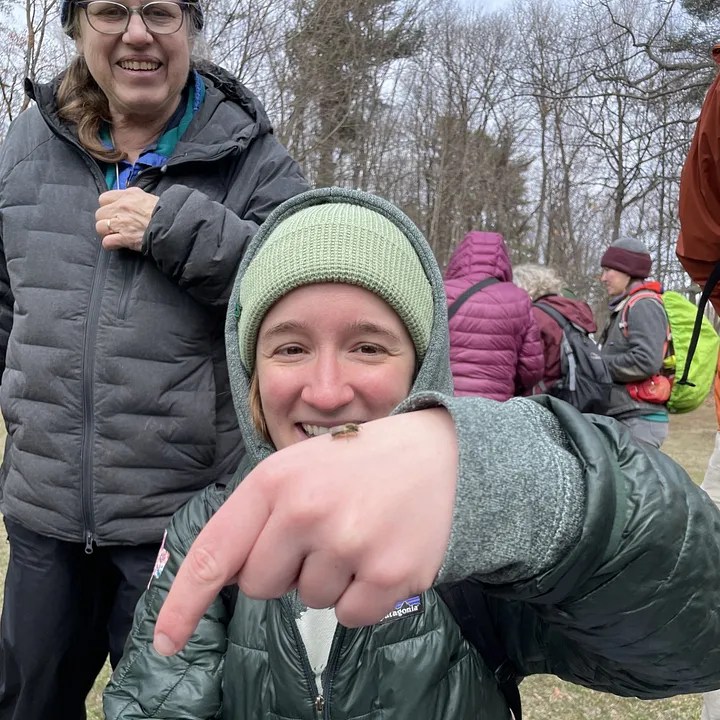
As if the frog song and jiggly eggs weren’t enough spring magic for one day, despite still being bundled in puffy coats and knit hats, the first bee of the season appeared. It landed right on one of our barn handouts. Impromptu bee lesson time! It was a male cellophane bee – typically the first bee species to emerge in Vermont each year, a true harbinger of spring. Always a joy-filled moment to know they’re back.

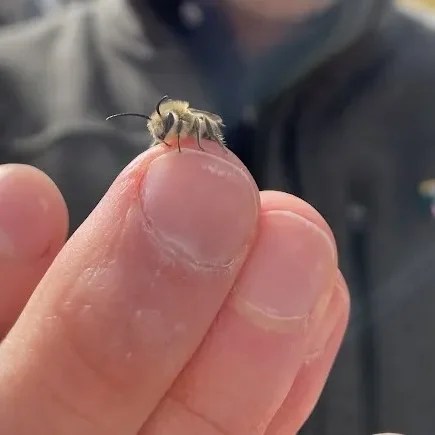
Left: Impromptu bee lesson time! A male cellophane bee (Colletes inaequalis) is perched on my hand. Thanks Lena for capturing this show and tell moment! Right: An up-close shot of the same kind of bee, this time, last spring.

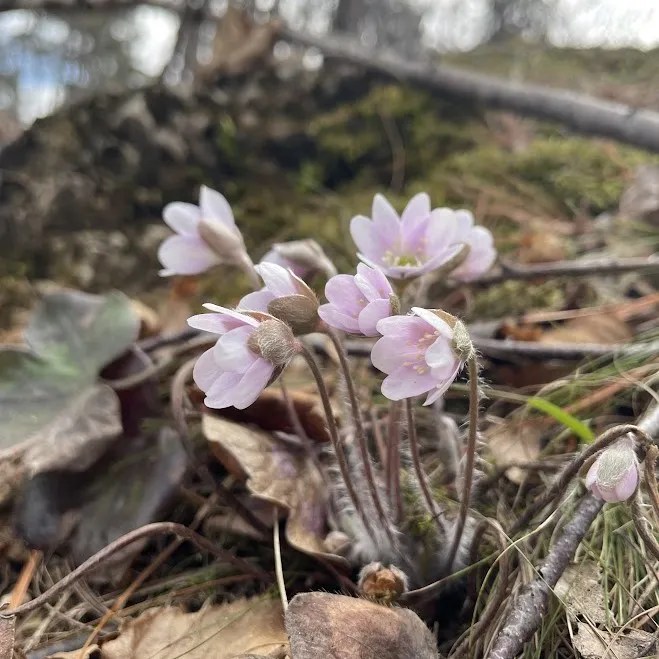
Following the barn activity, up the hill we went, to learn about the local dolostone that went into building the tower at the high point of the park. Just below the tower we stumbled upon a cluster of hepaticas – other than skunk cabbage, the first wildflowers of the season.

Already high on the joy of wood frogs and cellophane bees, the hepaticas served as the cherry on top of a day of early spring magic. A “big dopamine hit,” as my friend Nick would say.

Round-lobed hepaticas (Hepatica americana) emerging just downhill of the Ethan Allen Park tower. Aren’t they perfect?

This is now my third spring in Burlington, and I’ve been finding so much joy and comfort in learning the rhythms of the season’s return. Each year, I’m getting better at knowing how—and where—to look for signs of hope.

It feels like a gift to witness so much spring magic within the urban wilds of our city—frog song from vernal pools, native bees emerging, ephemeral wildflowers blooming. As I mentioned in my last post, spotting familiar flowers in Colorado last week felt like a comfort and also a push of energy in an unfamiliar moment.

All photos by Leslie Spencer unless otherwise noted.

This post was originally published here.
Winter tracks and trees

By Leslie Spencer, VMN Lower Winooski participant 2024

An Immense World

Lately, I’ve been reading An Immense World by Ed Yong. It’s been a refreshing antidote to doomscrolling about whatever he-who-shall-not-be-named is up to today. Every page of his book draws you deeper into mesmerizing stories about non-human perception, revealing how astonishingly diverse sensory experiences can be across the animal kingdom.

We humans rely on five senses—sight, hearing, smell, taste, and touch—to navigate the world. These senses shape where we feel safe, how we determine what’s edible, and more. We just never really think about it that way. Yong challenges us to step outside of our sensory bubble to imagine the world through the experiences of other creatures.

Did you know that butterflies taste with their feet? That mallard ducks have a 360-degree field of vision? That catfish are essentially swimming tongues with taste receptors all over their bodies? Or that flowers reveal hidden patterns visible to bees but invisible to us?

Page after page, Yong illustrates how each animal has its own sensory world—its umwelt (or umwelten, plural)—often existing beyond our human comprehension.

Tuning into the umwelten around me today

One of Yong’s key points is that animals aren’t deficient for lacking senses we have—they’ve simply evolved to perceive the world in ways that meet their own unique needs. Take bees, for example: they can’t see red the way we do, but they can see ultraviolet light. For bees, this reveals unique patterns on flower petals, invisible to us, that guide them to nectar, which is sugar that provides them with the energy to fly.

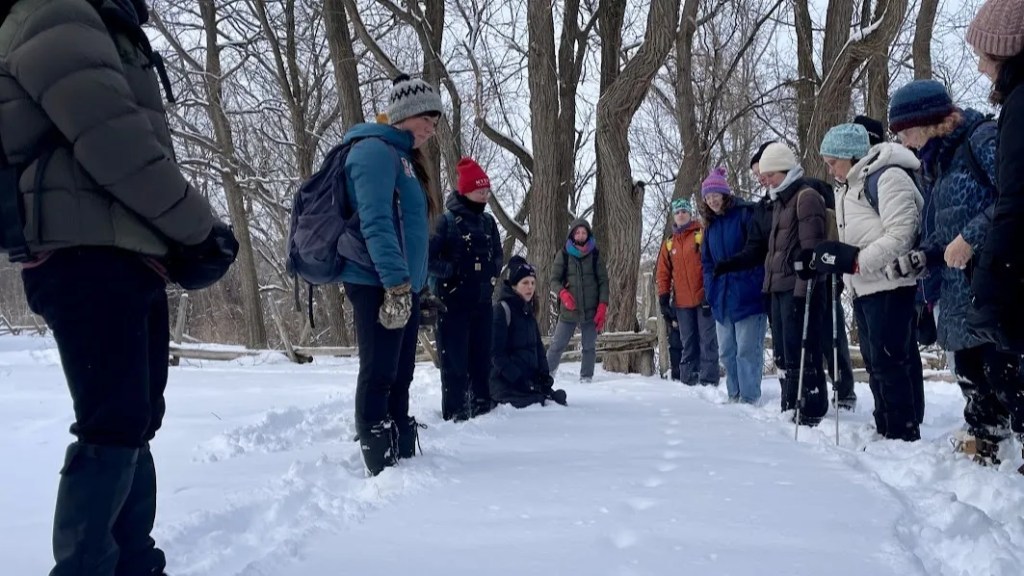
Today, I had the chance to tune into the umwelten of the creatures I share the city of Burlington with. As part of the Vermont Master Naturalist program, I joined Alicia Daniel and Sophie Mazowita for a winter field day focused on wildlife tracking and tree identification.

We couldn’t have asked for better conditions. A few inches of fresh powder fell overnight, with the snow tapering off just before sunrise. Around 10am, under a gorgeous bluebird sky, Burlington was shimmering as bits of snow gently blew loose from the treetops. We set out into the woods at Leddy Park, and later Ethan Allen Homestead, eager to see which creatures had left tracks for us to find in the fresh snow over the past few hours.

Never write off a squirrel

About twenty feet from our morning rendezvous point, we stumbled upon our first set of tracks. (Pro tip: don’t join a group of curious naturalists if you’re hoping to cover a lot of ground quickly…)

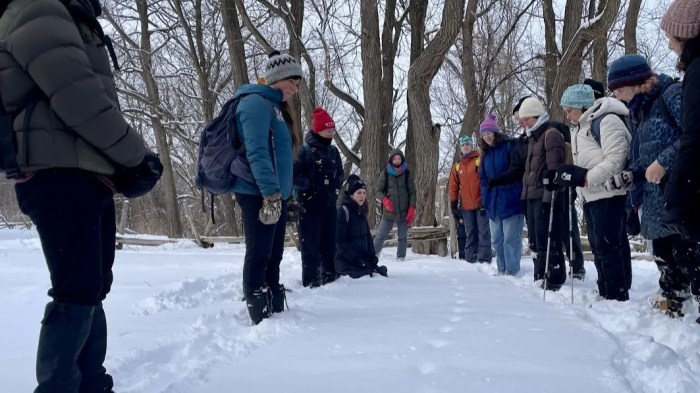
Sophie encouraged us to start by observing the tracks—taking note of their size, shape, and orientation—before interpreting them: What direction was the animal moving? Which species could it be? She explained how cultivating sharp observation skills and staying open-minded is crucial to decoding animal tracks in the snow.

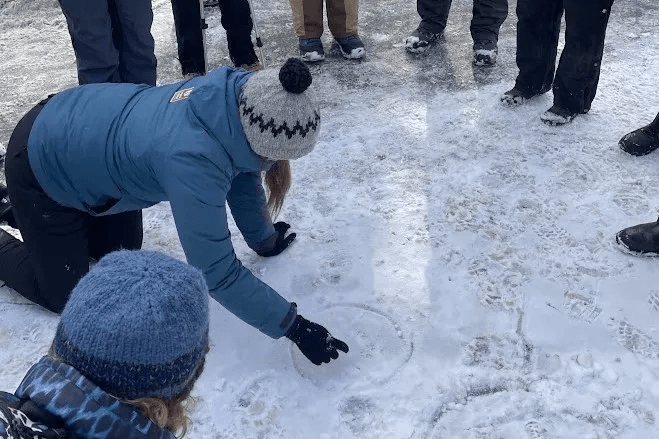
These particular tracks revealed a bounding (i.e., leaping) pattern, with two telltale pairs of prints (the front and hind feet). The size of the prints and the trails connecting tree to tree pointed us to an eastern gray squirrel, bounding through the fresh snow in the past few hours.

Sophie Mazowita pointing out fresh tracks from an eastern gray squirrel.

We learned how slight differences could tell different stories: smaller but similar tracks would belong to a red squirrel, while a subtle shift in the orientation of the feet might signal prints of a flying squirrel.


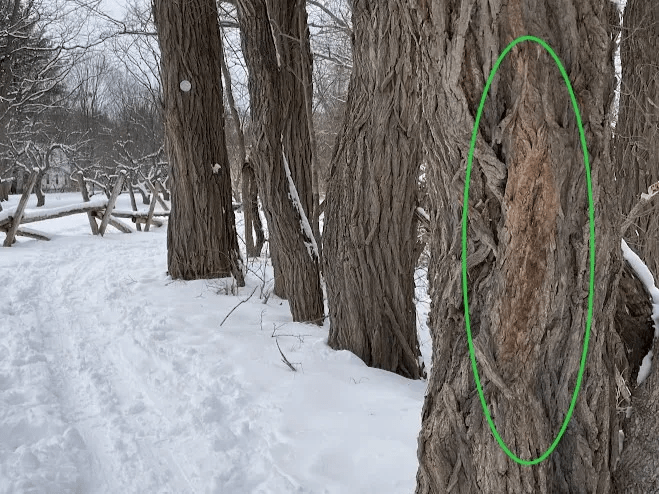
Tracking isn’t just about footprints. Animals leave all kinds of signs of their movements if we tune into their umwelt, not ours. Sophie showed us “squirrel stripes” on the base of some trees—spots where squirrels chew on the bark and rub their cheek glands, leaving scent messages for each other. It’s like the “coffee shop bulletin board” for squirrels, Sophie said.


I’ll never dismiss a squirrel as ordinary again—learning how they navigate the world invites us to step outside our human-centric sensory bubble.

A squirrel stripe on a black locust trunk at Ethan Allen Homestead.

A springtail surprise

In addition to observing tracks and other signs of wildlife, sometimes looking closer—literally—can reveal stories in the winter woods.

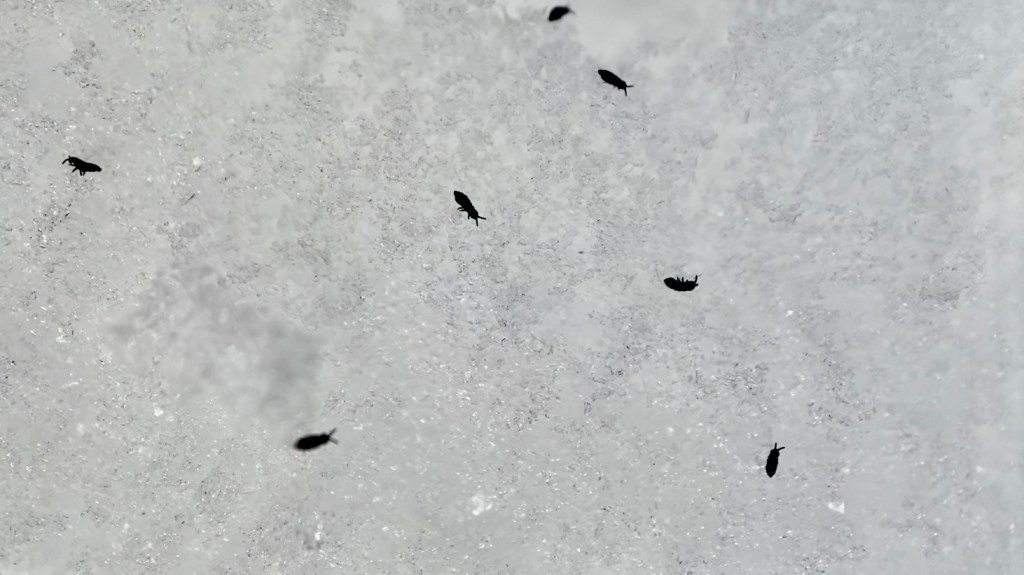
Take snow fleas, for example. These tiny creatures are often overlooked unless you use magnification. Unlike the parasitic fleas you might be familiar with, these harmless arthropods—also known as springtails—hop around in the snow on warm winter days. They live in the soil and emerge into the snow, often found clustered within animal tracks.

Snow fleas with my hand for scale. Do you see the tiny black dots?


A special shoutout to my friend Braden DeForge, who captured them with his iPhone macro lens:

Not only mammals leave tracks

It may seem obvious, but we were caught off guard today: not only mammals leave tracks. When tracking animals, following a set of prints for a while can help you gather more clues about who made them.

We were following a trail of prints through the woods at Leddy Park when we hit a dead end—literally. The tracks just disappeared at both ends of the trail. How could that be?

Birds!

It’s easy to forget that our umwelt is biased toward creatures that walk on the ground—not those that fly.

One end of the trail we were following led to two distinct arched prints. At first, we were stumped. Whose feet could make tracks like that?

Then, it clicked—wings! Not all prints in the snow are feet, that’s a human-centric assumption.

We’d stumbled upon evidence of a bird, likely a crow, swooping down to the forest floor, perhaps searching for a snack beneath the fresh snow.

Once again, tracking the creatures around invites us into another sensory realm and provides a humbling reminder that we are not the only ones using these woods.

Note the curved prints where the bird landed in the snow. Then it pivoted 90-degrees and walked on the forest floor until it took off again.

The drizzle castle tree

To weave together winter tree identification with tracking, Alicia gave us homework for today’s field day. Each person was assigned to a tree and asked to look up a few facts about it, to be ready to share about the tree we came across it in the woods.

Hackberry was a new tree for me today. It’s one of those things that once you know what it is, you begin to see it everywhere. It has a very distinctive bark, described scientifically as having “wart-like protuberances.” Other, more pleasant descriptors our group came up with included the bark’s resemblance to 1) the Badlands National Park and 2) a drizzle sand castle.

One of my fellow naturalists is from South Dakota, so the Badlands thing totally worked for them. Having grown up playing in the sand on New England beaches, drizzle castles really hit home, and I will now never forget hackberry—the drizzle castle tree.

A friendly reminder that even as humans with the same five senses, we all have different, and perfectly valid experiences and perceptions of the world around us.

Hackberry, Celtis occidentalis.

Who is living in my backyard?

In the summer, my morning ritual involves checking on my garden from the window at the top of the stairs. Bleary-eyed, I take in how it changes from day to day—tomatoes ripening, beans climbing their trellises, zinnias abloom—and then I scurry downstairs and out into the backyard to get a closer look. I love paying attention to how everything changes daily.

But today, after spending the day learning about winter ecology in Burlington, I realized I hadn’t been paying as much attention to the backyard lately. Covered in snow, the garden is dormant, and I had been operating under the assumption that—other than squirrels feasting at the bird feeder—not much is going on out there.

This evening as I peeled off my snow clothes and glanced out the window, I noticed something that I had not observed before. Besides the familiar squirrel tracks, there were other prints leading toward the shed. From the size and pattern, I think they belong to a cottontail rabbit bounding over to the shed looking for a cozy shelter during the snowstorm during the early hours of this morning. 

I am always grateful for how this naturalist training sharpens my attention, expanding my own umwelt, to help me better appreciate the happenings in my own backyard.

All photos by Leslie Spencer unless otherwise noted.

This post was originally published here.
Wild Heart of Place: The Making of Vermont Master Naturalist

By Alicia Daniel, Director of Vermont Master Naturalist. This is a reflection on the origin of VMN.  It starts with her own journey to become a naturalist. 

Photo: © Merlee’s Moods merleesmoods.com

No one becomes a naturalist by accident. It doesn’t happen because your guidance counselor suggests it’s a good idea. Ask any naturalist. Blazing their own trail will be at the heart of their story. 

My “career path” began in the forests, fields, and riversides of Montana, with me watching beavers while my dad and siblings fished for trout or fell into the stream. It took another 20 years to arrive at anything

resembling a trail head. It was a winding path with no map and plenty of dead ends.

And yet I woke up as a naturalist on an island in Bear Track Cove, Alaska, the summer I turned 28. Yawning from lack of sleep—in the middle of the night, the shush, shush of my eyelashes brush-ing against my sleeping bag sounded like a bear walking around outside my tent—I made my way down to the beach. I’d traveled to Alaska to track black bears. I was, at best, a novice tracker. But when I came upon a set of large pawprints with the mud gooshing up between the five toes, I knew they were fresh and I knew they were bear. I looked across the mudflat that now connected me to the mainland to discover (a) I was not on an island, and (b) the bear tracks led right to a black bear. Backlit by the rising sun, a halo of fur glowed around his head. I stood up, shook off my jacket, and waved it around, as I’d been told to do. He started walking toward me. Black bears in Glacier Bay defend their salmon streams against brown bears, which is to say they are big. Clearly there were safer places to be.

My journey to Alaska actually began a year earlier. After landing my dream job in Austin, Texas, with Bat Conservation International, I’d helped them move from Milwaukee to Austin, overseeing the installation of the phones and watching with pride as workmen bracketed bookshelves to the field station’s freshly sheetrocked walls. I loved the perks of field work, like a trip to Bracken Cave where 20 million Mexican free-tailed bats emerged at sunset like a black tornado. But it was my first day in the new office and I now had an in–person boss and the honeymoon was over. I was sitting at my desk feeling cooped up and claustrophobic, when I heard a metallic rending sound above me that made my hair stand on end. A fully loaded shelf of books torn off the wall, one end hitting a filing cabinet to my right forming a triangular cave with the floor. As I threw myself sideways into this shelter, a thousand pounds of books and shelves crashed down where I had been sitting. I rose up out of the rubble with sudden and sweeping resolve: I was not going to die at a desk slipstreaming behind some famous naturalist. I was going to be a naturalist—or at least die trying.  

Every 27 to 29 years, the planet Saturn returns to the sign it was in when you were born. In astrological lore, Saturn is the great taskmaster. He breaks you down, makes you lift heavy weights, so you can get into fighting shape. In my 28th year, I left Bat Conservation International, leapt from an English degree into a Master of Science program, crawled through a flooding cave for my “interview,” moved to Vermont where I figured out how to dress in winter layers (not one big bulky sweater), learned to cross-country ski to the amusement of my peers so I could follow moose through willow thickets in Wyoming, fended of unwanted advances from men who were hired to teach me, and much more. By the time I met up with that black bear, I was in fighting shape. As he stared me down, I slipped quietly into the forest. But later my friend, Michele, and I came back to steal one of his salmon for dinner.  

After my encounter with the bear, I got married and spent the next 29 years as a mild-mannered university lecturer raising two children and working part-time as a naturalist. Then, one day when I was walking in the Vermont woods with students, we came upon a black bear skull. 

By this time, I had found porcupine skulls, beaver skulls, deer skulls, seal skulls, mouse skulls, raccoon skulls, coyote skulls, fox skulls, and even gull skulls, but never a bear skull. As we turned it over, a long canine tooth fell out of its jaw. I felt a premonition. I took the tooth home and strung it on a leather cord around my neck. Things were about to change. My older daughter was already studying and working in Boston, and my younger daughter was headed off to college, too. My teaching at UVM was drying up

under a new budgeting model. Saturn was returning. I needed to get back into fighting shape.

I dreamed of migrating my naturalist teaching out of UVM (keeping ties only to the Field Naturalist Program) and into Vermont townships. So I started the Vermont Master Naturalist Program. I registered this “school” as a business because I am too old to listen to a board of directors, be routinely audited, write lots of grants, or even complete the necessary nonprofit paperwork. Every step of the process was a bear, from finding insurance to negotiating deals with partners. I quickly discovered that I don’t resonate well with business culture. In my new business–owner role, people either want to sell me things or teach me how to sell things. (Wear red! Be confident! Hand the person you’re talking to your phone so they can’t walk away from you!?!) None of this felt natural or worthwhile to me.

I wanted to find people who dream of being naturalists, create a path for them, help them meet other naturalists, and put them to work on saving nature in their towns. I wanted them to understand that being a naturalist is a practice. It is how you spend your time, not how much you know. People often don’t grow up to be naturalists even when it is their heart’s desire. Now for over 500 people and counting, the Vermont Master Naturalist Program is making that dream come true.

·

On a recent Saturday, I went tracking with Vermont Master Naturalists at a granite quarry where bobcat, coyote, porcupine, and fisher tracks mapped out their travels from the talus to the icy edge of the quarry pool. I am, at best, a middling tracker. But I delight in spending time with people who want to be out in the woods. When I see something magical, I want to turn to a kindred spirit and whisper, “Look”! I have a couple of decades before Saturn returns next time. In the meantime, I will be out in the woods. 

This post was originally published here, and here.