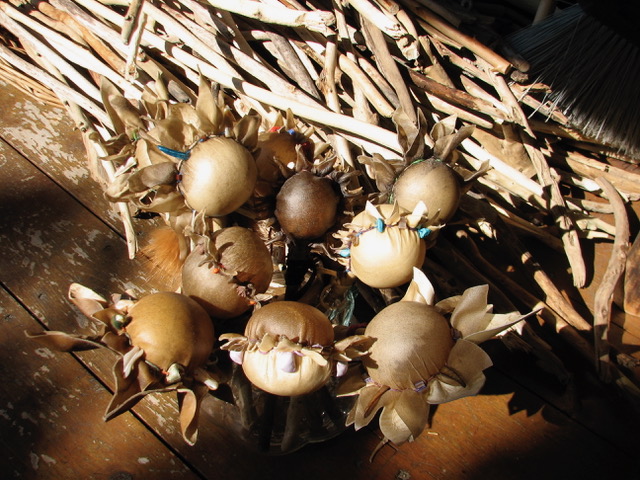
In the spring, you will find me walking along the beaches of Burlington picking up sticks. From the sandy stretches of North Beach and rocky coves at Rock Point to the driftwood strewn reaches of the North Shore, I walk them all like some people walk coastal beaches picking up sea glass. I walk them in the spring before the sticks that I am seeking are burned in secret beach fires or weather too far to be of use to me. I need fresh, strong spring sticks.
I look for ones that are sturdy, preferably beaver or beetle chewed, the length of my forearm and the girth of my finger. I test that they fit comfortably in my hand, that I can bend but not break them. I am collecting them to make into the handles for rattles. Sometimes I know what kind of tree a stick came from. White pine shows itself through the pattern of beetle galleries gnawed into the wood, the nubbiny whorls of tiny branches, the tangy scent of sap and its light tan color. The lake naturally sands the sticks for me removing the bark. I like walking beside the sloshing water that still breathes out the chill of winter ice. I like having the lake, the trees, the beavers and the sandy beaches as my partners in rattle making.
Each fall, I must find corn. I fill the rattles with hard flint corn. Corn doesn’t split and become dusty like beans. It makes a dry pleasing sound. (The tone of each rattle is unique.) I like to know who grew the corn. I like making that connection. One time on a whim in a lean corn year, I ask gentleman farmer friend if he grew it. He said yes. I thought I might get an ear or two. Instead, he led me into in sun porch where dozens of ears of colorful corn
were tied together and hanging in the rafters. It was a dizzying sight. Staring up at my heart’s desire, at the dried red and golden husks and the beautiful black, yellow, and orange kernels. So much to love about flint corn. He filled my backpack with dried corn and sent me on my way. I left feeling rich and grateful.
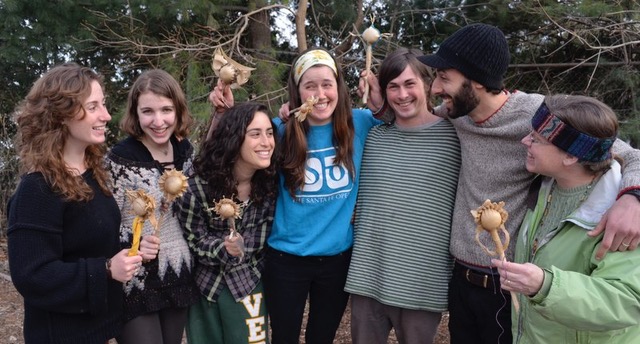
This spring I will be teaching a rattle making workshop. We will gather at Rock Point Center. It has large handmade wooden tables and a view of the lake. I love looking out over the lake. I love that the layout of the building is like the two wings of a butterfly: one side full of nature and one side full of spirit. Wings that flap and swirl nature and spirit together. We will practice how to cut the stiff rawhide into patterns. How to drill holes in it. How to soak it
in wild water to make it soft. How to sew it around air balloons, since we won’t have traditional deer bladders. How to fill it with corn and attach it to a stick. How to put heart into it.
Making a rattle, making anything of beauty from natural materials that you collect yourself is a quest, a prayer. Since you feel more in touch with the natural world, you may feel called
upon to thank the spirits. The last evening, we will shuck the corn off the cob into a hand turned wooden bowl. I will drum to call in the elk, who gave the rawhide we will use to make the rattles. Hopefully the spirit elk come to be thanked as they often do and feed on the corn. It is the kind of world I want to live in. One where we remember to give thanks to the spirits and they come in giant billowing herds to receive it.
By Gordon Coates, Field Naturalist Practicum Teaching Style
It was pouring rain for the first class of the program. This Vermont Master Naturalist cohort stood together underneath a two-trunked, sprawling red oak. We all giggled, nervous, and tried to stay sheltered under the oak and inside or “waterproof” shells. Our teacher, Alicia, stood calm, observant, and measured. The rain didn’t bother her or doesn’t seem to. Maybe she drank it through her roots.
Once the giggles were released, and the group was ready for the serious stuff, Alicia pulled out temporary tattoos. It is serious stuff, picking out and putting on a temporary tattoo of a unicorn, or a cartoon bird, or a heart that says “Mom.”
We passed the box of tattoos around and each picked one. I went for a hummingbird on my neck. My neighbor in the circle had to apply it for me. It’s an intimate spot to have a new classmate hold gently for 30 seconds in the pouring rain.
They’re small things, and they’re silly, but the temporary tattoos are a good stand in for the whole class. There’s a little bit of self-expression, a large helping of joy, and immediate intimacy.
Alicia starts a lot of her classes this way, even with adults because it breaks down barriers, lightens the atmosphere, and forces just enough vulnerability to bring people closer together. It takes vulnerability and openness to allow someone else to put a kid’s toy on you. The same vulnerability enables an opening to the land.
After the tattoos, we stood around a topographic map of the United States with the political borders removed. We each thought of a place that felt like home, and we tried to find it on the map.
One by one, we knelt and slid our fingers along the ridges and valleys and stopped when our finger found the home place. From there we told a story of this spot. We heard stories of rivers and mountains, of family and friends, of relationships.
Everyone found their spot by following coastlines and rivers and the shape of the earth, by going from the broadest scale to the smallest until we were at the personal level.
In these two actions lie the magic of the class. Many naturalist classes or environmental programs are academic and rigid.
Go out with a fern specialist and learn about ferns. Meet with an expert birder and go listen to birds. They can be almost transactional. Go to the woods, get the information. This class and its teaching style contrast the transactional by emulating the natural world where relationships are key, context is imperative, and the plants and animals are shaped by the beings around them.
Where other classes might be definition driven or motivated by identification, this class is relationship driven and motivated by story. Touch my neck, tell me where you came from.
In other classes, there is a clear instructor-student relationship. One person is the expert. Their job is to teach, and it’s everyone else’s job to learn. In this class, everyone is teacher, everyone is student. We learn from each other and from the land. It’s obvious that Alicia has more knowledge, more stories, more familiarity with the places we go, but that only adds to the way everyone else can connect to a place.
The Vermont Master Naturalist classes are led by four concepts: connection, reverence, experience, and story. Mix those things together, with a group of willing participants and magic happens.
Back out in the rain under the oak tree, we started walking. Our day was going to be spent at Rock Point, studying and understanding bedrock to birds and the stories all those beasts and beings have to tell. We made it 30 feet before we paused on top of a flat sandy cliff that looked out over the lake and Rock Point. Clouds rolled in from the west and shrouded the point, but we could still see far back in time. This flat sandy spot was likely an ancient delta of an ancient stream that flowed into the ancient lake that still waves and breaths and bursts today as Lake Champlain.
But Alicia didn’t tell us it was a delta. We had to guess and grope and dig in our heads and in the sand before she gently guided us to the explanation. Then, without much other prompting, she led us down and around the sandy cliff and we looked up to where we had just been. There was a mystery here, birches at odd angles, the steep cliff, a pile of sand. We had the clues, and Alicia let us discover them. We roamed the base of the cliff, touched the sandy precipice, admired the beauty, and speculated aloud. We built off each other’s observations and followed our own threads until we were called back together to present the evidence we had found. “These trees are at a weird angle. Maybe they’re reaching for the sun from under the cliff?” “The trees seem to be the same age as the ones on top.” “There’s a lot of sand.”
Alicia asked probing questions until one of us had the epiphany. “A landslide!” Of course, now it was impossible to unsee, the slanted trees had grown on top of the cliff until a large rain event cut out enough of the sand to make the whole thing topple.
Alicia knew from the beginning. She had come check out this event as Burlington’s city naturalist, but she let us discover it with our own experience, our own intimacy with the place, our own stories.
The human brain is so adept at creating stories. It does it to make sense of the world, to make connections, to make predictions. The classes teaching style harnesses the need for story. We often spread out and do our own investigating of a place before coming together and sharing. “There is a barbed wire fence over that hill, maybe this land was grazed.” “I see no young cedar trees in this forest, perhaps there is an abundance of deer eating them.” Each observation is accompanied by an explanation, and as we put our observations and explanations together, we begin to see the shape of the land and come to a truth of what the place is, was, and will be.
We continued the day repeating this sort of exercise, spreading out investigating and sharing. We explored the human use of Rock Point, ate berries and apples picked from the tree, and walked along the thrust fault. We talked about human history, geological time, orogenies, how bedrock influences natural communities, and the specifics of it all. I left each all-day class with more information and understanding of the world than semester long college classes, but instead of textbooks, we read the land, instead of monologue lectures, we heard collective ideas.
There is no one right way to teach. Lectures work for some folks and some topics, but to learn the eye of the naturalist, to understand the pieces, patterns, processes, and relationships that are happening in the world around us, nothing compares to collective experiential storytelling.
Everything builds and connects and flows into the other. The relationships between people open doors for vulnerable stories. The vulnerability opens to door for connection to land. The connection to land leads to the deeper understanding and respect of the world on a biological, human, and spiritual level.
This aspect of spirituality and reverence is woven throughout the class, sometimes explicitly in a piece of art, or a recitation of a prayer, and sometimes in a more nuanced way in the silent exploration of a landscape or the invitation to observe without naming. Spirituality is an element of the human-nature experience that is frequently ignored, especially in scientific, academic, western dominated experiences.
This class acknowledges that something unexplained, something emotional that happens to people in the natural world is inherent to the human experience. It is, in fact, crucial to the understanding of how we as individuals and a species fit in the broader system of life.
…
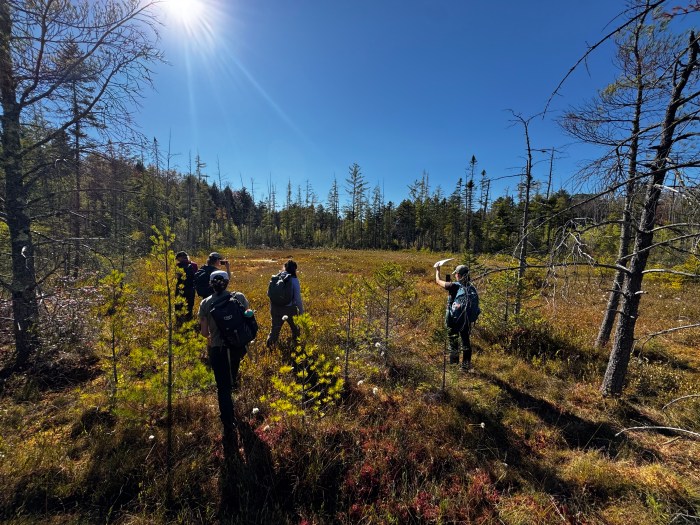
On a different day, we went to a kettle hole bog that has been around for thousands of years. Kettle hole bogs are created by leftover glacial ice creating a depression where water enters through rain and cannot leave. They are a unique bog construction, with concentric rings of vegetation, tough conditions, slow growth, and even slower decay where peat builds up meters deep, carbon is stored, and otherworldly life forms thrive.
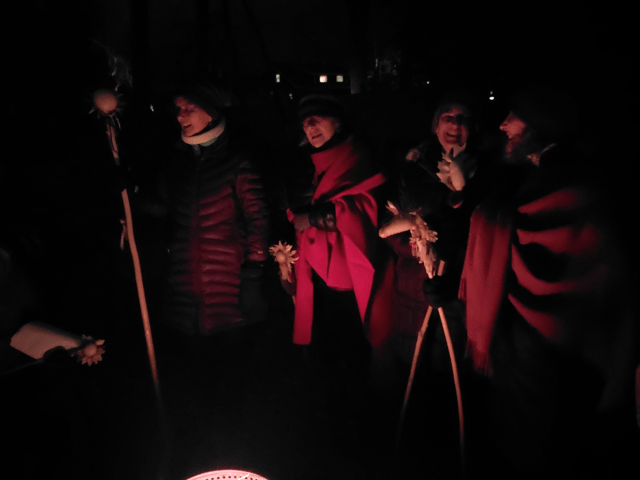
Before we entered, we stood outside the woods, next to a Christmas tree farm, and closed our eyes. Alicia recited a prayer to the four cardinal directions, centering gratitude, the seasons of life and the animals that represented them, all the while shaking a rattle made of elk hide and local wood. It is a prayer and a practice taught to her by indigenous folks that she acknowledged and credited beforehand.
When the prayer was over, she rattled over each of us, starting from our bellies, rising over our heads and descending to the small of our backs. Rattling the whole time. Rhythmic rattling. It was like a river. It was like the wind. I felt chills all over my body and my awareness opened. I was elated. Christians might call that the holy spirit. I call it the acceptance of our place in the world, the buzzing connection between all living things. Afterwords we walked into the woods in silence, experiencing everything on the physical and metaphysical level.
Some balk at including spirituality into a naturalist class. They might say, “Learn the plants and the animals. Know the Latin. Understand the biology and chemistry. Learn the birdcalls and the mammal tracks. But don’t tell me how you feel.” I say, impossible.
That spiritual connection, that reverence, is why we seek understanding. We delve into the woods like theologians delve into religious texts, pulling out the facts, making the meaning, and finding the miracles. It just so happens, that in the woods, the miracle is life, animacy, and intimacy with the world around you.
Once we emerged out of the dense black spruce forest and onto terra firma, Alicia asked us to explore the bog, being careful not to get sucked in, and write a few words or phrases down that described what we were observing.
We wrote things like rebound, Ericaceae, Dr. Seuss trees, carex galaxies, sphagnum, peat, other-worldly, pitcher plants. After our exploration, we came together to discuss what we found, but we didn’t share our observations yet. Each of us had done research on a key aspect of bogs, and we presented on the importance of moss, pitcher plants, cotton sedge, and cranberries.
Zoë taught us about the creation of the bog. We were teachers. We were students. We were explorers. We taught ourselves and each other the science, and Alicia added where necessary making connections and adding crucial facts if necessary. In a 20-minute period, we practiced our public speaking and science communication, we learned about the ecology of bogs, and we got to play in a new magical place. We took the lead in our own education and we learned from each other.
At the end of the day, we were lying on the matt of sphagnum moss, waiting to become bog bodies, when a poem drifted over us that described our experience.
It talked about rebound and cranberries, about puffball trees and puffball sedges, about galaxies and other worldly beauty. It repeated some of the same sentiments each slightly differently. Each difference adding to the whole.
They were our observations from the beginning of the day, organized and connected by Alicia into a piece of art. We wrote an accidental poem. We created collective magic.
Through intentional observation of the scientific, we touched on something spiritual that captured the essence the feeling of the bog.
When the ecology of a place and a deeper understanding of how it works is tied with an emotional/spiritual connection, a profound relationship is built. This class not only built those relationships over and over again, but it taught us how to build those connections for other people.
This program is a special place. Yes, we learned the intimacies of the geologic histories of Vermont, and the ecology of all sorts of places, and how to recognize the natural world like you recognize a friend, but there was so much more than ecology. Every day was teaching and listening and discovery and play. Every day we had the time and the space to explore on our own, tell our own stories, and in sharing them create a collective story of a place. Every day we were reminded that the natural world is animate and inextricably linked to our humanity. Every day the alchemy of relationship turned scientific understanding into emotional connection into spiritual exploration for every one of us.
The winter before last, I spent the whole season teaching myself trees.
I’d been introduced to tree ID before, had tried to memorize each species’ unique characteristics, and spent hours working my way through keys in various field guides. But the knowledge didn’t stick. It came and went, as fleeting as the leaves I pored over. Then in the fall of 2023 I was met with an incredible opportunity: to create an illustrated winter twig guide for one of my favorite clients, Vermont Master Naturalist.
On a sunny fall afternoon, Alicia and I sat on her porch and talked twigs. Alicia is the founder and director of Vermont Master Naturalist, a program that teaches natural history from a holistic perspective and builds community around conservation and local ecology. I completed the VMN program in 2021, am currently in the Tier II program, and can genuinely say it has changed my life. The first time around, VMN solidified my passion for nature study and now, it continues to instill the confidence I need to pursue this path in a more serious way.
I was both elated and overwhelmed as we looked through a stack of books together and started brainstorming what we wanted our winter twig guide to look like. I nervously admitted to Alicia that my tree ID skills were mediocre at best, and she reassured me that not only would I learn, but that my lack of knowledge was an advantage: I could use my own learning experience to determine what ID characteristics were most useful to a beginner.
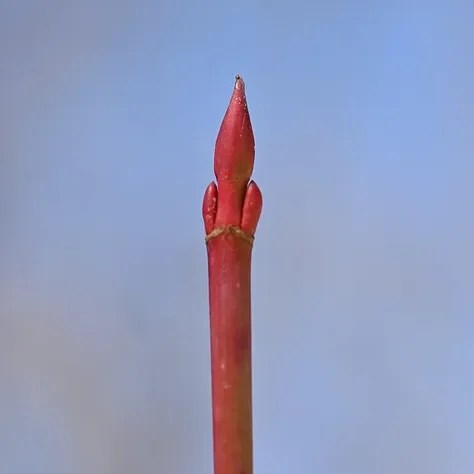
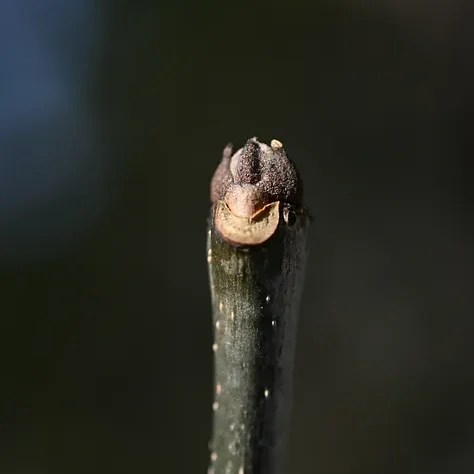
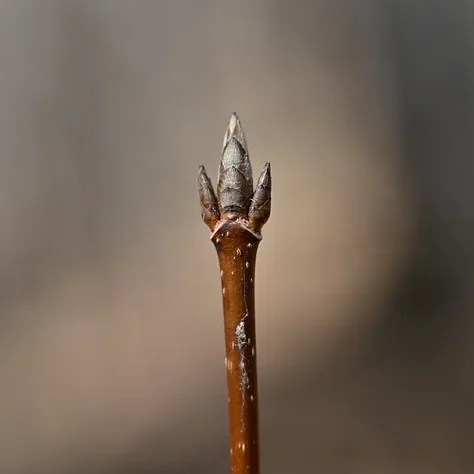
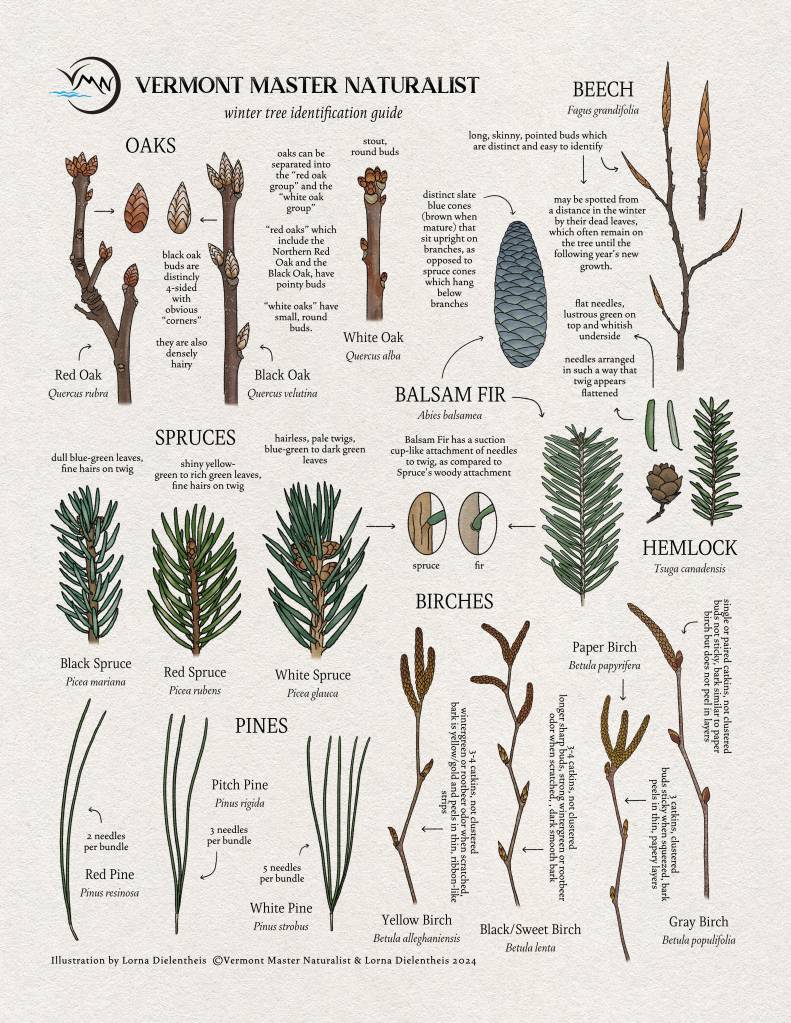
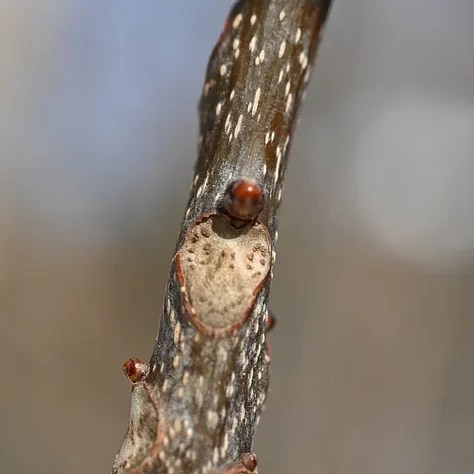
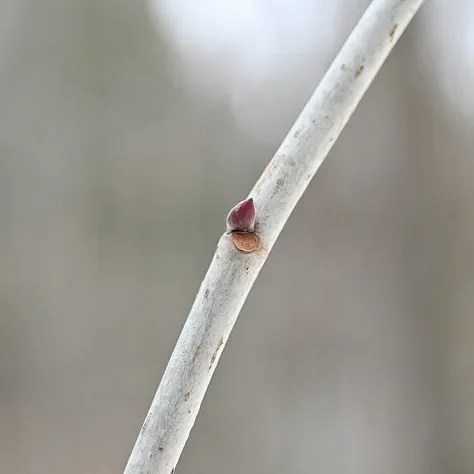
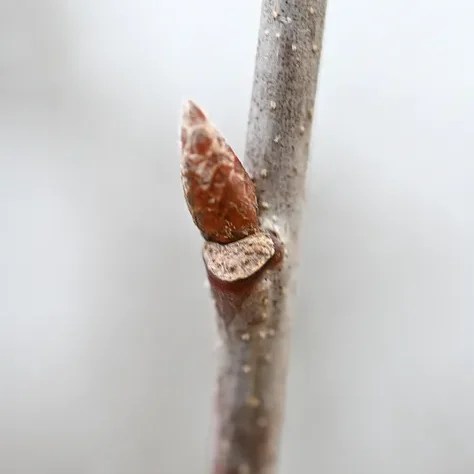
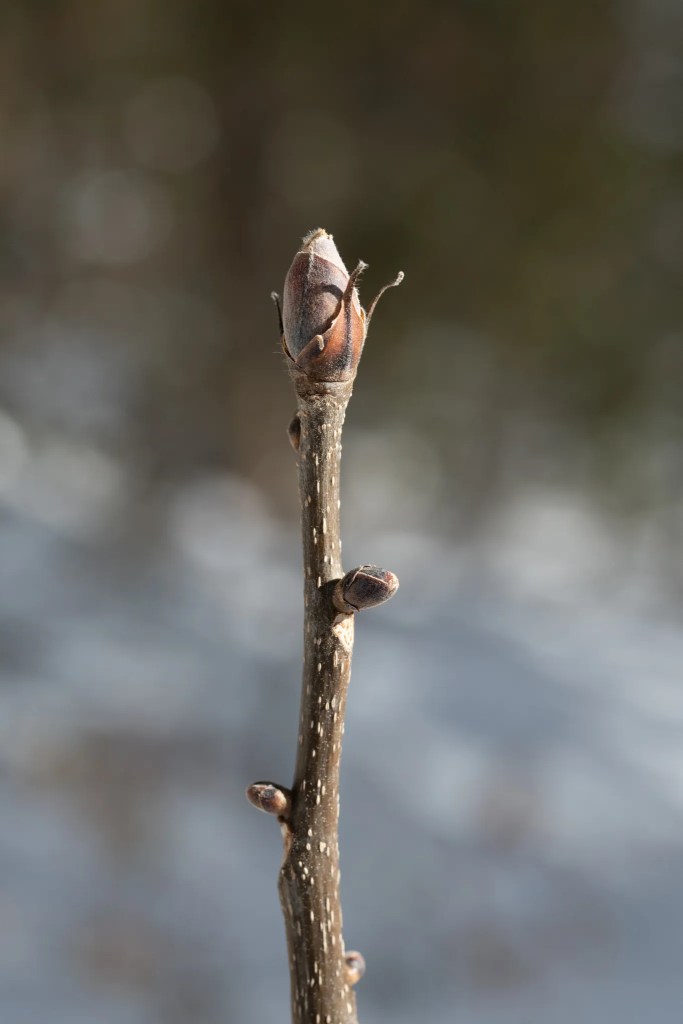
twigs from left to right: striped maple, white ash, sugar maple
Throughout that fall and into early winter, I set my mind to learning trees once more. But instead of trying to memorize every single characteristic of each tree like I’d done before (bark texture, leaf shape, branch arrangement, pith, soil conditions, etc), I focused solely on the winter twig. It was this method of close study, careful observation, and of paring down the scope of my learning that finally made the trees stick with me.
Don’t get me wrong– at first, it was really hard. I didn’t trust myself; I was hyper aware of how much I did not know. What if a bud kind of looked like the pictures in a field guide, but not quite? How do I tell what’s natural variation, versus a different tree entirely? How hairy is “hairy”? Of course this is why dichotomous keys exist, but having a basic understanding of what a key is even asking requires a significant amount of knowledge. I found that when I was out in the field, and especially as the days were getting shorter and colder, I didn’t have the resources or time to look up every scientific term I didn’t know.
Instead, I began carrying a set of clippers and ziploc bags in my trail pack. I’d take pictures of a tree and note where I found it, taking a twig home with me for further investigation. Later, when I’d dump out my ziplocs of unlabeled twigs, sometimes finding one broken to pieces or otherwise compromised by the chaos of my trail pack, I’d worry my methods were haphazard. But over time I worked out the kinks and eventually the learning structure became routine.
After the first month or so, I began to have an awareness of what trees were around me, and my searches became more focused on seeking out particular species. Perhaps most importantly, my confidence grew– not only in my ability to identify trees, but in myself.
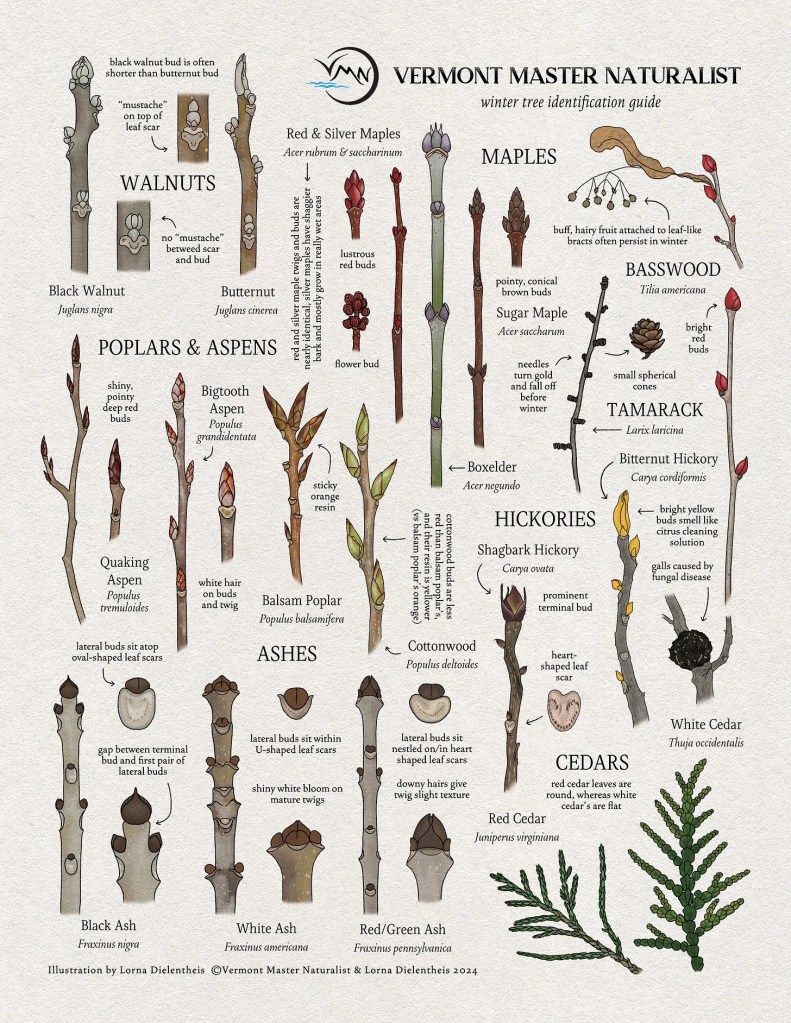
The finished winter twig guide I created 1/2
The finished winter twig guide I created 2/2
Notes on Self-teaching
It’s vulnerable to teach yourself a skill. You don’t know what you don’t know, and you’re responsible not only for the actual learning but also for creating the curriculum to structure it. It’s not like taking a class or going to school, where you’re provided with all of the correct information, and the guidance, expertise, and deadlines you need to absorb it. When you teach yourself a skill, you have to self-motivate and hold yourself accountable; you have to know when to trust yourself, and when to reach out for help.
As lonely and difficult as it can be, teaching yourself something is also incredibly empowering. It’s an exercise in self-acceptance and self-reliance, a test of dedication and grit. I have never been more proud than when I’ve taught myself new skills. And despite all of the challenges of self-teaching, you do have one key advantage: you can tailor your teaching methods to your individual style of learning. For me, this means a lot of visual and field study and less book learning. It also means incorporating art into my learning– photographing and sketching twigs helped them stick in my brain much better than flash cards or highlighting a textbook would have.
With that said, take the guidance I provide with a grain of salt; this is what worked for me, it may not be what works for you. But now, without further ado: my guide to teaching yourself trees in the winter. Or to teaching yourself anything in nature, really– though I am writing this in reference to winter twigs, the advice applies broadly.
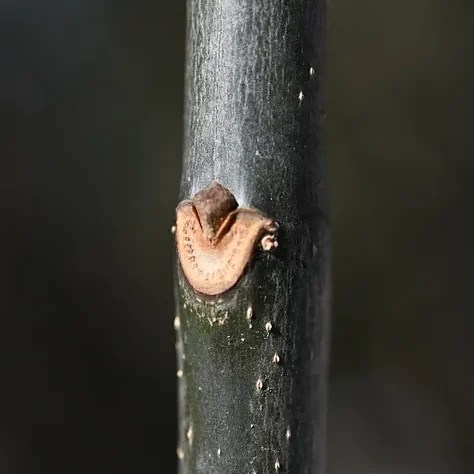
twigs from left to right: swamp white oak, black walnut
Learning to Look
When you start learning trees, everything looks similar. There’s a period of time when you just have to soak up as much visual information as possible in order to calibrate yourself. Before you task yourself with identification, I recommend heading outside to look at a bunch of trees, any trees, to accustom yourself with the breadth of variation, the similarities and differences between species and individuals. It doesn’t matter if you know what kind of tree it is at this point, in fact I encourage you to put the urge to identify aside for the moment. The goal here is to familiarize yourself with the act of observation.
Run your hands over the bark of the tree and think about the texture– what words would you use to describe it? Is it corky and pliable, flaky, rough, or smooth? Look at the way the branches sit. Do they grow perpendicular to the trunk, or curve upwards? Do they zig-zag or tangle? Find something about the tree you think could easily go unnoticed, then let yourself be drawn to a part of the tree you find beautiful. Maybe it’s a bright yellow bud, or the tiny white dots speckling a young branch. Step back and look out at the landscape, and down at your feet. What is the soil like, how does the air smell? There are a million things to notice about this tree, and none of them require prior knowledge. You will learn all of the terminology in time; what’s most important at the beginning is learning how to look.
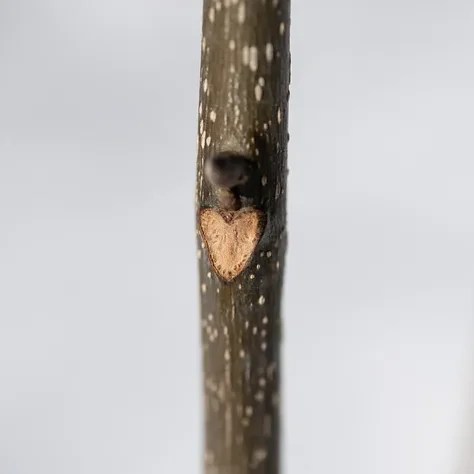
leaf scars from left to right, top to bottom: shagbark hickory, basswood, white ash, black walnut, red oak, another shagbark hickory
This practice applies to most forms of nature study, and beyond that is an exercise akin to meditation. As a person who struggles with anxiety, I’ve been suggested a very similar methodology countless times: “have you tried doing a grounding exercise?” The core actions are the same– engage your senses and notice what’s around you in order to guide your anxious mind back to your physical body. Although I roll my eyes a bit at the simplicity of it, I have to admit it often works, at least temporarily. And I don’t think it’s a coincidence that each time I come home from a nature excursion, I feel lighter, more secure, and more attuned to myself and to what’s important in life. Even if you never learn the names of trees, being in the moment with what’s around you is a habit worth cultivating and can have a profound effect on your state of being.
twig of a red oak
Curate Your Resources
When teaching yourself anything, it is critical to have good resources, though what constitutes a “good resource” will look different to each person. For me, it’s got to be detailed, but also easy to find the information I’m looking for. I like field guides that are largely visual and don’t require me to hunt through paragraphs of text to glean important information.
The best way to figure out what resources are going to be most useful to you is to start with far more than you think you’ll need. Check a bunch out from the library, peek at what your friends are using. Familiarize yourself with each of them, and see which ones you reach for. It’s unlikely you’re going to be able to rely on a single field guide; instead, plan to refer to a few trusted books and websites in order to paint a full picture of your subject.
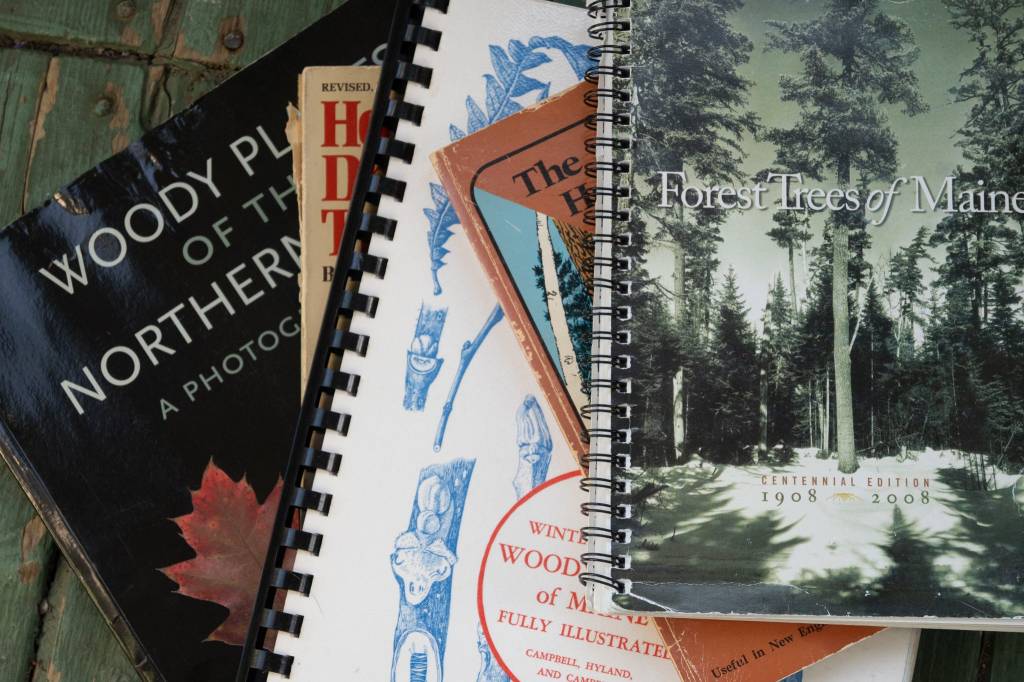
These are the guides and websites I use most frequently in tree ID, and why I like each of them (and keep in mind, I am in the Northeastern United States, which many of these guides are specific to):
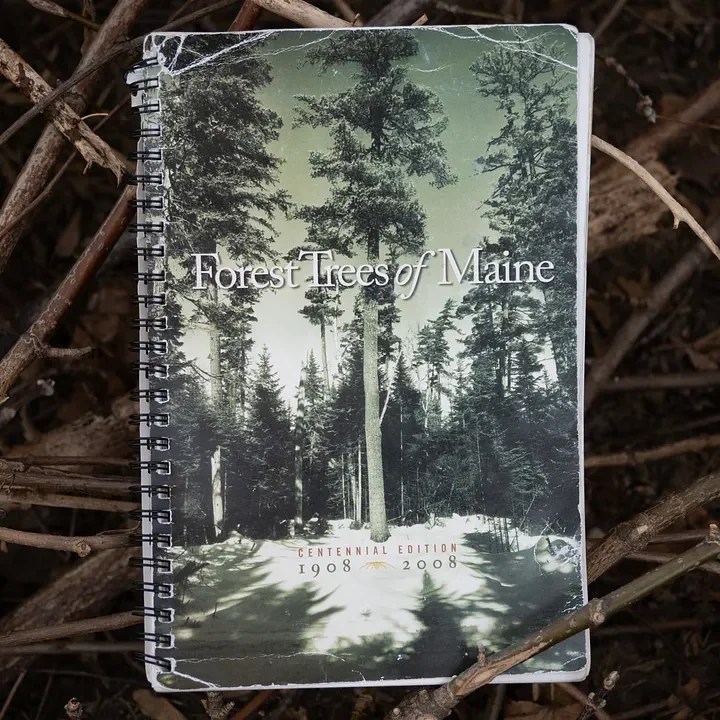
This is the first tree guide I used. I was introduced to it through VMN, and it is still the guide I reference the most. It is simple, easy to carry out into the field, and has all the right information. It’s relevant for most of the Northeastern United States, not just Maine. If you can only get one tree guide, this is the one. It’s also available to view/download free as PDFs from the Maine Forestry Dept. website.
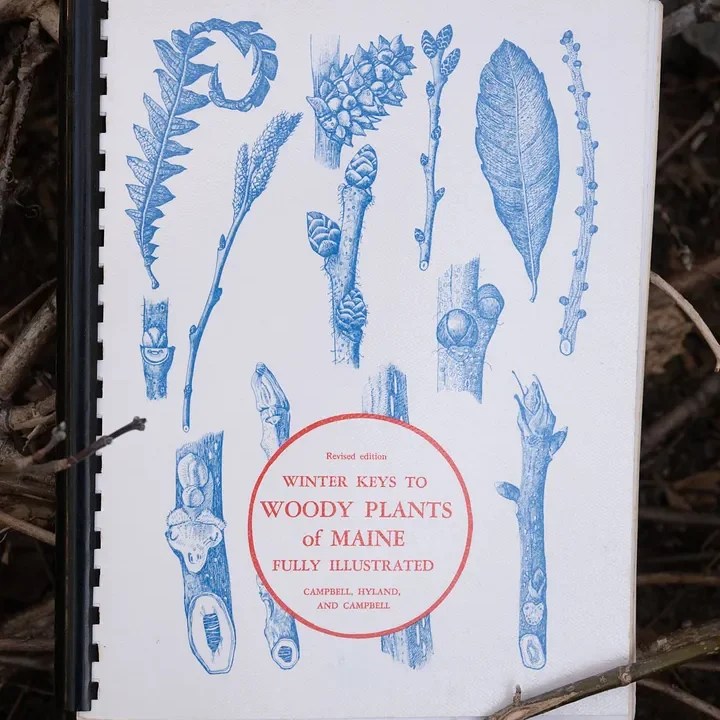
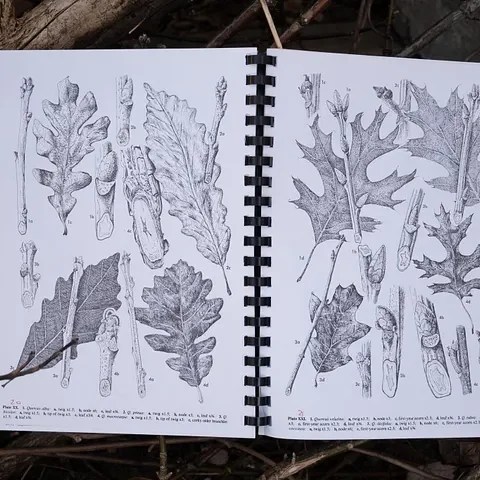
This book is filled with highly detailed illustrations of winter twigs. It’s out of print, and hard to find for a reasonable price. I was lucky to find a copy on eBay for $50, after borrowing one from Alicia while working on my twig guide. I wouldn’t say this book is necessary to have, but if you’re getting really deep into the subtle differences between closely related species’ winter twigs, this is a great addition to your collection. And the illustrations are so, so gorgeous.
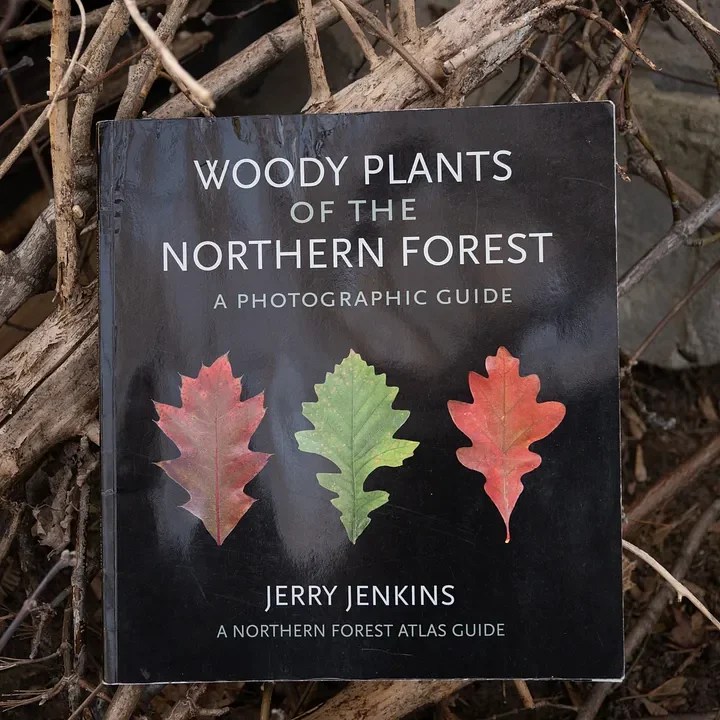
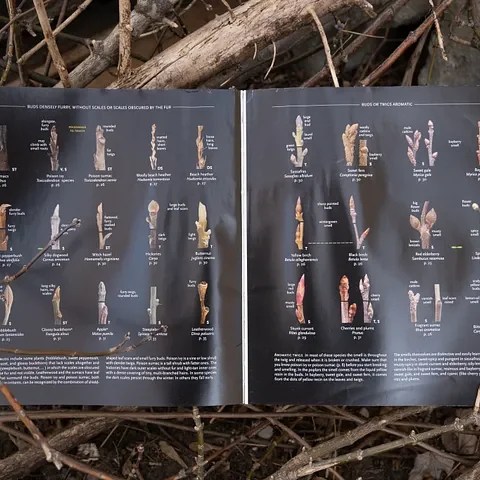
This is a great one for beginners because it’s photo-heavy and provides direct comparisons of visually similar twigs and leaves. You can also view and download this resource for free on the Northern Forest Atlas website, along with several other invaluable photographic guides. The only downside to this book is that it’s not great for taking out in the field– it’s large (though thin) and awkward to stick in a backpack.
This author/organization is also coming out with a far more robust version of this guide on Nov. 15, which includes a lot more species (not just trees, but many other woody plants too), called Field Guide to the Woody Plants of the Northern Forest. I pre-ordered it from my local bookstore and they goofed and gave it to me early! Lucky me. I haven’t taken it out in the field yet, but I can already tell it’s gonna be a go-to, and especially useful for my natural community visits. However, for a beginner, I’d recommend starting with the pared-down version.
Bark is what it sounds like– a field guide to trees based solely on bark. This is a great accompaniment to your twig learning. I learned twigs alone, and am aiming to get better at identifying bark this winter, but learning them together would provide you with all the tools you need to ID a tree in any season. I’ve taken this guide out in the field a few times now and wish I’d bought it sooner.
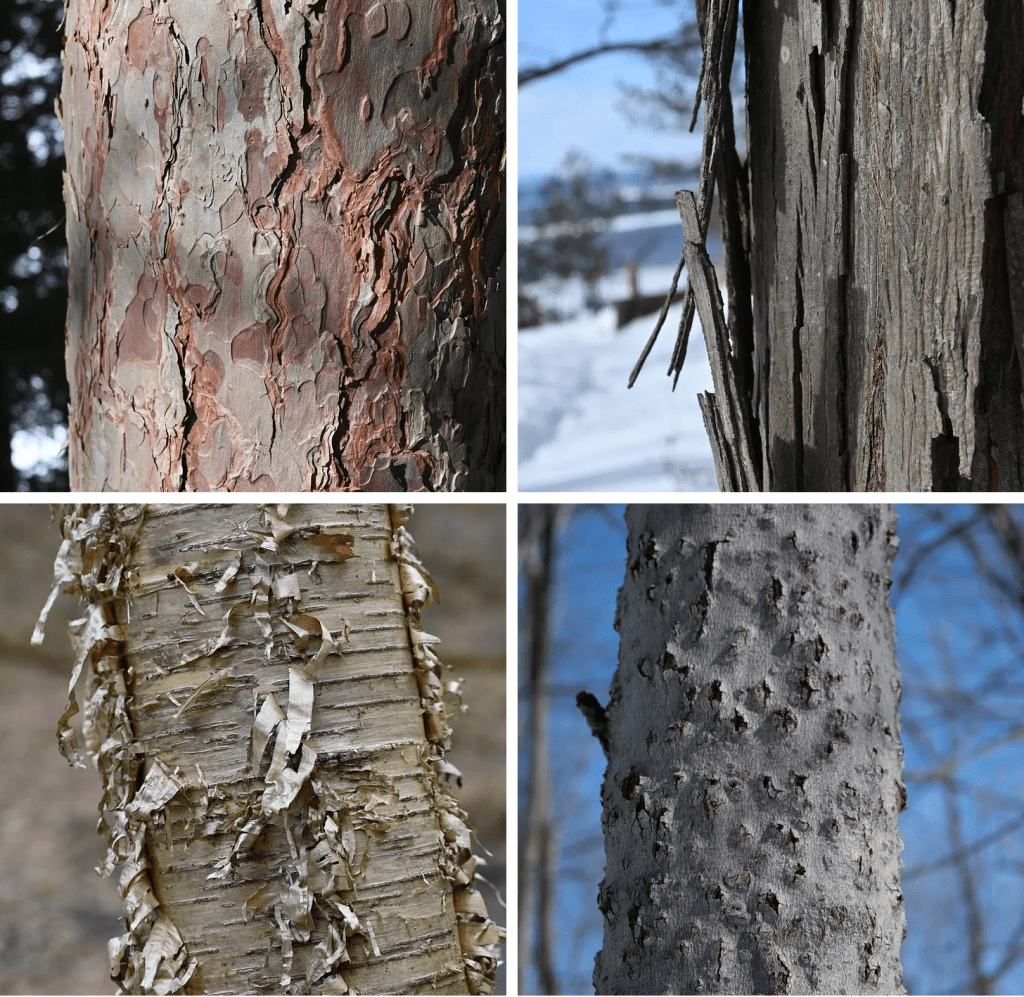
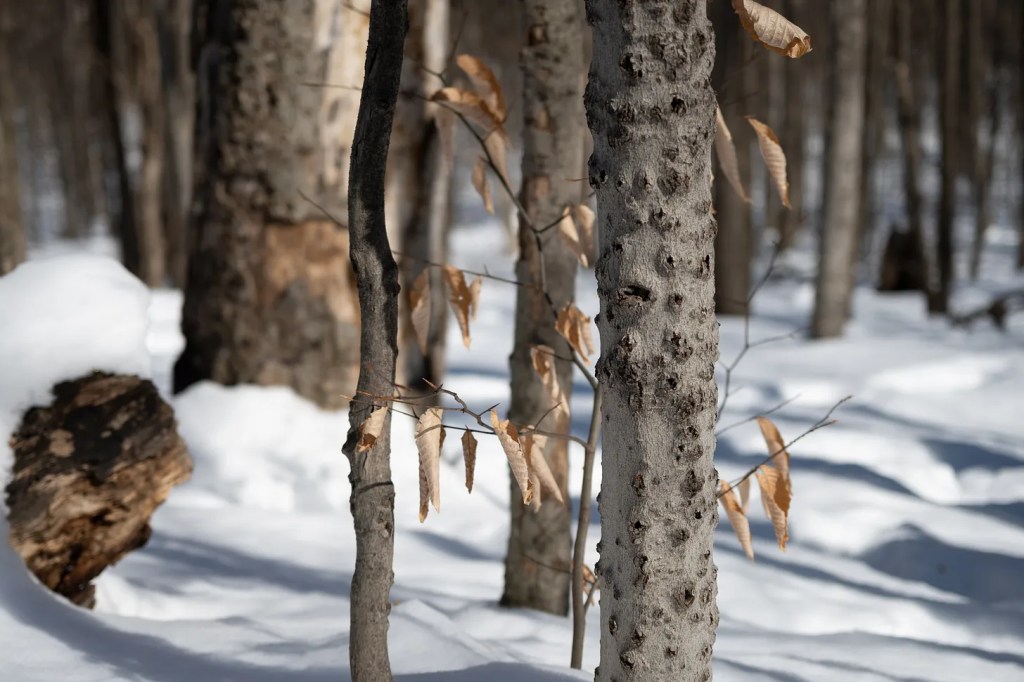
a few examples of trees with really distinct bark, from left to right, top to bottom: red pine, shagbark hickory, yellow birch, beech (diseased)
Go Botany, an online resource by Native Plant Trust
There are numerous online resources, but this is the best and most reliable source of information I’ve found for plants, including trees.
I know I plug iNat every chance I get, but I can’t stress enough what a powerful learning tool it is when used correctly. By this I mean– don’t use it to ID the trees. You won’t learn by doing that. Use it for finding particular species of trees, tracking patterns (what grows where? etc.), and keeping a digital log of the trees you’re learning. It’s also great for helping to gauge how much variation there is among species, since there are tons of photos to look at.
Start Small
Once you’ve gathered your resources, you’re ready to begin your study. Again, you don’t need to know much before you go out to look at trees. Familiarize yourself with some basic terminology, then get outside with a field guide or two! You will learn more through curiosity and observation than you will studying from a book. Let yourself explore and form questions, then bring those queries back to your stack of resources.
a diseased beech on a beautiful winter day
I like to start with a single tree (or bird, or flower, or whatever you’re studying, again this method applies broadly), the first one that piques your interest. Spend some time with it, use whatever guides you were able to carry into the field, and see what you can figure out. Don’t beat yourself up if you get stumped (pun intended). You probably will if this is the first tree you’re trying to ID. Remember you are learning something new, and it will take some time to feel competency. Start small and return to the sensory exercise if you get stuck. Take pictures/notes and look it up later if that works better for you.
The Tiny Beauty of Twigs
Trees are fun to learn in any season, but there’s something particularly magical about learning trees from their winter twigs. They look like tiny fairy scepters, wizard’s wands, or elaborate walking sticks in miniature. Each twig is unique, each a work of art. Finding beauty in their minute yet ubiquitous presence can transform your experience of the bare winter season.
one of the most fairy scepter-like twigs, that of a shagbark hickory
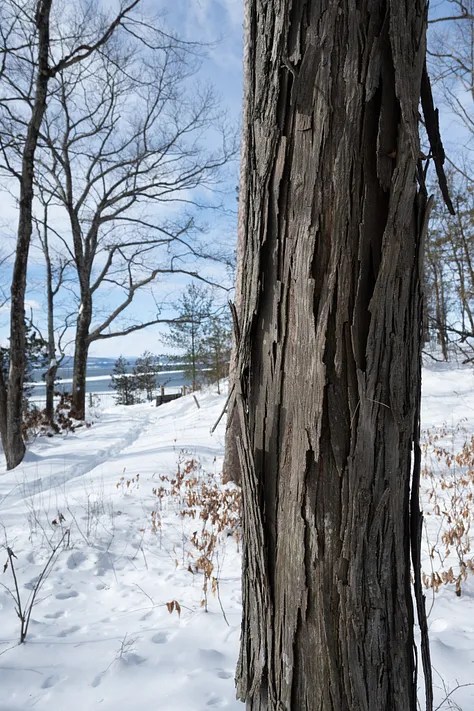
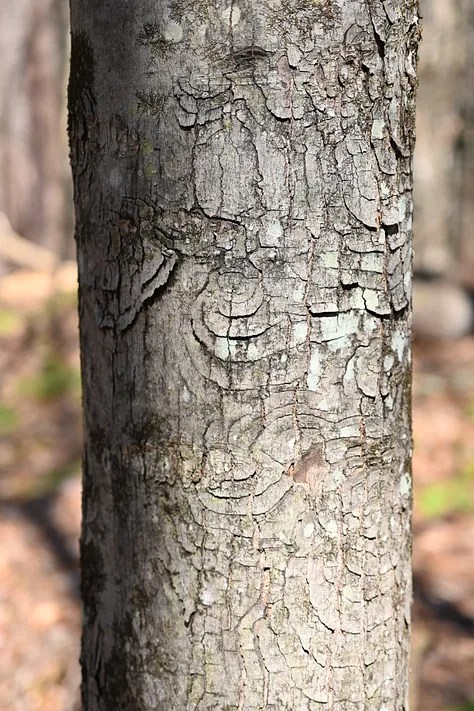
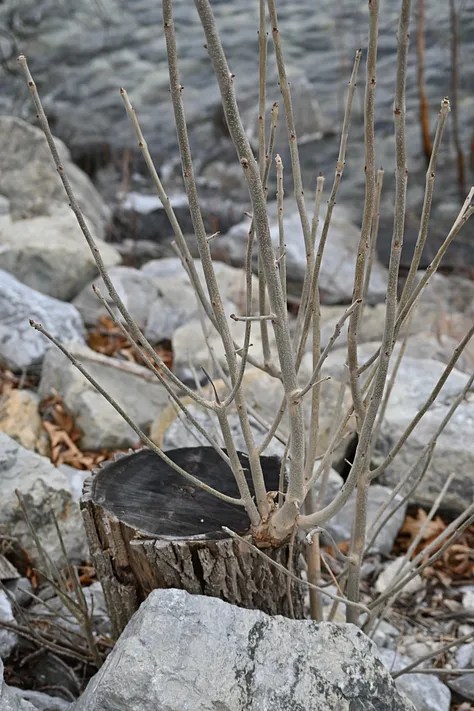
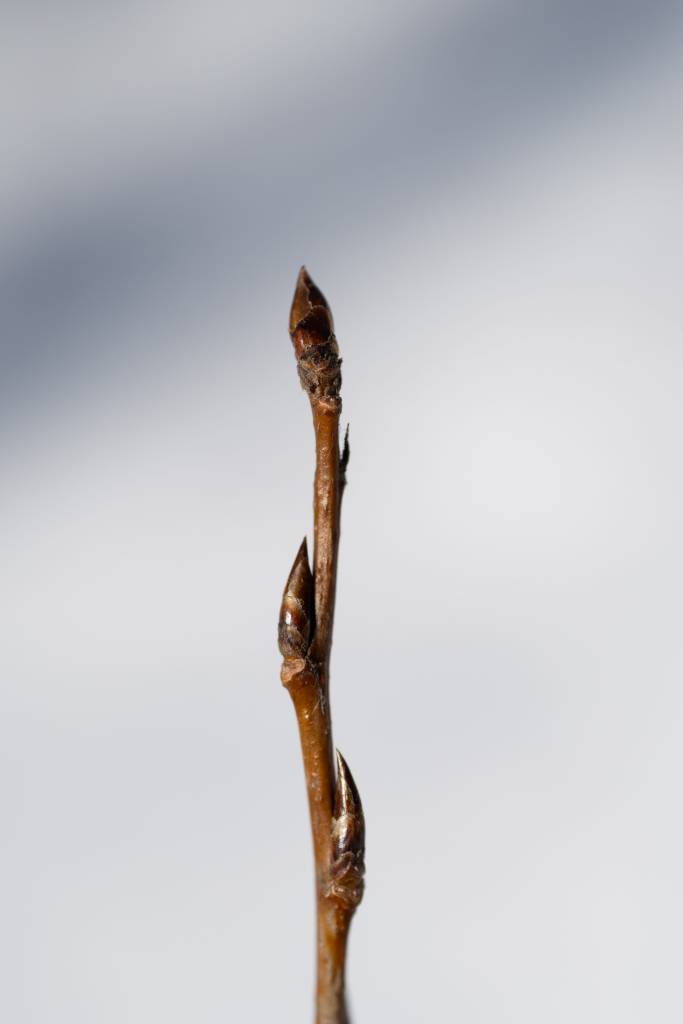
Twigs hold a lot of clues that can aid in identification. Buds alone contain so much detail– their arrangement, shape, color, number of scales, and texture are just a few of the traits that point to an ID. And then the twig itself: its thickness, pores, hairiness, pruinosity… the list goes on. And although the winter twigs are just one small part of a tree, I guarantee as you learn them you’ll pick up other knowledge, too. You’ll notice shagbark hickory’s distinct bark, and the way its branches curve enthusiastically, like arms thrown up in celebration. You might see a strange, target-like pattern on a tree’s trunk and find that it can be a useful field ID for red maples. Maybe you’ll start to wonder why the majority of the ash twigs you study are on small saplings, or shoots regenerating from stumps (more on that here).
a shagbark hickory’s distinct bark, target canker on a red maple trunk, an ash sprouting from its stump
The more you look, the more you learn. Developing a sense of wonder and curiosity, which you no doubt have already or you wouldn’t be reading this, will lead you to knowledge. That, and putting yourself in nature again and again— practice, time, and experience are essential.
As you cultivate the habit of looking closely at twigs, you’ll begin to grasp the complexity and nuance of each individual species. You’ll start to notice and unravel the million other small mysteries that await each time you go outside. And, undoubtedly, you’ll come to recognize the beauty in all the minutiae of this world.
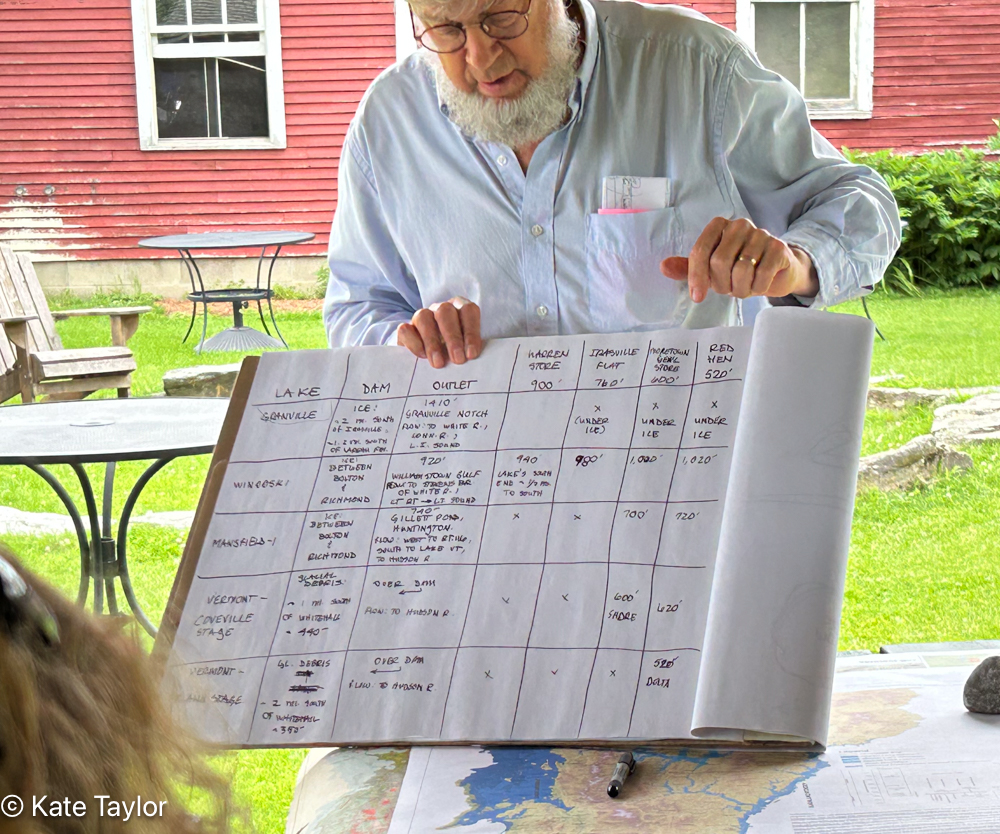
Recently I spent the day as part of the Vermont Master Naturalist Program learning about world history. I don’t mean wars and kings. I mean the movement of continents and glaciers. I mean history where time is measured in eons and eras. We were taught by Craig Heindel, a Vermont hydrogeologist as well as a fascinating and enthusiastic instructor.
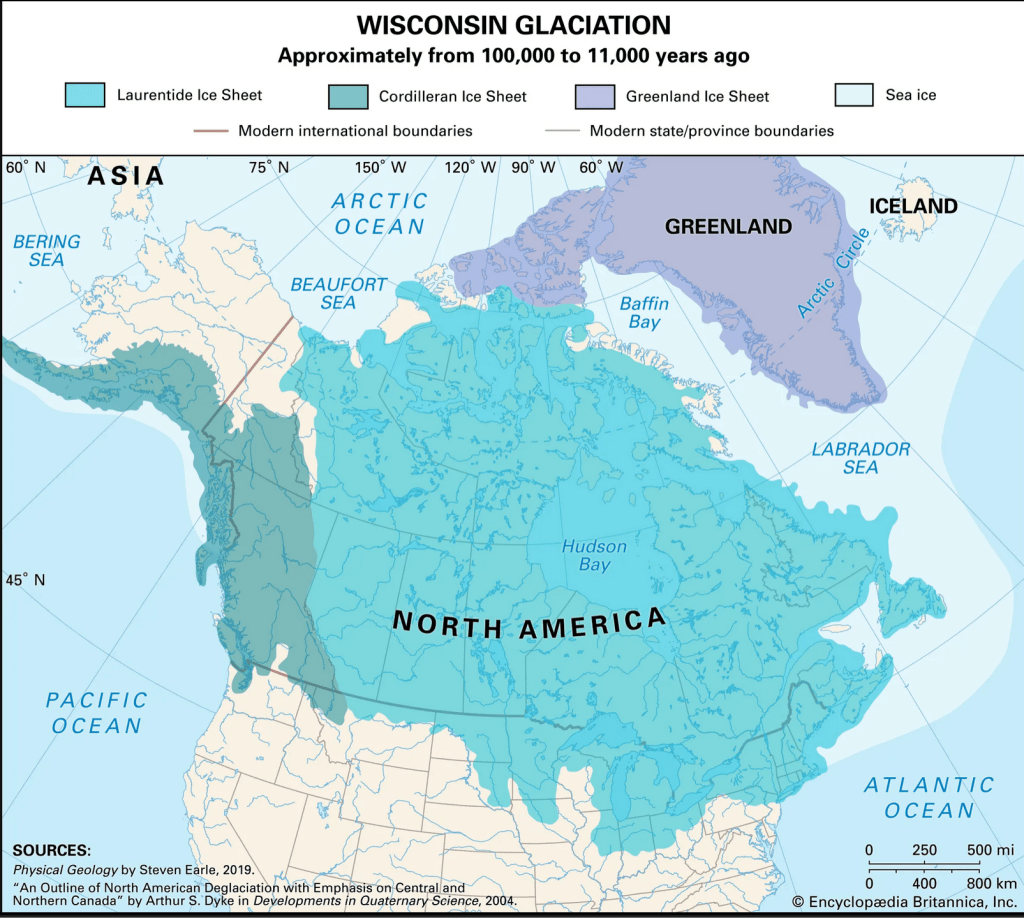
He told us how a few million years ago the world was in an ice age. There were periods of freezing and thawing, some lasting hundreds, or even thousands of years, but the overall trend was ice. Around 25,000 years ago a giant glacier called the Laurentian Ice Sheet, reached its maximum size, covering most of Canada and dipping into the United States. All of New England was buried under more than a mile of ice. Mount Mansfield was buried under ice.
Camel’s Hump was covered in ice. Mount Washington was likely topped with ice. There was so much water trapped in the glacier that it lowered the ocean level by around 600 feet (six hundred feet!). You could have walked over ice to George’s Bank. It would have been an unrecognizable landscape.
Interesting, you may be thinking, but that was a long time ago, it has nothing to do with me and my modern interests. Oh, but it does matter. That is the amazing thing.
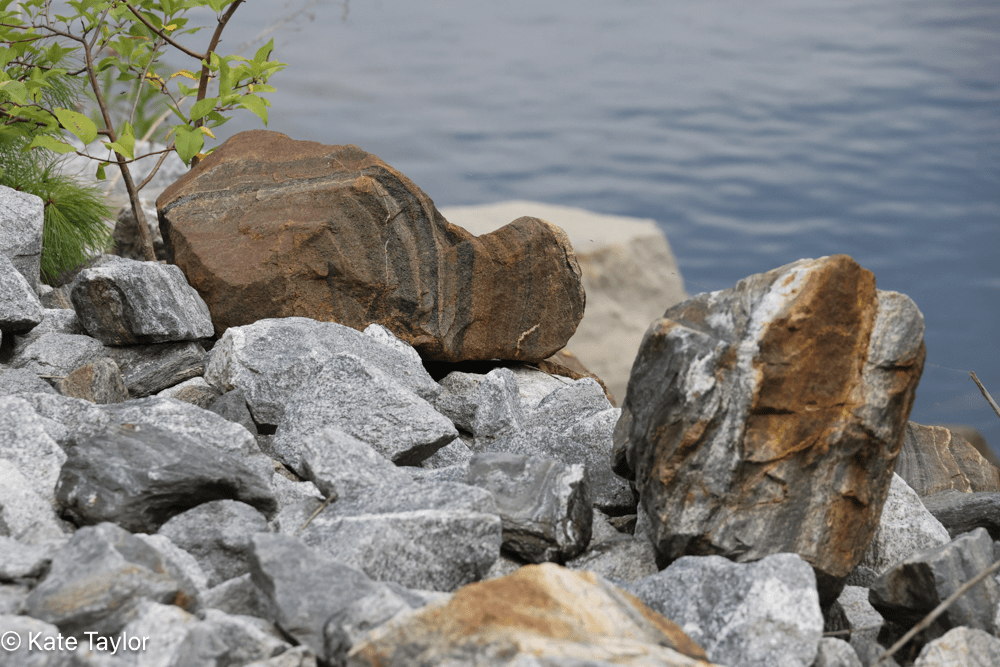
Let’s talk about rocks for a moment. Bear with me, it’s related. What is a rock? Basically, it’s a chunk of minerals. Occasionally a rock is comprised of a single mineral, more often they are a combination of many different ones. Nitrogen, phosphorus, magnesium, silver, iron, and calcium carbonate are some of the many, many, minerals that make up rocks.
Rocks are defined by the minerals they contain and the molecular structure of those minerals. The structure determines the hardness of the rock. Some rocks are soft, while other easily chip or flake. Some seem indestructible. Rocks can be boulders, sand grains and everything in-between. Rocks are easy to take for granted.
Map of various lakes that were formed in the Mad River Valley over the past ten to 25 thousand years. The different colors show the extent of different lakes. (Map created by Craig Heindel, using the VT Agency of Natural Resources’s Natural Resources Atlas)
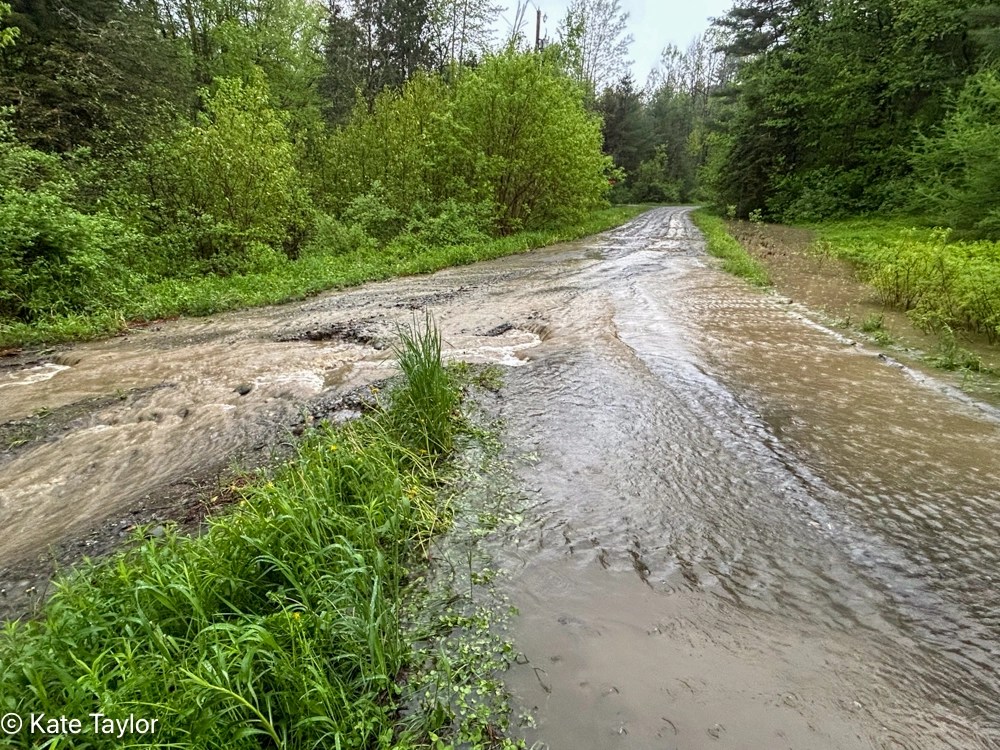
Now, back to all that ice. Imagine it melting. That’s a lot of water. As it melted the water had to go somewhere, but the glacier itself blocked the water from flowing North into the St Lawrence as it does today. Instead, the water flooded Vermont creating gigantic glacial lakes between and among the Green Mountains. Periodically a portion of the gigantic ice dam that was the glacier would give way with a catastrophic torrent of water that gouged the land and scoured a path as it rushed downhill. Other times, the melt was a slow trickle, wearing away the land.
This brings us back to our rocks. Flowing water not only carves out the landscape, it also carries rocks, soils and sediments along with it. A fast-flowing river can tumble rocks breaking them down into sand and the smaller sediments that make up clay, releasing the minerals into the water. Some minerals are dissolved, remaining in the water until the water evaporates, some simply break into smaller particles that can be taken up in other forms.
(A bobcat for instance, crouching to drink at the river’s edge will lap up the minerals in the water it drinks, or your well dug 200’ into a subterranean lake contains minerals leached into it from the surrounding soil. Plants too, drink in those minerals with roots stretching down into the soil.)
When the river reaches a wide, shallow area, it can create a lake or pond. As the water slows it dumps the heavier particles first, while the lighter ones drift further out until they eventually settle. That means that near shore the soil is sandy and contains heavier particles while further out the sediment becomes finer. When the river changes course or the lake disappears the soil remains behind, stones, sand, clay or some mix.
If you travel to those spots today you can find evidence of those lakes in the landscape and in the soil. Places that were in the center of a deep lake tend to have clay, while spots where a rushing river ended are more likely to be sand.
In other words, the ground beneath our feet was influenced by the movement of all that ice and water. Not only the shape of the land, but the quality of the soil itself. All life has its preferred habitat and in Vermont that habitat was influenced by the glacier that covered it for thousands of years. The life in Lake Champlain, the clay for bricks and pottery, rich or poor fields for farming, the water in your well and the soil in your garden can all be traced back to a time before humanity covered the earth.
It’s a reminder of how we are not separate from this great planet we live on, but rather fit into our own specialized niche as does all life on earth.
*Disclaimer: My knowledge is shallow and my explanation is an oversimplification. Craig is a great instructor, and any mistakes are mine alone.
By Lorna Dielentheis, VMN Mad River Tier II participant
Note: I wrote this reflection and then realized I never properly introduced the natural communities I visited! The two communities I focused on while at Peacham Bog were the Black Spruce Woodland Bog and the Dwarf Shrub Bog. At Peacham Bog (and this is the case for many bogs), there is a gradation between related communities which also includes Black Spruce Swamp and Poor Fen community types.
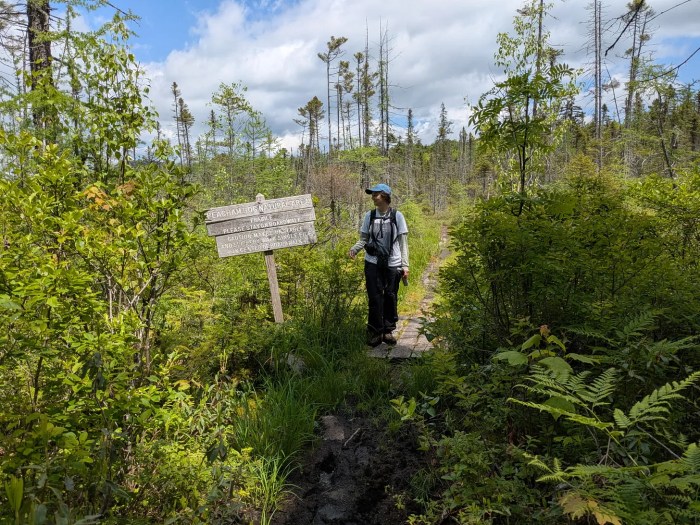
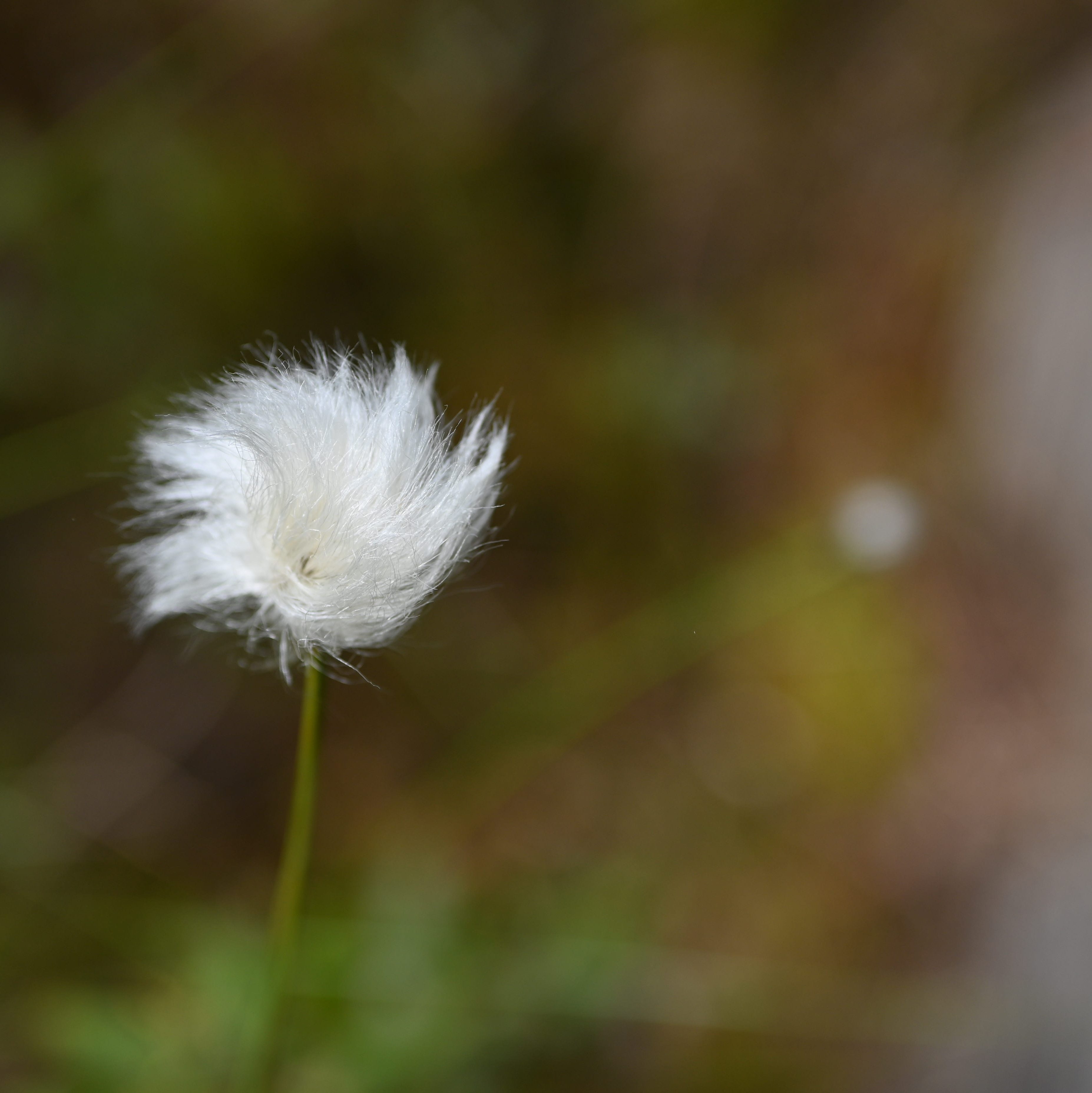
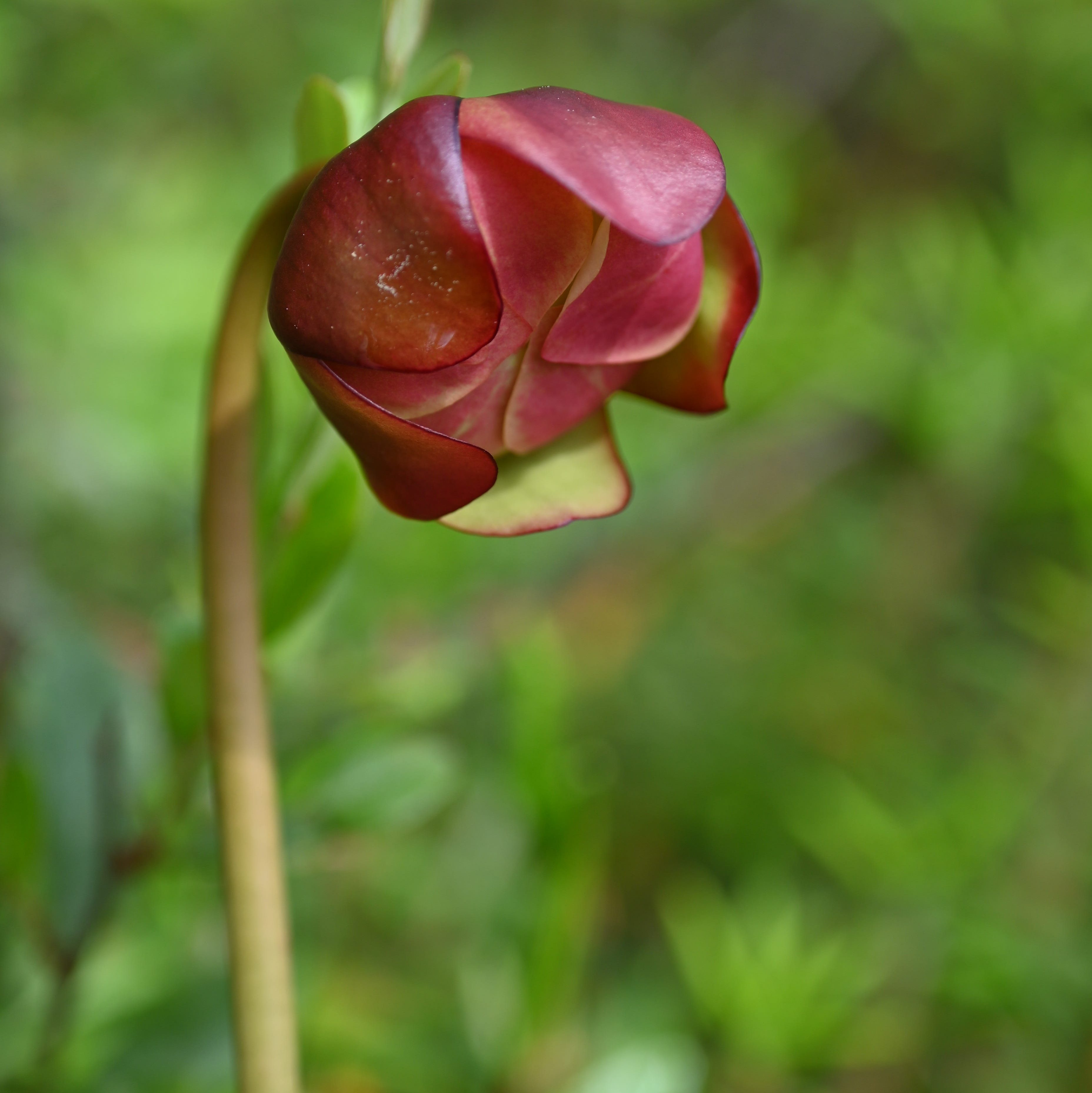
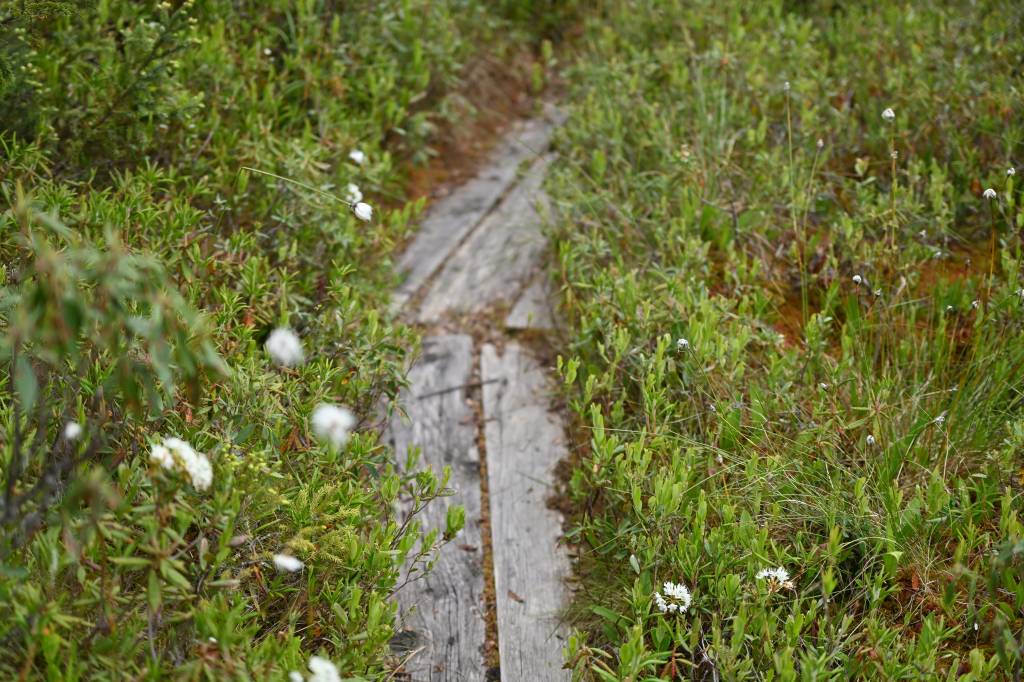
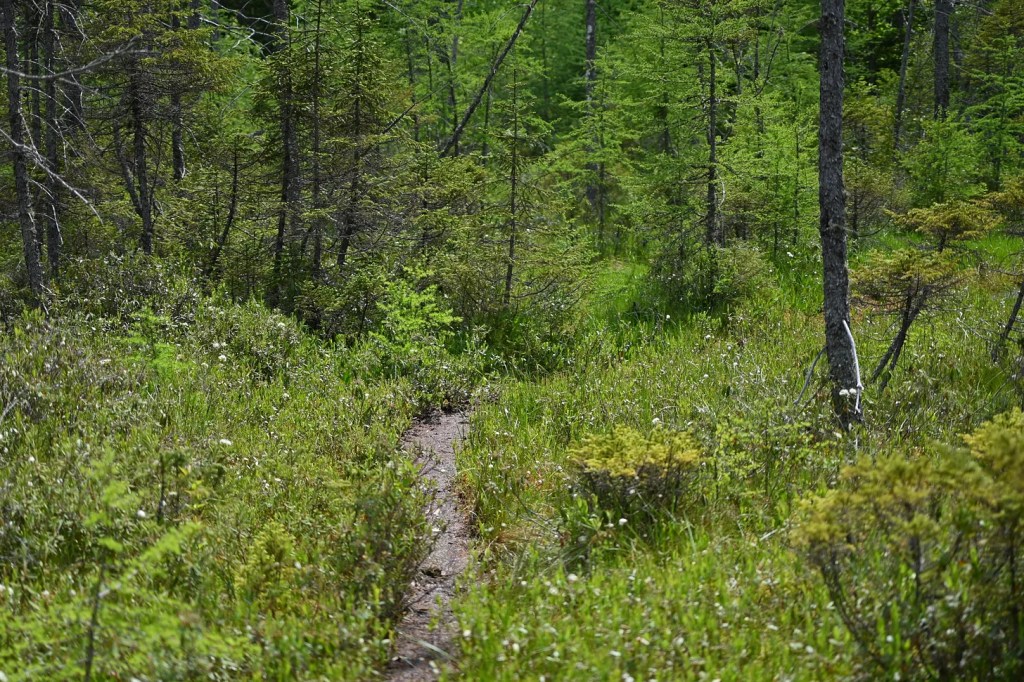
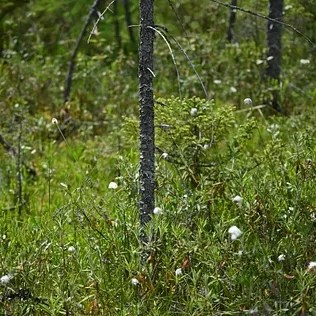
At last we emerge from the damp, buggy woods. The open blue sky greets us, sunshine pouring over the expanse of mossy peat stretching out into the distance. The whole basin seems to glow. Towering black spruce trees loom like sentinels as we step onto the narrow, overgrown boardwalk, while little tufts of cotton grass cheerfully dot the lush greenery beneath. The strange waxy forms of purple pitcher plant flowers lend an air of surreality to the landscape, as if we’ve just stepped into another world entirely. In some ways, we have– the ecology here is completely different from that of the land surrounding it. Though perhaps stepping into another time would be a more appropriate description.
The entrance to Peacham Bog
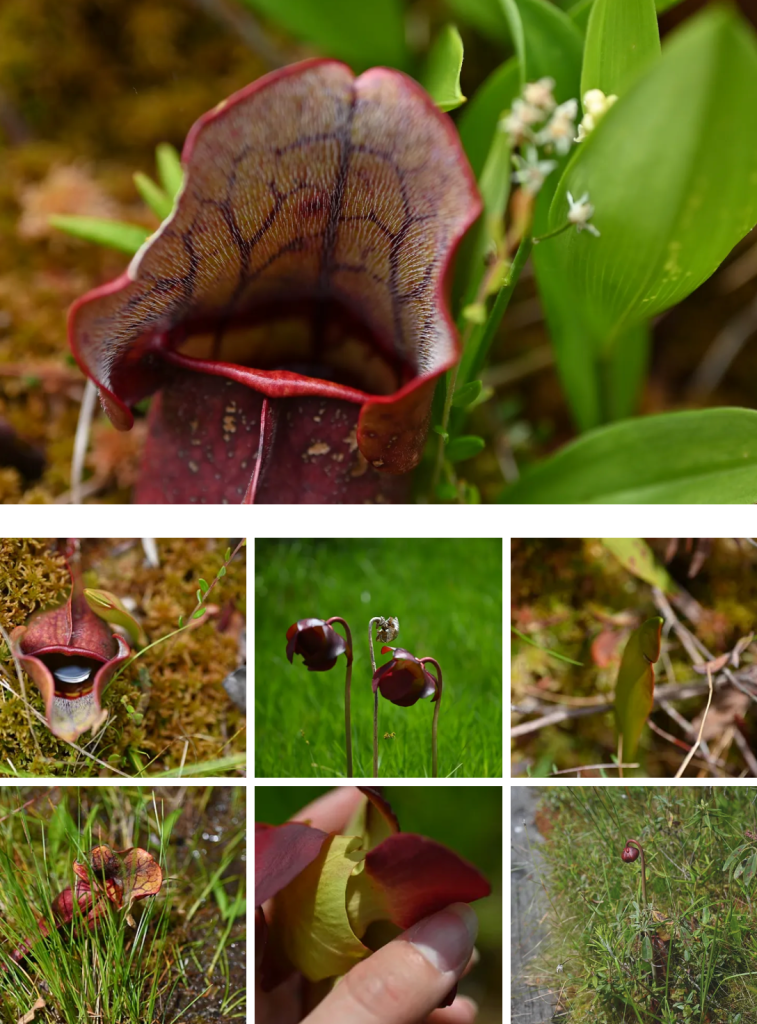
Tussock cottongrass, purple pitcher plant flower
13,000 years ago, a melting glacier left a shallow depression in the earth where we now stand. Acidic rainwater collected in this basin. Stagnant and cut off from other water sources, this nutrient and mineral-poor water lacked the aquatic microbes that would normally aid in decomposition. So as sedges, sphagnum, and other plants invaded the water, their intact remains accumulated and compressed over time to form a floating mat of peat.
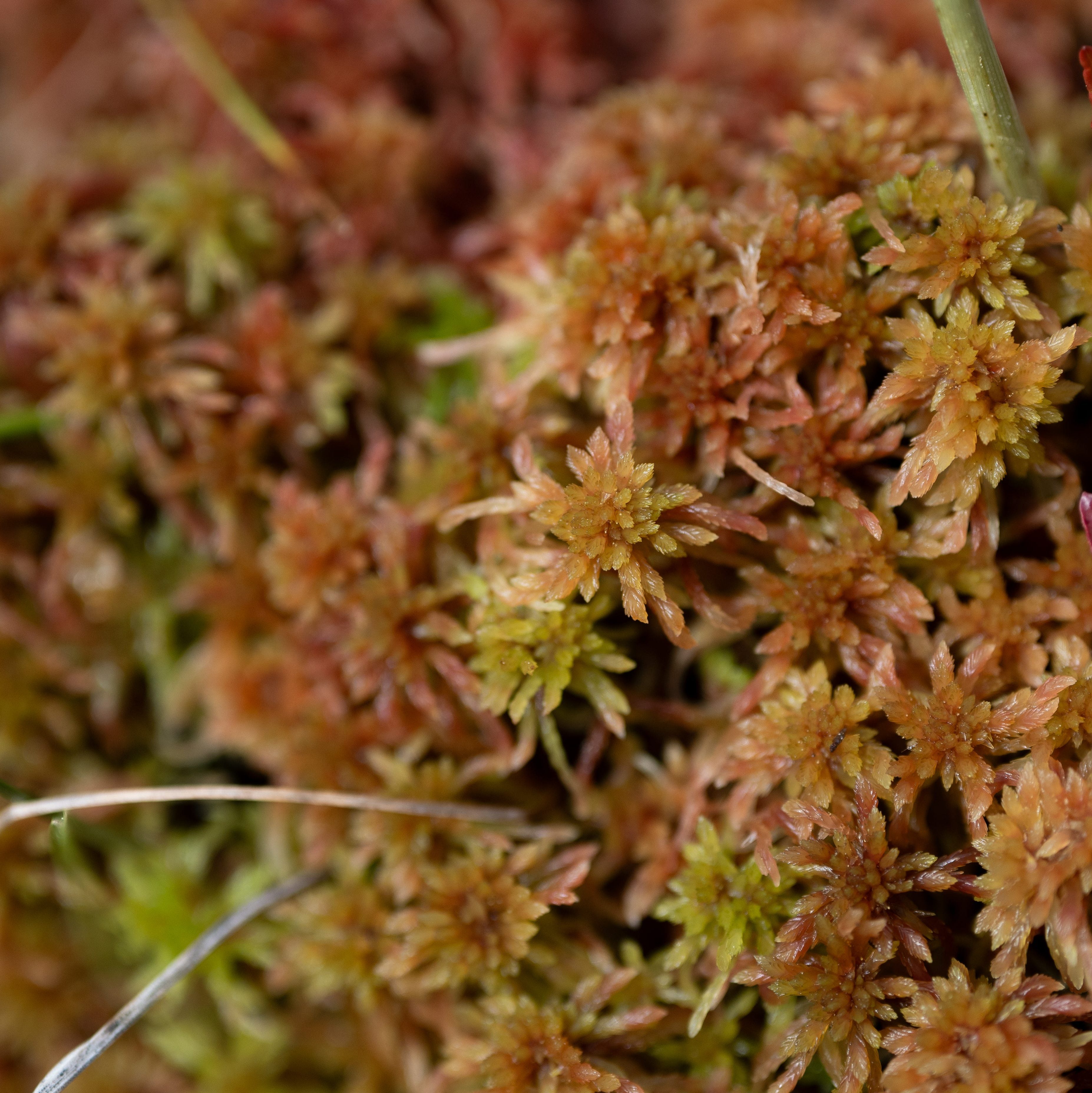
The sphagnum moss, which thrives in these tough conditions, now blankets the peatland as far as the eye can see. This dense layer of saturated moss insulates the acidic water beneath and reinforces the cold, low-oxygen, nutrient-poor conditions, encouraging more and more peat buildup. Eventually this self-fulfilling cycle can (and does, at Peacham Bog) form a dome that elevates the acidic center of the bog above the surrounding water table.
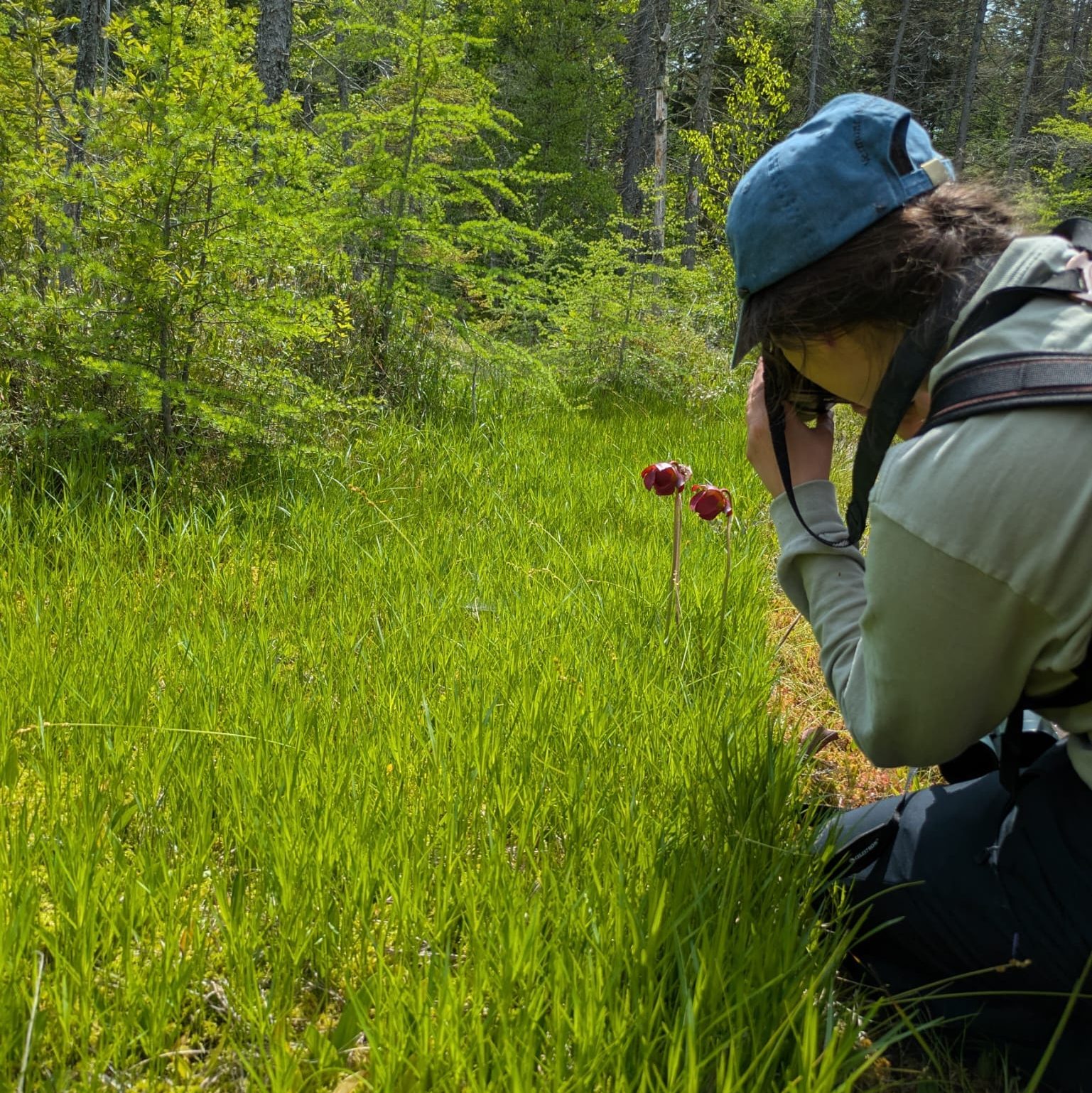
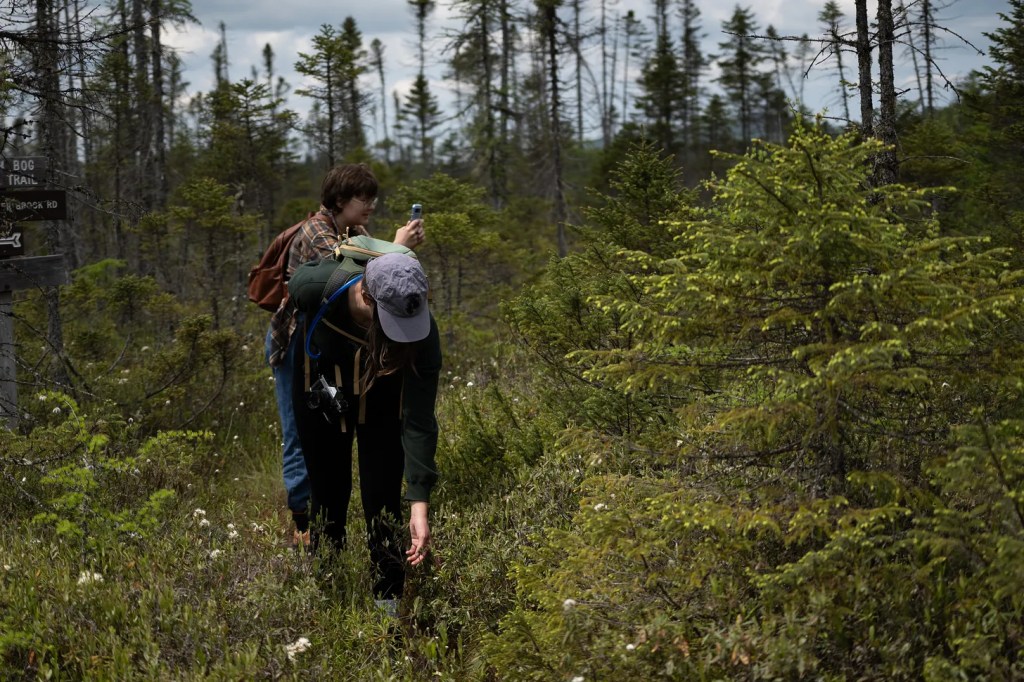
me photographing a pitcher plant flower, sphagnum moss
The overgrown boardwalk
As we venture further into the bog, I’m struck by the vastness of this place. I’ve been to a few other bogs, but never one this big. And never to one where I’ve felt such a palpable sense of fullness– as if the bog is bursting from its container (it literally is).
The worn wooden planks depress as I walk on them, small amounts of water seeping through the slats. I wonder whether they’re secured at all or just set gently upon the peat. It feels as though, given a few days without human presence, the bog might swallow them up entirely. The low shrubby plants brush wetly against my legs, and when I kneel to photograph a pitcher plant I imagine sinking into the surrounding sphagnum. How quickly would it grow up around my body, my face?
Pitcher plants (and other bog plants) emerging from the sphagnum
I continue on, setting aside the urge to examine each plant and instead tuning into the otherworldliness of the ecosystem as a whole. There will be plenty of time to survey the plant species and take photos later. So much of my enjoyment of nature comes from its indescribable presence, the sense of place that forms when I spend time simply absorbing the interconnected beauty of it all.
It’s easy to zoom in on singular details –the strange plants, the rare butterflies, the birdsong– and boy do I love that type of niche observational study. But each of these pieces interact with each other and the whole in a way that, when understood, touches on the profound. Imagining a place as an entity unto itself composed of many smaller entities, each essential, imparts a sense of both the fragility and the expansiveness of the natural world. Compromise one element of this carefully balanced system and the repercussions can be catastrophic.
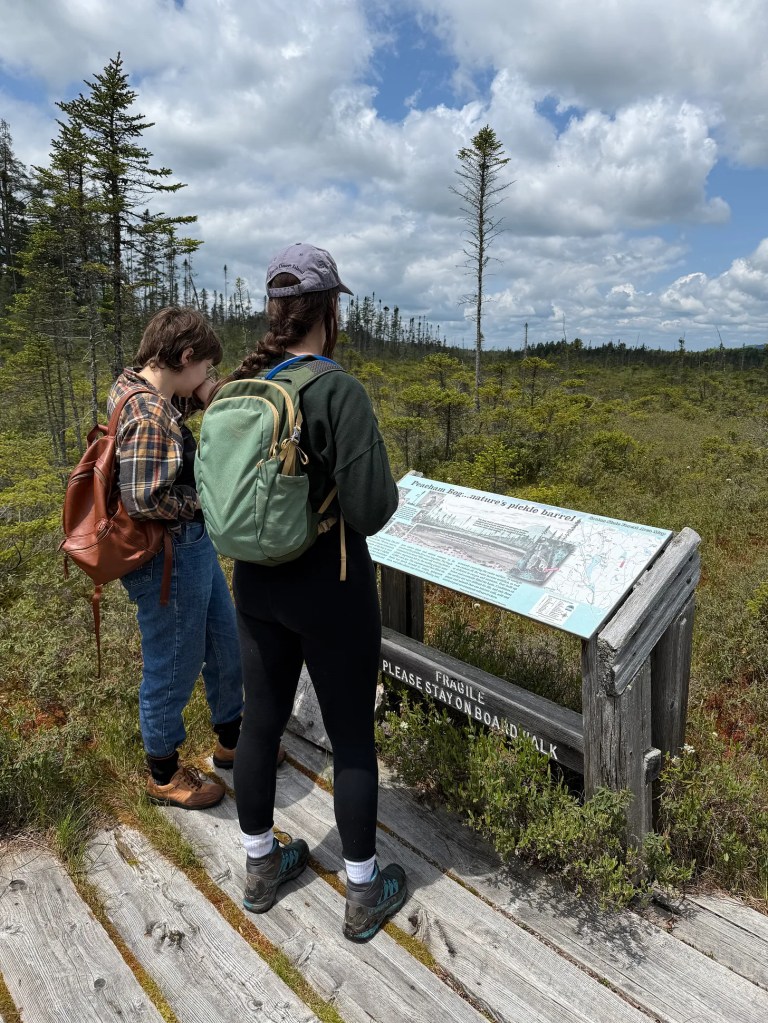
Peacham bog viewing platform
The sign at the lookout platform reads: “Peacham Bog… Nature’s Pickle Barrel.” And indeed, the acidic peat is known to preserve the remains of any creature who dies here– “bog bodies,” they’re called. I envision the peat extending deep below us, wondering how far down it goes and what creatures lay suspended in its spongy murk.
The lack of decomposition that leads to these preserved corpses also means that the bog stores carbon that would otherwise be released back into the soil or atmosphere. Peatlands are one of earth’s most efficient carbon sinks, covering a miniscule portion of earth’s landmass —about 3%— yet storing twice as much carbon as all of earth’s forests (NYT 2022).
Read that again: peatlands cover only three percent of earth’s land, but store twice as much carbon as all of its forests combined.
And yet, these ecosystems are imperiled. Peat has been harvested for fuel, peatlands drained for agriculture and architecture. Consequently, immense amounts of stored carbon are released back into the atmosphere as CO2, warming the earth. And as climate change worsens, more peatlands dry out, releasing yet more carbon: another self-fulfilling cycle.
To say nothing of the beauty of these places, it’s easy to understand why their existence is essential. It’s shameful that we’ve taken part in destroying them. We are only beginning to pay the penalty for it.
Mae & Kim
After reading the interpretive sign, my friends and I eat our snacks, each of us in contemplation of our 30-something year old bodies surrounded by this 7,000 year old bog. I think about the cycles of life and death that have sustained this place, the animals that walk upon the moss and later rest beneath it.
Eventually the eerie, single-note song of a white throated sparrow echoes across the open peatland. The bog’s reverie now broken, we chat and laugh and after a little while I wander off to start cataloguing the plants.
It’s astounding how many species grow here, each with its own unique adaptations to survive. Compared to the surrounding landscape, the bog isn’t what you’d call biodiverse, but given the conditions I am nonetheless surprised at the array of plant life.
Purple pitcher plants
Perhaps the most fascinating of the bog species are the pitcher plants, who get their nutrients not from the substrate or water, but from the bodies of insects that fall into their hollow tubes.
Purple pitcher plant, or Sarraceniapurpurea,is the only pitcher plant native to New England. These alien-like plants collect water in their hollow leaves, in which insects drown. The insects, attracted to the fleshy red/green/purple pitchers, land on them and are then guided downward (and prevented from climbing back up) by directional hairs at the mouth of the tube-like leaf.
Young leaves secrete a digestive enzyme that aids in the breakdown of the drowned insects into nutrients the plants can absorb. Older leaves, however, also rely on the invertebrate and bacterial community that develops in the collected water to help break down their food. In turn the plant oxygenates the water held within their modified leaves, so these organisms can survive. Little oases of livable water within the bog’s acid nutrient desert.
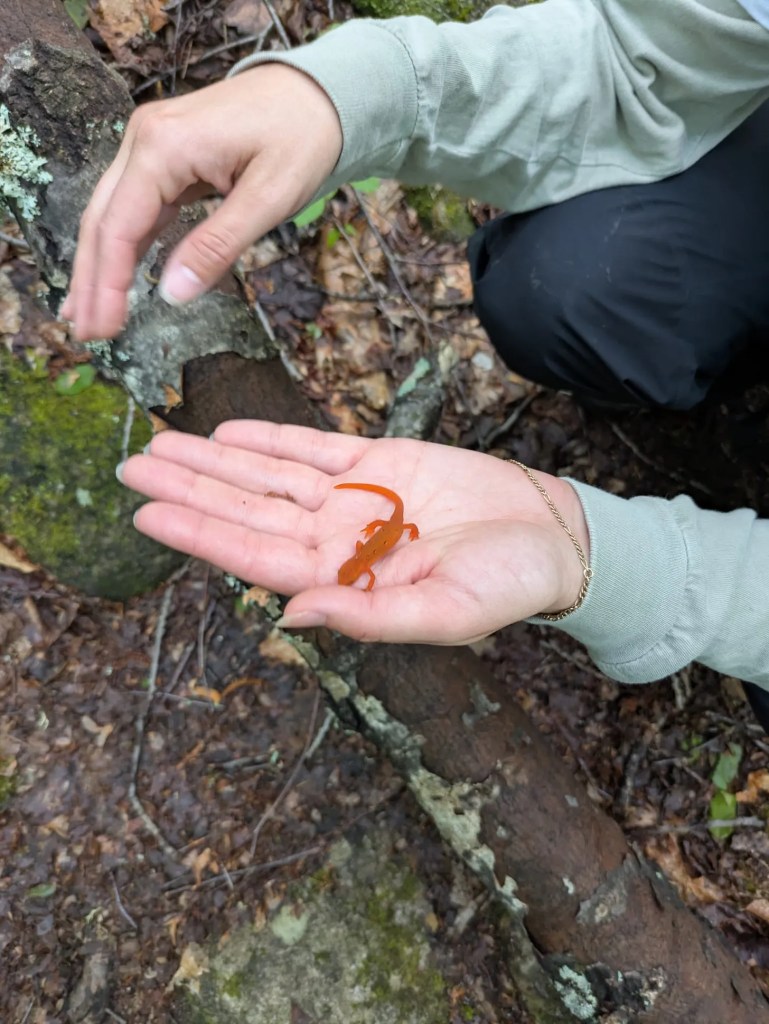
Me holding one of the many newts we spotted in the forest on our way to the bog
While researching this post, I was startled to find that in addition to insects and other invertebrate prey, Sarraceniapurpurea has also been discovered to capture young salamanders! Though, the plant’s ability to digest these much larger prisoners is unclear. Read more about it here.
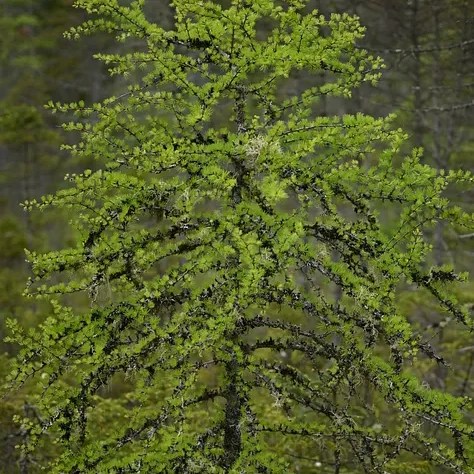
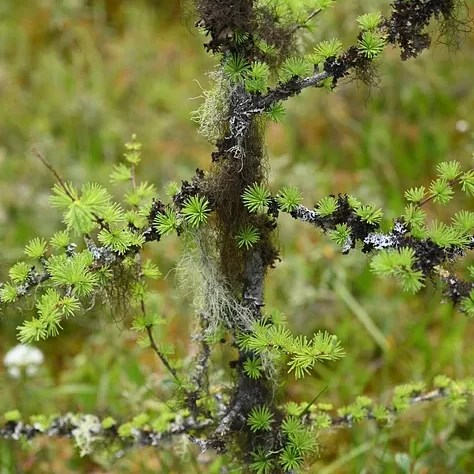
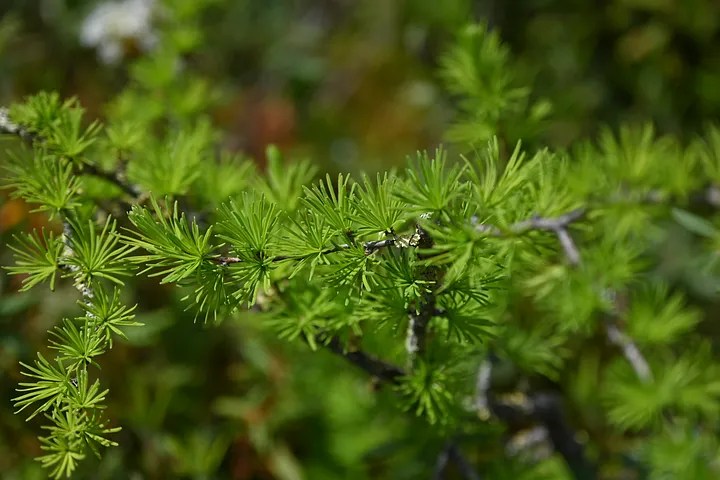
Tamarack, tamarack close up with mosses and lichens, and a barren black spruce trunk
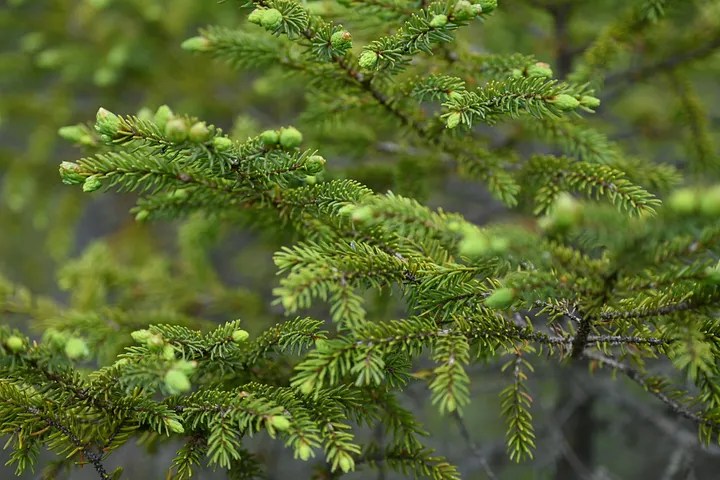
Left: tamarack, right: black spruce
A lone black spruce, tall with a lollipop top. Thanks to Mae for this photo.
I’m surprised any tree can sufficiently anchor itself in the springy bed of moss, but black spruce and tamarack both find a way. The lack of nutrients stunts their growth, though the black spruce in particular seems to dwarf its surroundings, growing tall but rather barren aside from their “lollipop” tops. They emerge from the shrubbery like street lamps in a parking lot, scattered and solitary. Their leafless trunks are perhaps due to nutrient deficiency, but also may serve the purpose of helping them avoid blowing over during high winds.
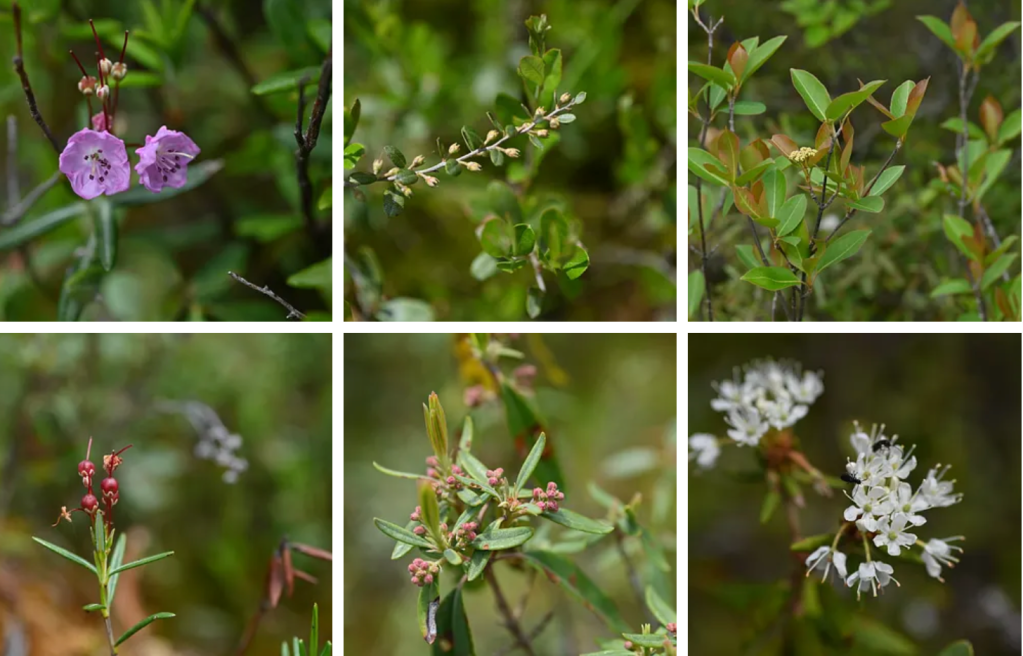
From left to right, top to bottom: swamp laurel, leatherleaf, northern wild raisin, swamp laurel, sheep laurel, bog labrador tea
Most of the shrubs in both the Black Spruce Bog and the Dwarf Shrub Bog are in the heath family, which are largely evergreen: producing leaves once takes far less energy than doing so annually. Plants in this family are adapted to acidic conditions and are among the few species that grow well here. Leatherleaf, sheep laurel, and bog labrador tea are just a few of the ones I found.
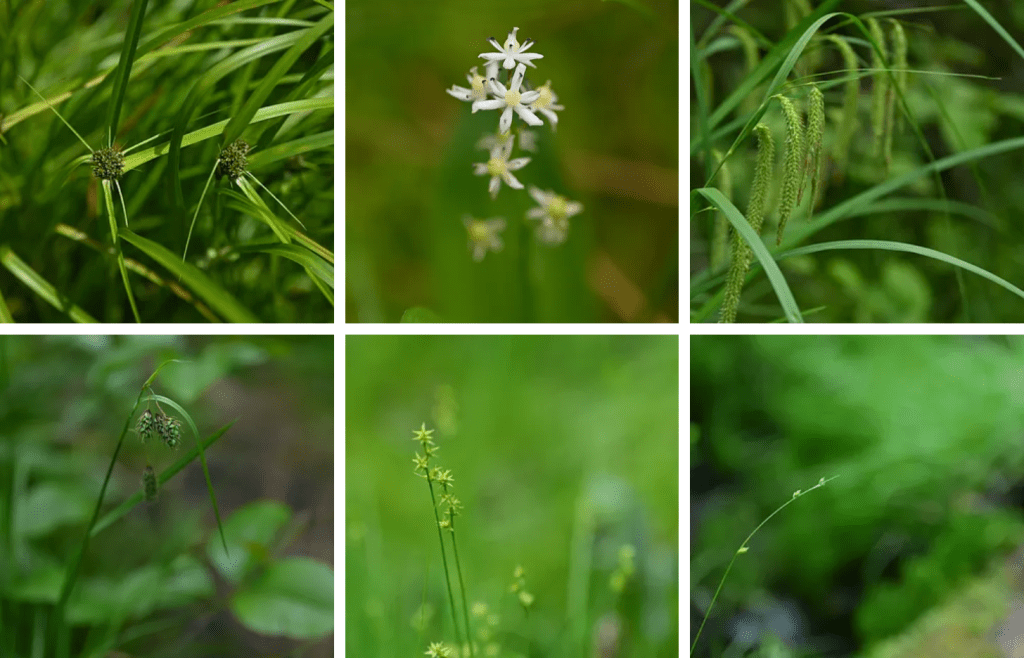
Left to right, top to bottom: a bulrush, three-leaved falso solomon’s seal, fringed sedge, tall bog sedge, star sedge, and either two- or three-seeded sedge
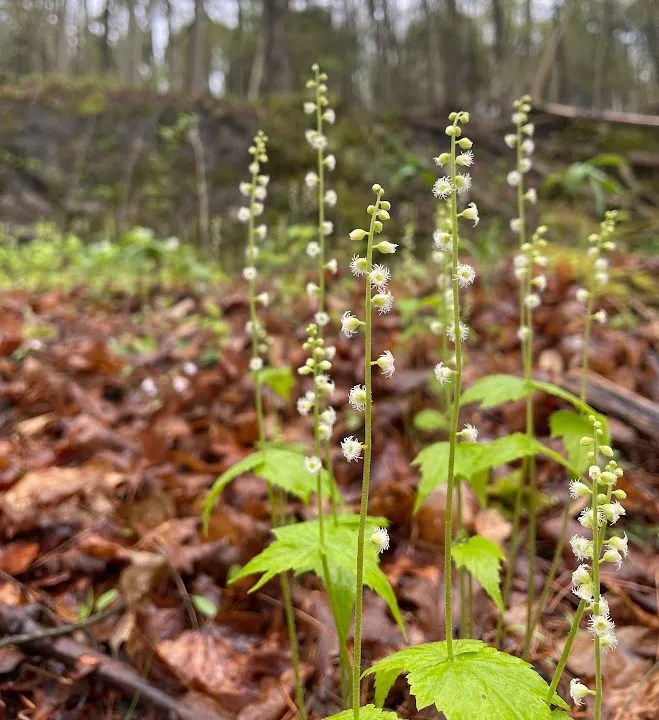
Closer to the sphagnum I spot the petite, delicate white flowers of three-leaved false Solomon’s seal, several sedge species, and the tiny round leaves of the vine-like creeping snowberry. I look for sundew, another carnivorous plant common in Vermont’s bogs, but don’t spot any. Thankfully I’d be visiting two more bogs in the coming weeks and would find some there.
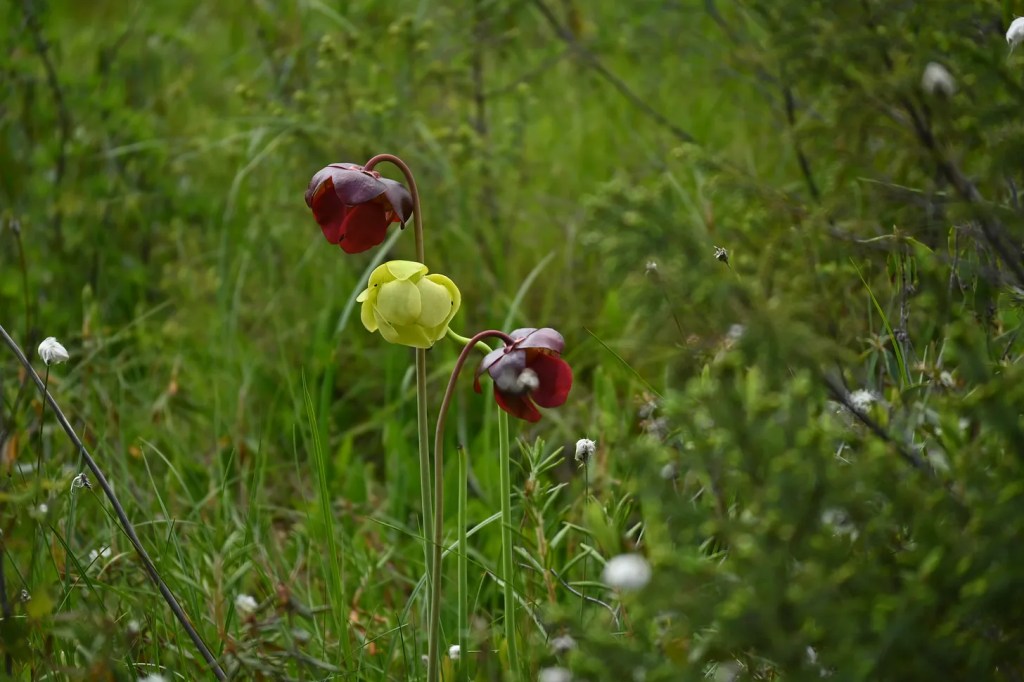
I wonder what makes this pitcher plant flower yellow?
Close up of the bright yellow pitcher plant flower
Kim & Mae enjoying the bog
I wander and photograph and wander some more, apart from my friends now but happy to hear them laughing a little ways off. I see butterflies and dragonflies and one pitcher plant flower that is bright yellow rather than the usual red. I am humbled by this place. I feel alive in a way that is both invigorating and nostalgic; perhaps the bog’s ancient spirit has touched my own.
My friends call me over to watch a tiger swallowtail meander lazily through the sun-soaked bog. I feel calm as I watch the elegant creature drift and flutter, swoop and cruise. She is in no hurry.
Luckily, neither are we.
If you are considering a visit to Peacham Bog, I highly recommend stopping into the Groton Nature Center. Not only is this where the trail begins, but the wonderful interpreter there was able to give me detailed information about the bog, plant life, and trail conditions (shoutout to Brian!). The center also features an array of beautiful exhibits ranging from glacial history to bog species. Well worth a visit.
This weekend marked the bittersweet conclusion to my year in the Vermont Master Naturalist (VMN) program. Our cohort has come together for five field days in Burlington, learning to read the “layer cake” of Vermont’s landscape, from bedrock to birds. Each field day made me feel more connected to this place that I am lucky to call home.
We began with bedrock geology, to understand the foundation of our region, which was then followed by glacial geology, where we explored the imprint left by the last glacial maximum, when New England lay beneath a mile of ice. Next came winter tree ID and wildlife tracking, then cultural geography, examining how humans have shaped and used the land over time.
I’m a Vermont Master Naturalist now — woohoo!
For our final gathering, we met in the woods for wildflowers and graduation festivities. Wildflowers are a perfect topic to end this course on, as their story ties together all of the layers of the cake that we’ve studied – both ecological and cultural. Their presence here in the Champlain Valley is rooted in ancient history, in the bedrock story we learned on day one. And their absence in places where they once thrived tells a more recent story—one of development and overharvesting, which have erased these blooms from parts of our landscape.
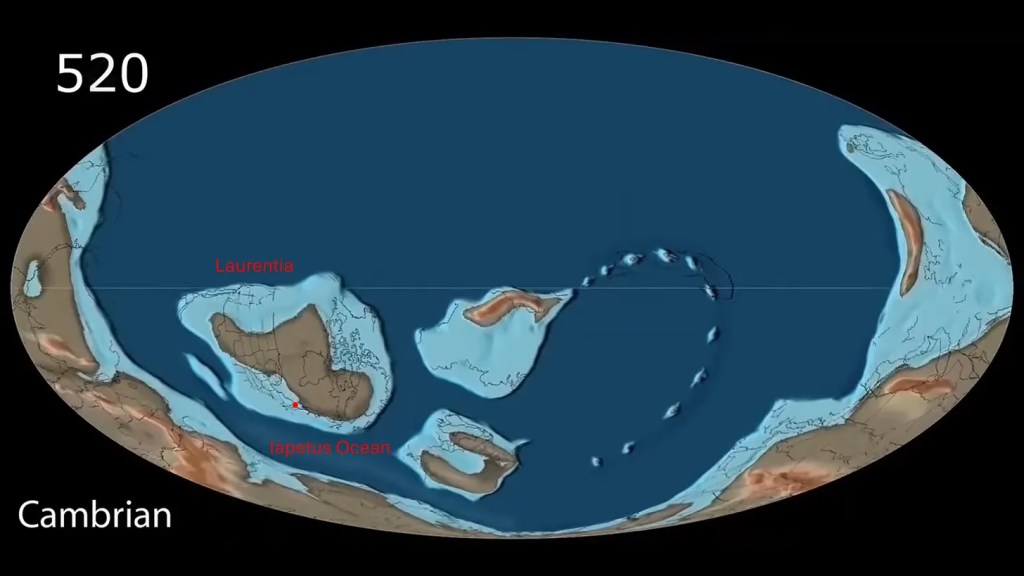
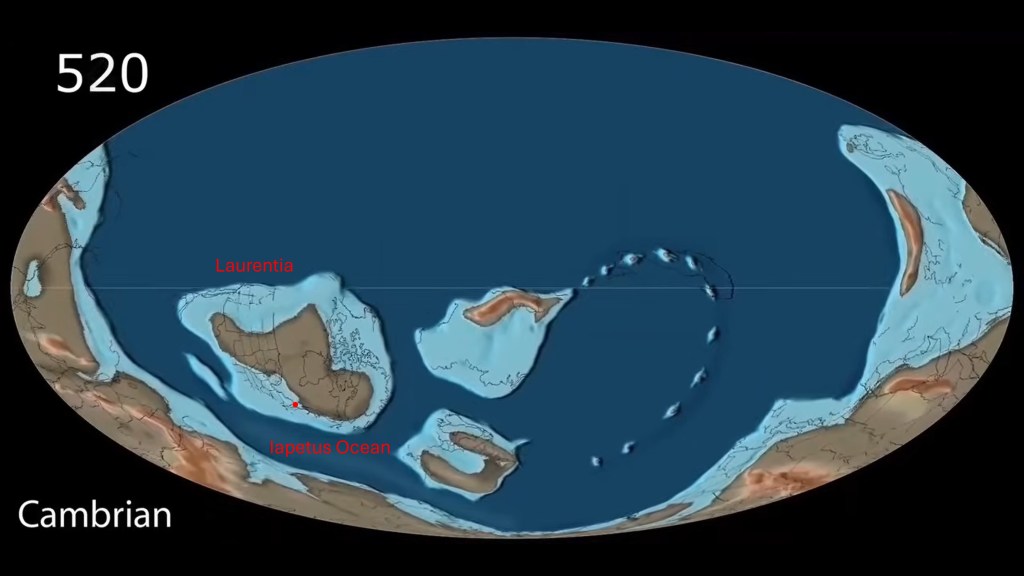
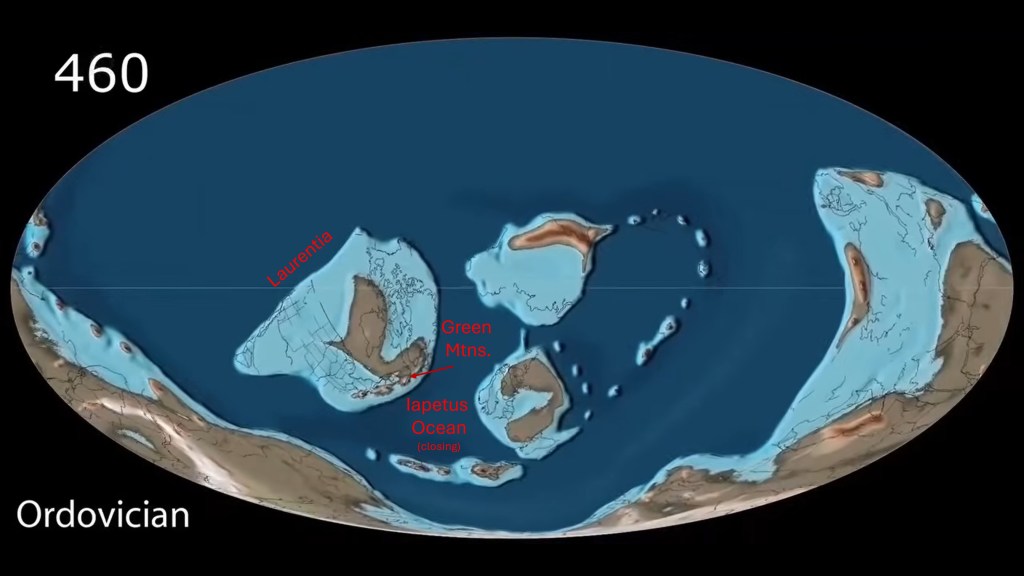
Our wildflower story begins 500 million years ago, when what would become Vermont lay below the equator, at the bottom of the Iapetus Ocean (which was named for Iapetus, the father of Atlantis, as this ocean was the precursor to the Atlantic that we know today). This was long before humans or flowering plants were in the picture, but the planet was teeming with marine life. Over time, as sea creatures with calcium rich bodies died, they settled at the bottom of the Iapetus and lithified – turned to stone.
About 500 million years ago, Vermont (the red dot) lay at the bottom of the Iapetus Ocean, on the ancient continent of Laurentia (what later becomes North America). This is an annotated screen shot from this plate tectonics animation.
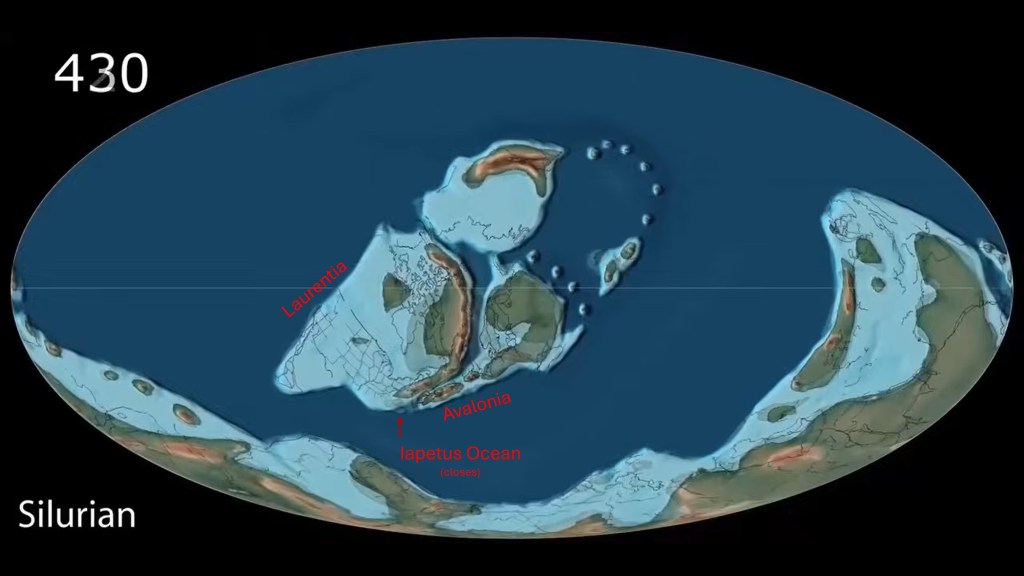
Fast forward about 50 million years, and the calcium-rich rock from the bottom of the ancient ocean was thrust up high when continents collided as the Iapetus closed (think of it like a multi-car pileup, but with tectonic plates). This event is called the Taconic Orogeny – it’s when the Green Mountains formed.
Today, we have strips of calcium-rich bedrock in Vermont thanks to the ancient ocean (see anything blue in the map below). In places where the glaciers did not bury the bedrock too deeply in sand (a story for another post!), calcium-loving plants, like our spring wildflowers, thrive in rich soils.
Ecological classifications of Vermont’s bedrock. Figure 2 from Wetland, Woodland, Wildland. What’s important? Blue = calcium = wildflowers.
We call many of these wildflowers “ephemerals,” because they bloom briefly right now, while sunshine can reach the forest floor, before the trees leaf out. By the time the summer solstice comes around, many of these flowers will already have disappeared without a trace, storing energy underground (e.g., in rhizomes or corms) so they’re ready to pop up again first thing next spring.
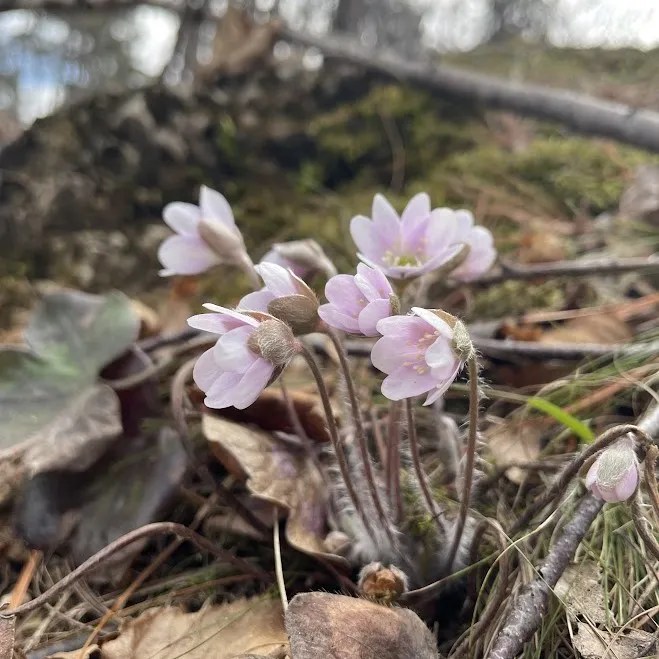
Some of our calcium-loving spring wildflowers in Vermont: hepatica, blood root, dutchman’s breeches, bishop’s cap, jack-in-the-pulpit, red columbine, largeflower bellwort, red trillium, trout lily.
After a beautiful day of admiring wildflowers, we gathered in a circle for one last time to close out the program. Going around, one-by-one, we shared favorite moments and takeaways from the program. Fellow naturalist, Lena, shared their reflection about the connection between ancient history and ephemeral flowers – the amazing duality that something so fleeting comes from something so incredibly old.
I’ve been ruminating on this idea since – how I already loved wildflowers, but now, thanks to VMN, I see them not only as beautiful and fleeting, but also as rooted in a story that is much older and bigger than all of us. That’s so humbling. This program deepened my sense of connection to Vermont, wonder about the world, and responsibility to protect it.
We then closed the day with a sweet treat… layer cake, of course.
To my Vermont friends out there, I can’t emphasize enough how amazing the Vermont Master Naturalist program is and how much everyone should do it. Reach out to me if you have questions about it!
Have you ever heard the shrill cries of spring peepers on a warm April night? Or the bizarre quacks of wood frogs, resounding deep in the forest?
I remember the first time I heard them. I was walking a trail at Missisquoi Wildlife Refuge several years ago and thought I heard ducks in the distance. I followed the sound, but every time I got close, the quacking dissipated and began again further away. Not one to shrug off a mystery, I followed the sounds for nearly an hour, at one point convinced there must be a secret duck oasis hidden among the brambles. I wasn’t far off– except the “ducks” were actually wood frogs, the “oasis” a massive vernal pool.
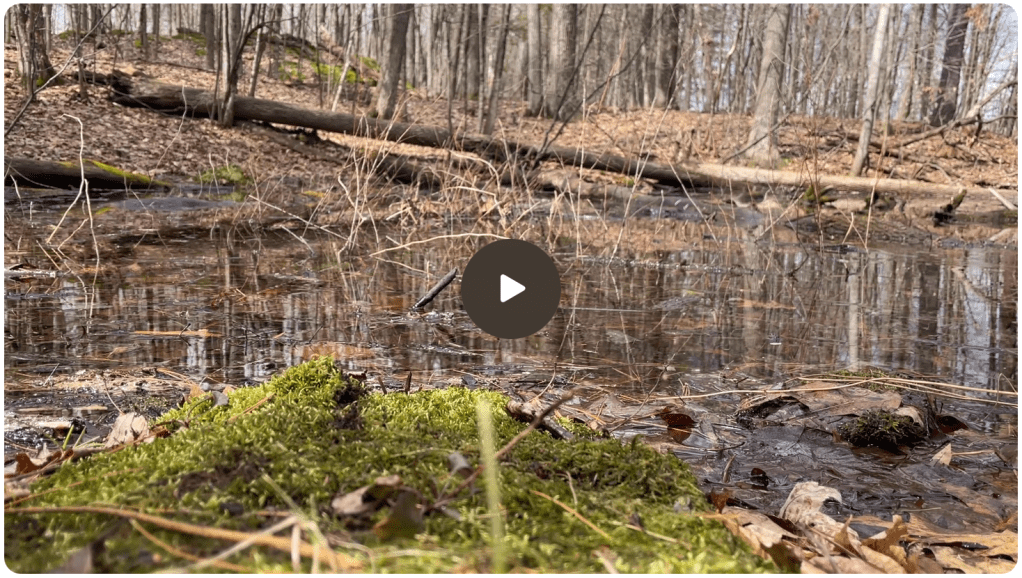
Vernal pools are seasonal accumulations of water caused by spring rain and snowmelt. They provide essential habitat to breeding amphibians, many of which return to the same pool year after year to mate and lay eggs. Spotted salamanders, jefferson salamanders, blue-spotted salamanders, wood frogs and spring peepers are just some of the pool-dwellers you might see. Look closer, and you’ll find tinier inhabitants: fairy shrimp, diving beetles, water striders, and many other invertebrates. It’s easy to understand why these temporary wetlands are considered natural communities; they are miniature worlds unto themselves.
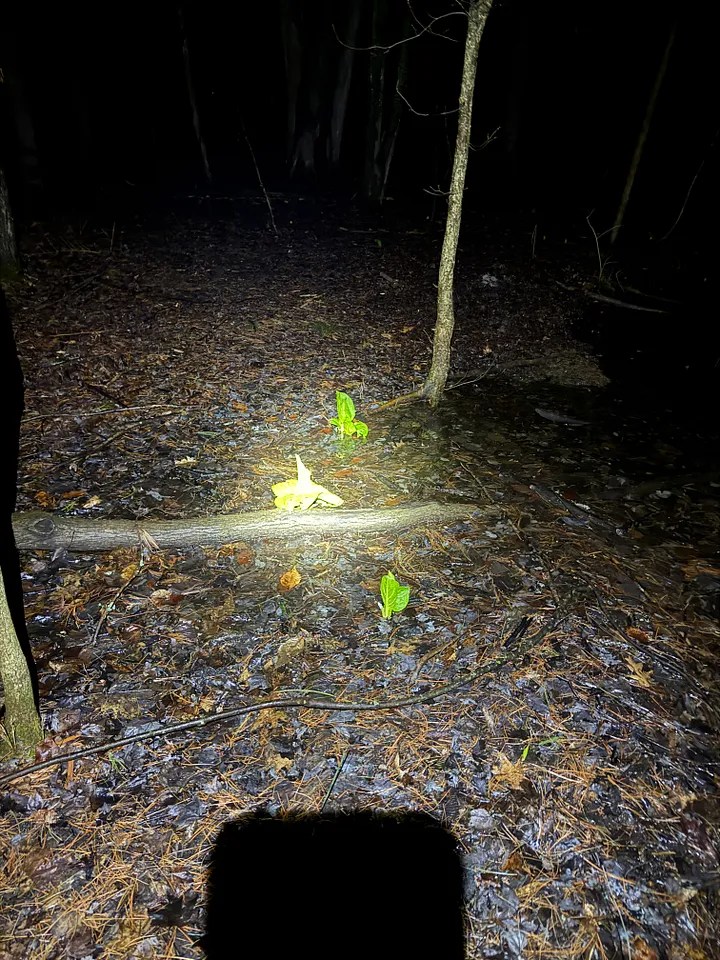
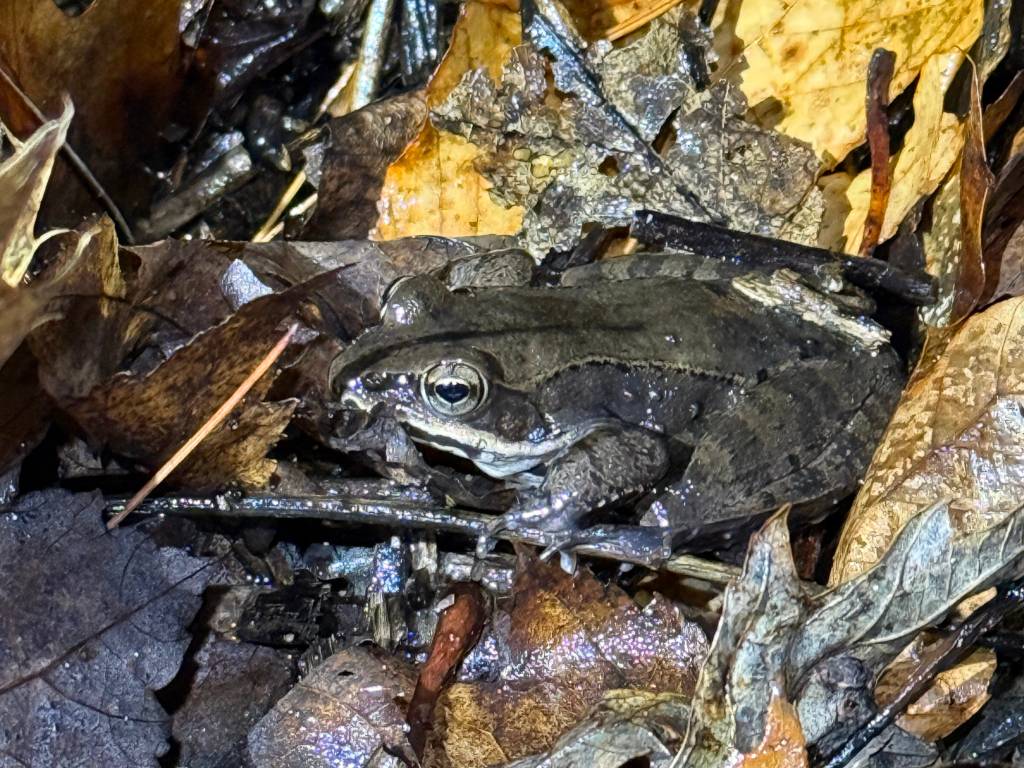
a wood frog hovering in the vernal pool, skunk cabbage
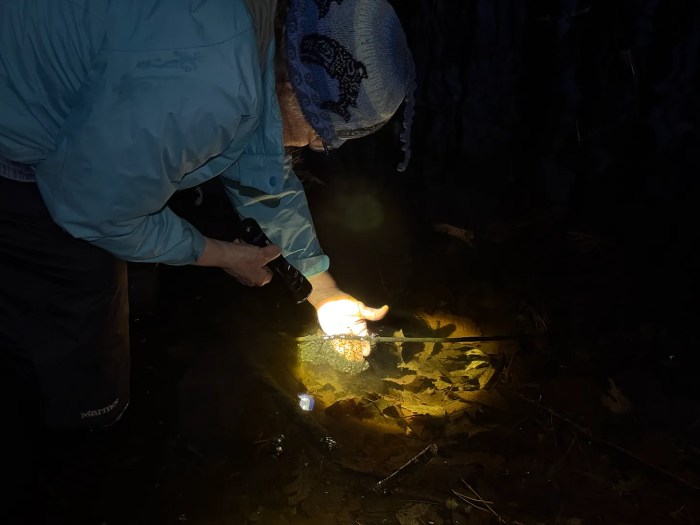
Last night I visited one of these pools. Accompanied by my friend Alicia and a couple other amphibian enthusiasts, we arrived just past sunset and made our way into the woods. It had rained all day, and I hoped the wet, warm environment would mean lots of activity surrounding the pool.
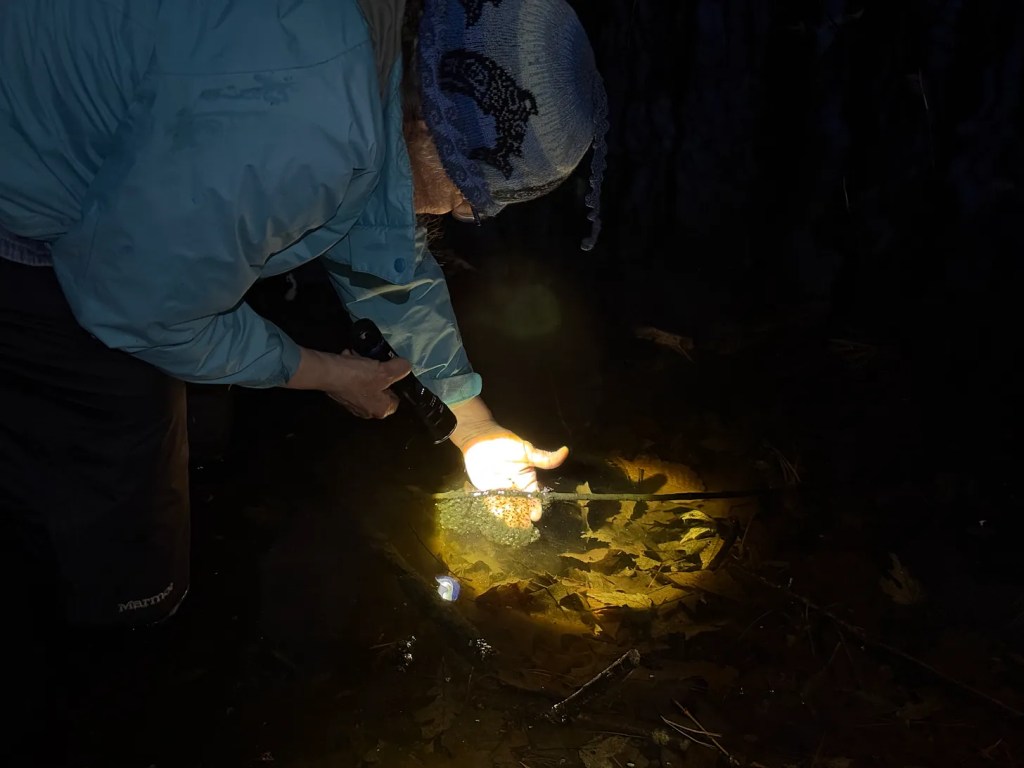
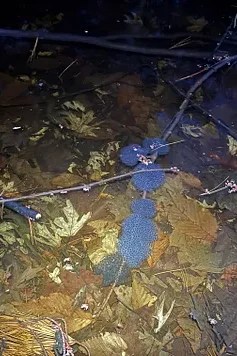
The woods were silent, a bad sign for us frog-seekers. We proceeded to the pool’s edge nonetheless, illuminating the placid water with our flashlights. Skunk cabbage and dead branches interrupted the glassy surface but nothing moved; the damp, mute air hung around us like a fog. We maneuvered around tangled shrubs and fallen logs, each of us stopping occasionally to peer into the shallow basin. Alicia spotted a single clutch of frog eggs, and on closer inspection informed us they were nearly fully formed tadpoles. It was beginning to look like we’d missed our ticket to the amphibian nightclub.
Alicia inspecting the eggs
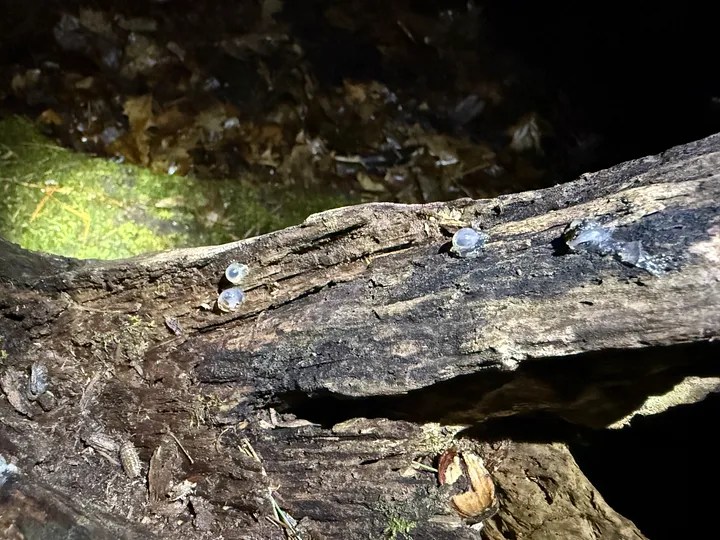
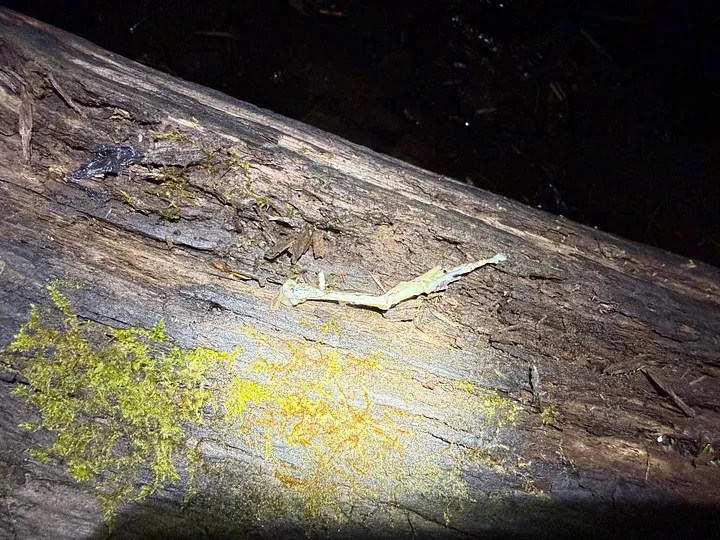
I ventured out on a wobbly tree trunk, hoping the deeper part of the pool would reveal its secrets to me. I noticed frog eggs smeared along the log, signs a predator of some kind (probably a bird) had enjoyed an easy, protein-rich meal. Nearby, another tasty treat: a munched-on frog leg floating just beneath the surface.
caviar et cuisses de grenouille, or, frog eggs & a frog leg
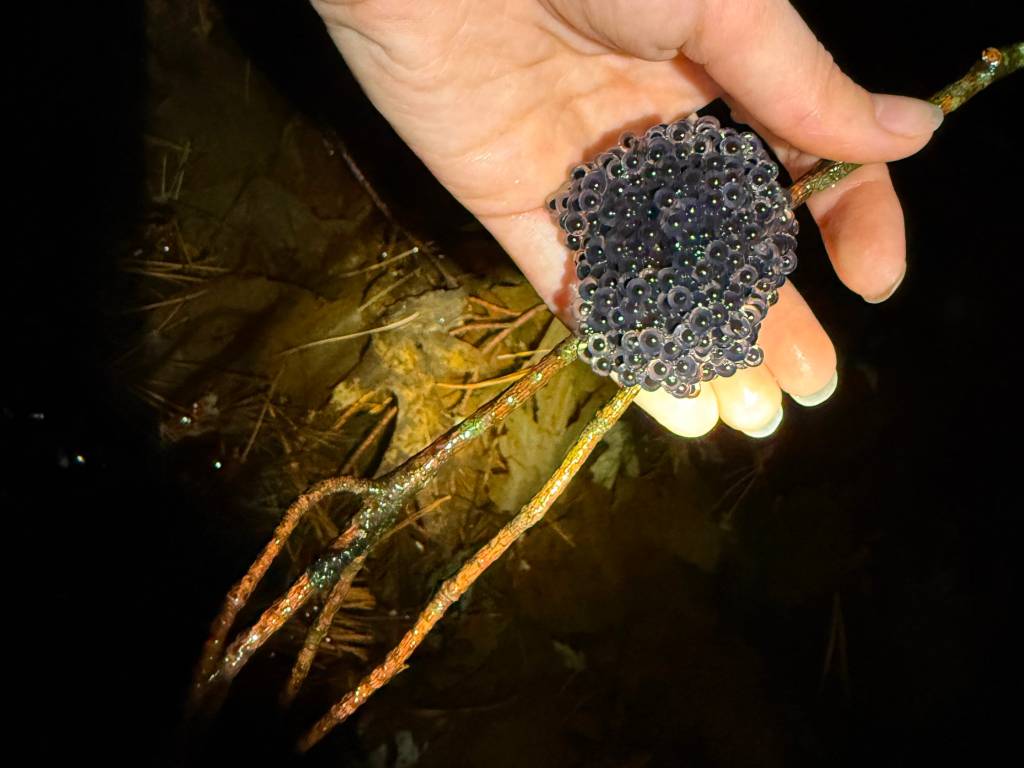
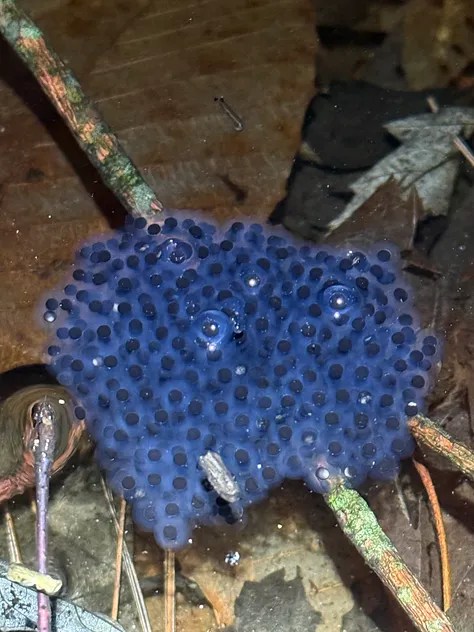
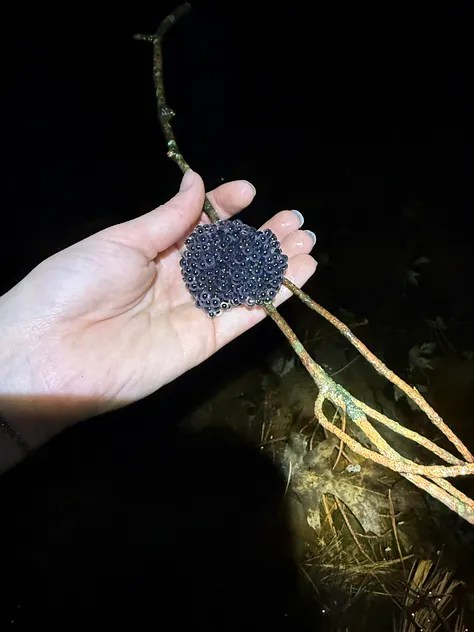
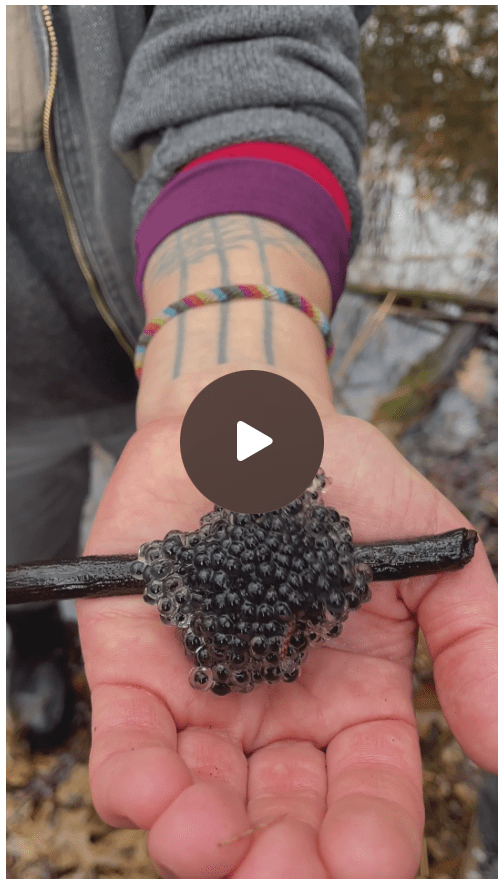
I continued along the edge of the pool, leaving the others to marvel over a graceful diving beetle they’d spotted. I saw a couple wood frogs, a fairy shrimp, the fuzzy white fiddleheads of a cinnamon fern poking out of the leaf litter. And eventually– the motherlode. Just a foot from the pool’s edge, I spotted a fresh cluster of frog eggs, and as I glanced around, I saw that every branch within ten feet had multiple egg bundles clinging to it. I scooped up the nearest clutch, the jelly-like egg sacs trembling in my palm. Small orbs containing the possibility of life. They clung firmly together, the embryos reflecting the light of my headlamp. I wondered how many would survive, and how many would instead provide nourishment to some other creature. I wanted to kiss them. Instead, I silently wished them well before returning them to the black water.
the motherlode
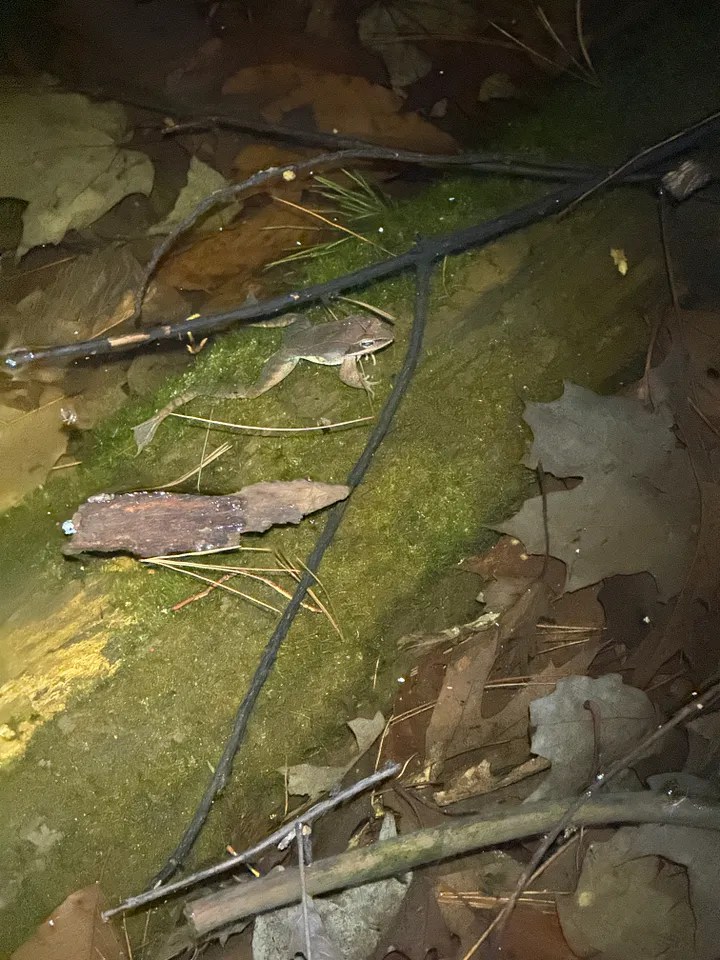
Alicia, Heather and I picked our way along the muddy bank. We spotted a wood frog resting among the leaves and sat down next to it, commenting on the frog’s white lips and adorable little face.
Then, an interruption— a single wood frog quacked, as if to join our conversation. We went silent. Slowly, more frogs began to join the first brave soloist: a handful, a dozen, then the whole pool coming alive around us.
We turned our lights off and sat enraptured as the chorus echoed through the dark, still woods.
The chattering steadily intensified, individual quacks growing closer and closer to us. Minutes passed. I thought about this sound, these frogs, what being here at this moment meant to me.
Ever since that first mysterious encounter at Missisquoi, I think of frog songs as a harbinger of spring. Each year I anticipate the first rainy, warm night when I can go help amphibians cross the road– an act of service, sure, but also an opportunity to touch the wet alien bodies of spotted salamanders. The deafening cries of spring peepers signal to me that ephemerals will soon emerge from the leaf litter, and Osprey will return to their nests.
a wood frog— note the white lips and adorable face
Witnessing these phenological events connects me to my animal body. Last night, as the watery chattering of the frogs washed over me, I realized these seasonal markers have become my self-recognized holidays, my own freshly hewn traditions. This year I will kayak beneath nesting herons and drive to see showy lady’s slippers. I will watch my porch fill with boxelder bugs and hear a pair of loons calling at sunset. The snow geese will return to dead creek. I’ll make my yearly pilgrimage to a trail that briefly fills with mushrooms and I’ll smell the bewitching scent of freshly fallen leaves beginning to decay. The first snowfall, the return of short-eared owls, bald eagles hunting on the ice. All the meaningful landmarks that make up a year.
A little splash sounded a few feet away from us and the frog song began to dissipate. My eyes had adjusted to the dark and I turned around to grin at the two women sharing this moment with me. I wondered if they were feeling the same indescribable emotion I was. Only a few frogs sung now, their final notes reverberating through the night air. Then as quickly as it had begun, the chorus ceased.
“How can anyone think of doing anything else this time of year?” Alicia whispered.
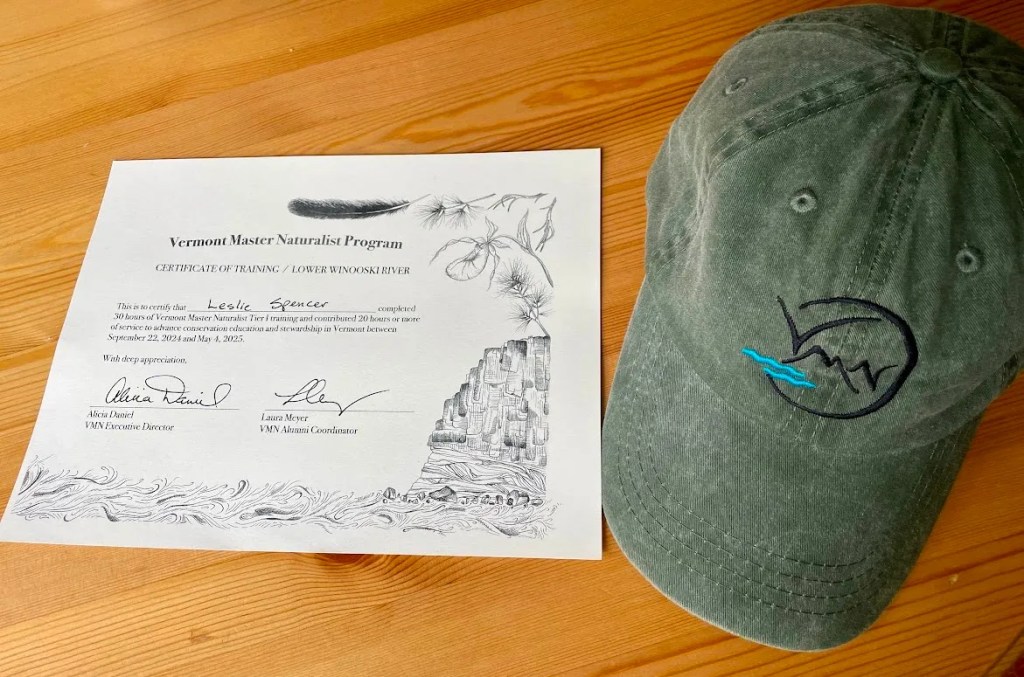
By Leslie Spencer, VMN Lower Winooski participant 2024
As spring unfolds before our eyes, there is so much for us to tune into—moments of joy amidst the State Of The World. This week, it’s frogs, flowers, and BEES! Tuning into these happenings in the natural world gives me renewed energy to tackle what’s ahead.
This weekend, I had the pleasure, for the second to last time, to gather with my Vermont Master Naturalist cohort to learn about cultural geography in Vermont from Sam Ford. Think, quarries, barns, ancient land laws, etc. More on that later!
We made our way around Burlington, learning about hidden cultural stories on the landscape. And, as a group of twenty-some curious naturalists, we can never focus on one thing for too long. There is so much to pay attention to!
On our way to visit an abandoned quarry in Arms Forest – once an important source of building materials for our area and beyond – we couldn’t help but ask each other, “What’s that sound?” We could hear a white noise in the distance, neither the hum of cars on the beltline nor the chorus of spring peepers. What could it be?
On our way back to the cars after the quarry visit, we wandered off the trail to a vernal pool – temporary, shallow pools that appear in the woods in the spring that serve as essential breeding sites for amphibians. As we approached the pool, the sound grew louder and louder, and our gaggle of chatty naturalists grew quieter and quieter.
Behold, the song of wood frogs:
I crouched on a mossy log, took a few deep breaths, and started to lose track of time—until my bliss was interrupted by the sound of oohing and aahing off to the right. A friend in tall boots had ventured into the pool to scoop up some eggs for us to see up close.
More bliss. Behold, fresh wood frog eggs:
If jiggling a bunch of frog eggs does not ignite your child-like sense of wonder, I do not know what will.
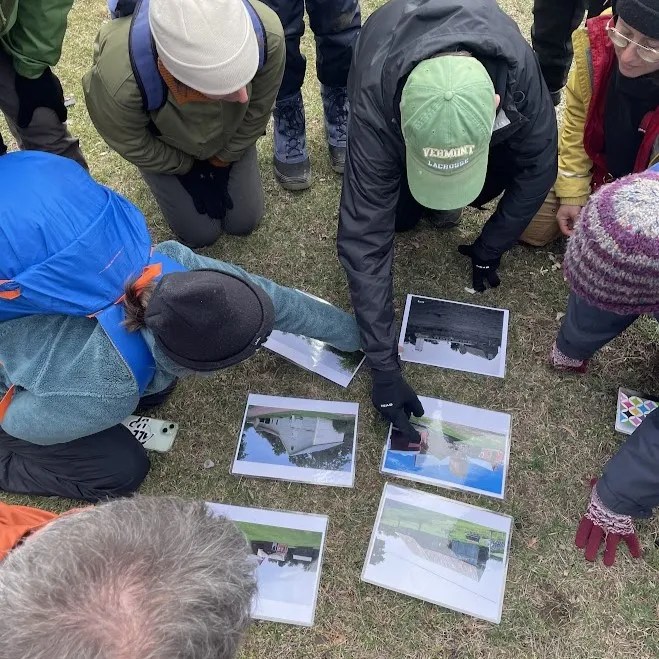
Later, we made our way across North Ave to Ethan Allen Park to learn more about the cultural history of Burlington. We started with an activity: given six photos of Vermont barns, we had to line them up from oldest to newest (a lesson on barn history followed). Feeling very out of my element, I opted to take the below photo of my team doing their darndest to accomplish the task at hand:
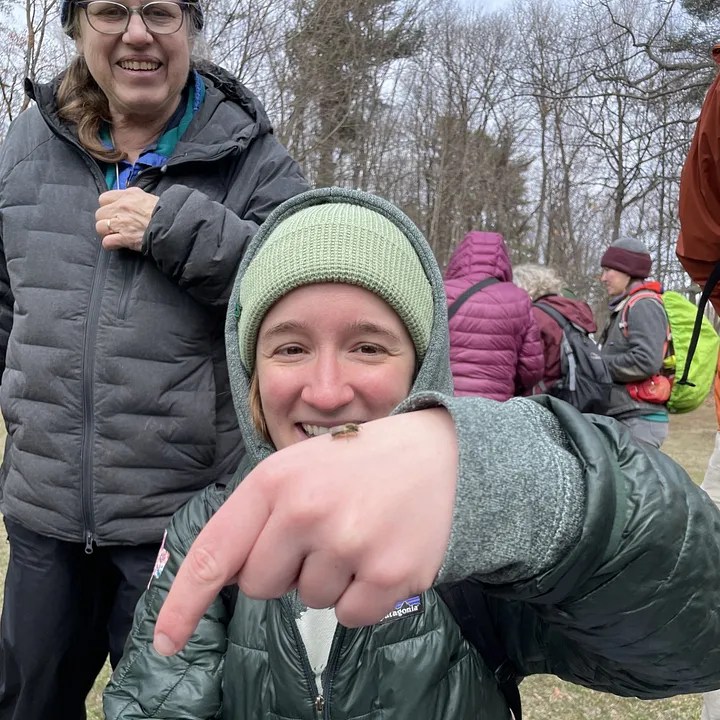
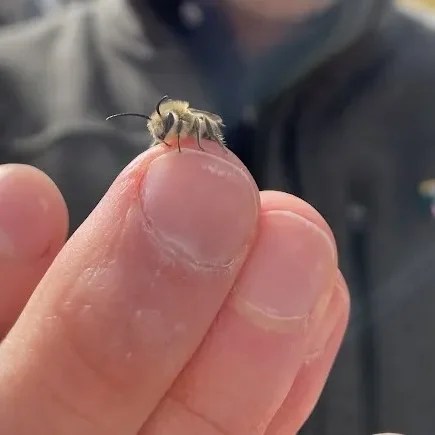
As if the frog song and jiggly eggs weren’t enough spring magic for one day, despite still being bundled in puffy coats and knit hats, the first bee of the season appeared. It landed right on one of our barn handouts. Impromptu bee lesson time! It was a male cellophane bee – typically the first bee species to emerge in Vermont each year, a true harbinger of spring. Always a joy-filled moment to know they’re back.
Left: Impromptu bee lesson time! A male cellophane bee (Colletes inaequalis) is perched on my hand. Thanks Lena for capturing this show and tell moment! Right: An up-close shot of the same kind of bee, this time, last spring.
Following the barn activity, up the hill we went, to learn about the local dolostone that went into building the tower at the high point of the park. Just below the tower we stumbled upon a cluster of hepaticas – other than skunk cabbage, the first wildflowers of the season.
Already high on the joy of wood frogs and cellophane bees, the hepaticas served as the cherry on top of a day of early spring magic. A “big dopamine hit,” as my friend Nick would say.
Round-lobed hepaticas (Hepatica americana) emerging just downhill of the Ethan Allen Park tower. Aren’t they perfect?
This is now my third spring in Burlington, and I’ve been finding so much joy and comfort in learning the rhythms of the season’s return. Each year, I’m getting better at knowing how—and where—to look for signs of hope.
It feels like a gift to witness so much spring magic within the urban wilds of our city—frog song from vernal pools, native bees emerging, ephemeral wildflowers blooming. As I mentioned in my last post, spotting familiar flowers in Colorado last week felt like a comfort and also a push of energy in an unfamiliar moment.
All photos by Leslie Spencer unless otherwise noted.
By Leslie Spencer, VMN Lower Winooski participant 2024
An Immense World
Lately, I’ve been reading An Immense World by Ed Yong. It’s been a refreshing antidote to doomscrolling about whatever he-who-shall-not-be-named is up to today. Every page of his book draws you deeper into mesmerizing stories about non-human perception, revealing how astonishingly diverse sensory experiences can be across the animal kingdom.
We humans rely on five senses—sight, hearing, smell, taste, and touch—to navigate the world. These senses shape where we feel safe, how we determine what’s edible, and more. We just never really think about it that way. Yong challenges us to step outside of our sensory bubble to imagine the world through the experiences of other creatures.
Did you know that butterflies taste with their feet? That mallard ducks have a 360-degree field of vision? That catfish are essentially swimming tongues with taste receptors all over their bodies? Or that flowers reveal hidden patterns visible to bees but invisible to us?
Page after page, Yong illustrates how each animal has its own sensory world—its umwelt (or umwelten, plural)—often existing beyond our human comprehension.
Tuning into the umwelten around me today
One of Yong’s key points is that animals aren’t deficient for lacking senses we have—they’ve simply evolved to perceive the world in ways that meet their own unique needs. Take bees, for example: they can’t see red the way we do, but they can see ultraviolet light. For bees, this reveals unique patterns on flower petals, invisible to us, that guide them to nectar, which is sugar that provides them with the energy to fly.
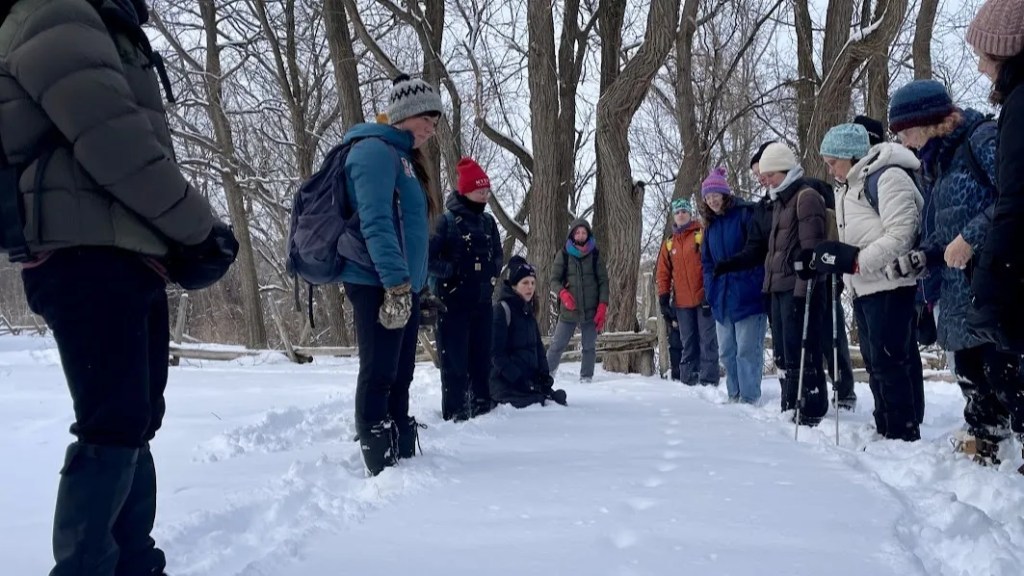
Today, I had the chance to tune into the umwelten of the creatures I share the city of Burlington with. As part of the Vermont Master Naturalist program, I joined Alicia Daniel and Sophie Mazowita for a winter field day focused on wildlife tracking and tree identification.
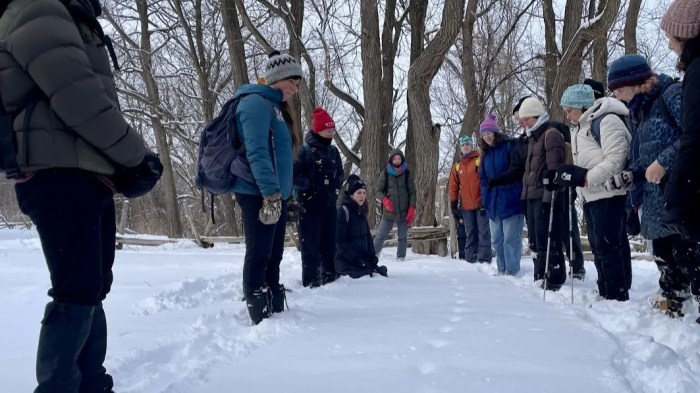
We couldn’t have asked for better conditions. A few inches of fresh powder fell overnight, with the snow tapering off just before sunrise. Around 10am, under a gorgeous bluebird sky, Burlington was shimmering as bits of snow gently blew loose from the treetops. We set out into the woods at Leddy Park, and later Ethan Allen Homestead, eager to see which creatures had left tracks for us to find in the fresh snow over the past few hours.
Never write off a squirrel
About twenty feet from our morning rendezvous point, we stumbled upon our first set of tracks. (Pro tip: don’t join a group of curious naturalists if you’re hoping to cover a lot of ground quickly…)
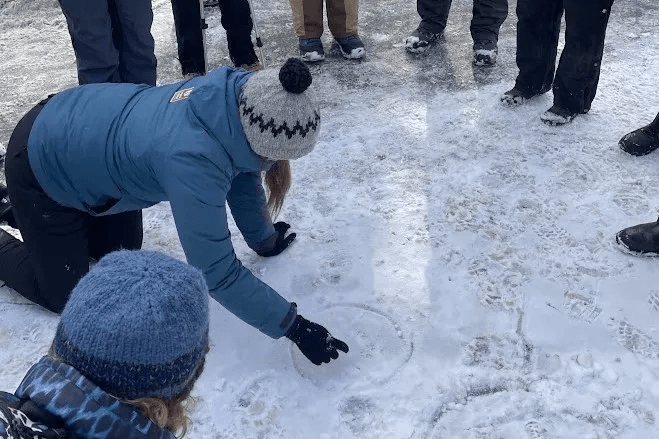
Sophie encouraged us to start by observing the tracks—taking note of their size, shape, and orientation—before interpreting them: What direction was the animal moving? Which species could it be? She explained how cultivating sharp observation skills and staying open-minded is crucial to decoding animal tracks in the snow.
These particular tracks revealed a bounding (i.e., leaping) pattern, with two telltale pairs of prints (the front and hind feet). The size of the prints and the trails connecting tree to tree pointed us to an eastern gray squirrel, bounding through the fresh snow in the past few hours.
Sophie Mazowita pointing out fresh tracks from an eastern gray squirrel.
We learned how slight differences could tell different stories: smaller but similar tracks would belong to a red squirrel, while a subtle shift in the orientation of the feet might signal prints of a flying squirrel.
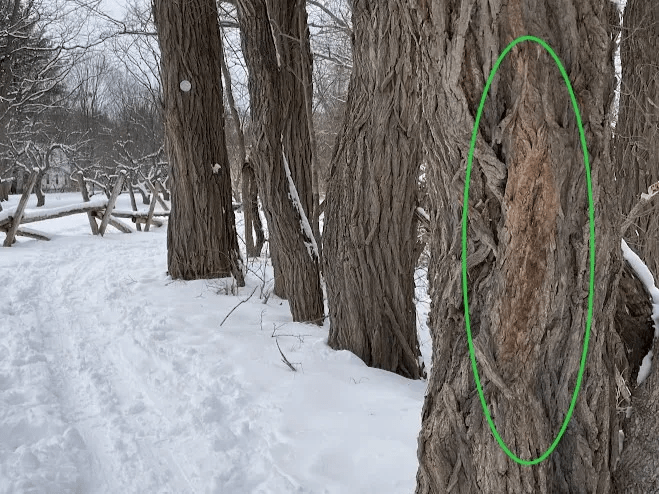
Tracking isn’t just about footprints. Animals leave all kinds of signs of their movements if we tune into their umwelt, not ours. Sophie showed us “squirrel stripes” on the base of some trees—spots where squirrels chew on the bark and rub their cheek glands, leaving scent messages for each other. It’s like the “coffee shop bulletin board” for squirrels, Sophie said.
I’ll never dismiss a squirrel as ordinary again—learning how they navigate the world invites us to step outside our human-centric sensory bubble.
A squirrel stripe on a black locust trunk at Ethan Allen Homestead.
A springtail surprise
In addition to observing tracks and other signs of wildlife, sometimes looking closer—literally—can reveal stories in the winter woods.
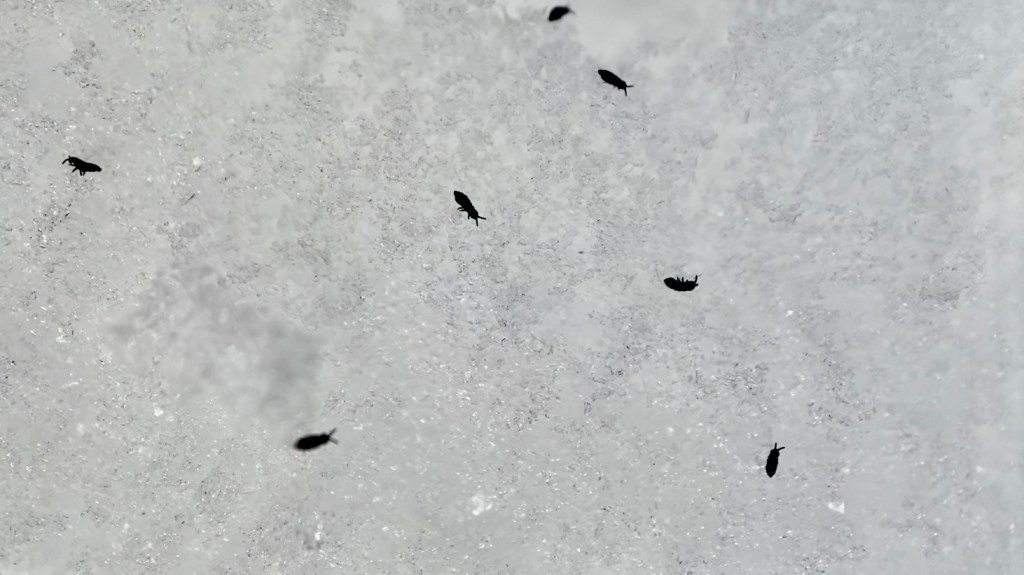
Take snow fleas, for example. These tiny creatures are often overlooked unless you use magnification. Unlike the parasitic fleas you might be familiar with, these harmless arthropods—also known as springtails—hop around in the snow on warm winter days. They live in the soil and emerge into the snow, often found clustered within animal tracks.
Snow fleas with my hand for scale. Do you see the tiny black dots?
A special shoutout to my friend Braden DeForge, who captured them with his iPhone macro lens:
Not only mammals leave tracks
It may seem obvious, but we were caught off guard today: not only mammals leave tracks. When tracking animals, following a set of prints for a while can help you gather more clues about who made them.
We were following a trail of prints through the woods at Leddy Park when we hit a dead end—literally. The tracks just disappeared at both ends of the trail. How could that be?
Birds!
It’s easy to forget that our umwelt is biased toward creatures that walk on the ground—not those that fly.
One end of the trail we were following led to two distinct arched prints. At first, we were stumped. Whose feet could make tracks like that?
Then, it clicked—wings! Not all prints in the snow are feet, that’s a human-centric assumption.
We’d stumbled upon evidence of a bird, likely a crow, swooping down to the forest floor, perhaps searching for a snack beneath the fresh snow.
Once again, tracking the creatures around invites us into another sensory realm and provides a humbling reminder that we are not the only ones using these woods.
Note the curved prints where the bird landed in the snow. Then it pivoted 90-degrees and walked on the forest floor until it took off again.
The drizzle castle tree
To weave together winter tree identification with tracking, Alicia gave us homework for today’s field day. Each person was assigned to a tree and asked to look up a few facts about it, to be ready to share about the tree we came across it in the woods.
Hackberry was a new tree for me today. It’s one of those things that once you know what it is, you begin to see it everywhere. It has a very distinctive bark, described scientifically as having “wart-like protuberances.” Other, more pleasant descriptors our group came up with included the bark’s resemblance to 1) the Badlands National Park and 2) a drizzle sand castle.
One of my fellow naturalists is from South Dakota, so the Badlands thing totally worked for them. Having grown up playing in the sand on New England beaches, drizzle castles really hit home, and I will now never forget hackberry—the drizzle castle tree.
A friendly reminder that even as humans with the same five senses, we all have different, and perfectly valid experiences and perceptions of the world around us.
Hackberry, Celtis occidentalis.
Who is living in my backyard?
In the summer, my morning ritual involves checking on my garden from the window at the top of the stairs. Bleary-eyed, I take in how it changes from day to day—tomatoes ripening, beans climbing their trellises, zinnias abloom—and then I scurry downstairs and out into the backyard to get a closer look. I love paying attention to how everything changes daily.
But today, after spending the day learning about winter ecology in Burlington, I realized I hadn’t been paying as much attention to the backyard lately. Covered in snow, the garden is dormant, and I had been operating under the assumption that—other than squirrels feasting at the bird feeder—not much is going on out there.
This evening as I peeled off my snow clothes and glanced out the window, I noticed something that I had not observed before. Besides the familiar squirrel tracks, there were other prints leading toward the shed. From the size and pattern, I think they belong to a cottontail rabbit bounding over to the shed looking for a cozy shelter during the snowstorm during the early hours of this morning.
I am always grateful for how this naturalist training sharpens my attention, expanding my own umwelt, to help me better appreciate the happenings in my own backyard.
All photos by Leslie Spencer unless otherwise noted.
By Leslie Spencer, VMN Lower Winooski participant 2024
Bedrock, a noun and an adjective
Today, let’s talk about bedrock — both as a noun and an adjective. Bedrock, the noun, is the solid, ancient rock under our feet, and bedrock, the adjective, speaks to our core values.
As I shared in my welcome post, Mary Oliver’s words, “attention is the beginning of devotion,” are constantly bouncing around my brain. This fall, through the Vermont Master Naturalist program, I’ve been captivated by the story of Vermont’s bedrock geology. Understanding how the land beneath our feet formed is intriguing on its own, but sharing the experience with community of naturalists who share the same core values of protecting our planet and advocating for a better world makes it even more meaningful. Learning about the layers of the earth beneath us can provide many grounding lessons.
Reflecting on bedrock feels particularly poignant today, on the heels of a week where it feels like the bedrock of American politics has been shattered. Looking toward another four years of Trump’s authoritarianism is destabilizing, and I want to share a bit about how learning about natural history helps me stay grounded. Learning about the ancient natural history of our place can teach us lessons of resilience and endurance today.
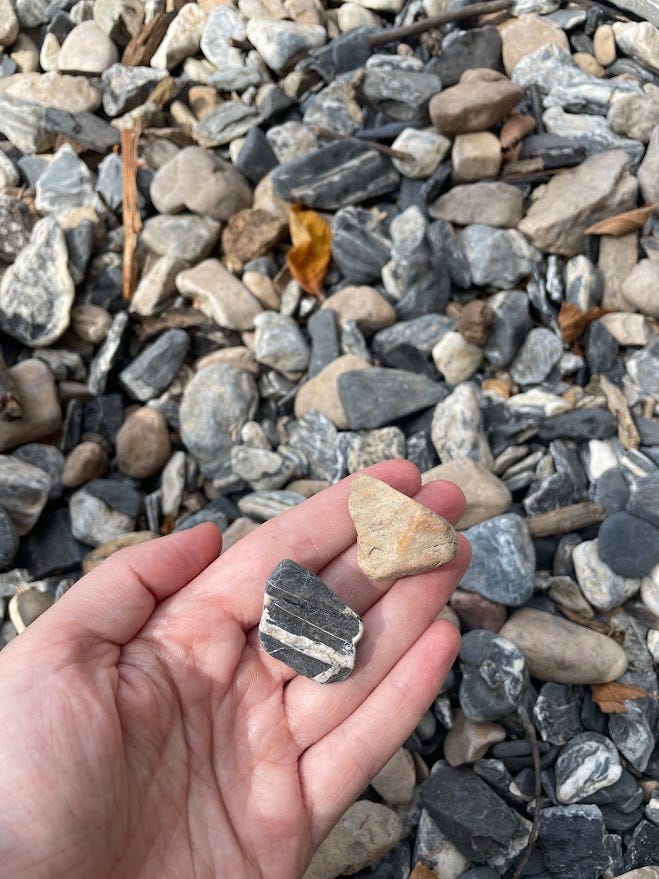
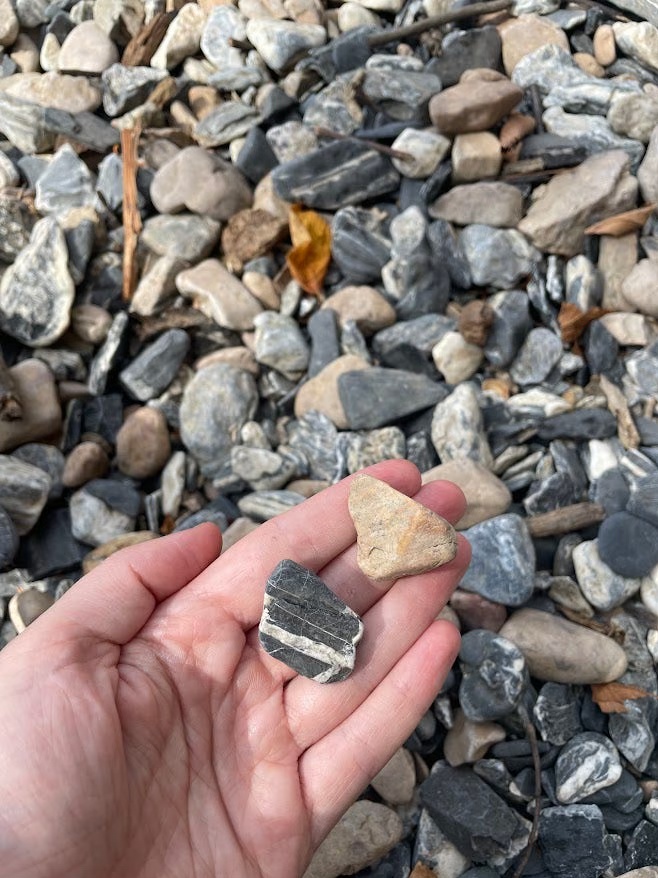
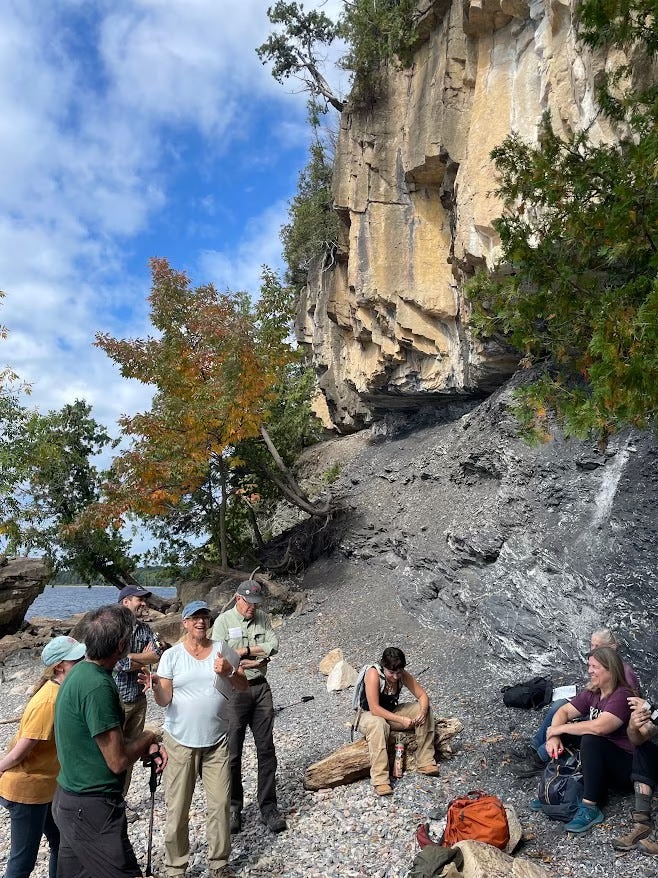
A handful of bedrock – Iberville Shale and Dunham Dolomite – at the Champlain Thrust Fault; a gathering of Vermont Master Naturalists at the Thrust Fault.
Vermont was once at the bottom of an ancient tropical ocean
Long story short: About 500 million year ago, Vermont was at the bottom of the Iapetus Ocean, a tropical sea that once stretched across the Equator. Through a dynamic geological history of tectonic plate movement, continental collisions, volcanic action, and years of erosion, present-day Vermont is made up of a stunningly diverse array of bedrock types. Mountain building events (the Taconic Orogeny and the Acadian Orogeny) essentially bulldozed paleocontinents together, folding and uplifting the floor of the ancient Iapetus Ocean into what we know as the Green Mountains today.
Dunham dolomite, for example, is one of the bedrock types that lies beneath our feet in Burlington, Vermont. It contains calcium carbonate from ancient sea creatures that lived in the Iapetus Ocean. I mean, how cool is that??!
Note: If you’re interested in a longer version of the geology story, it’s at the bottom!
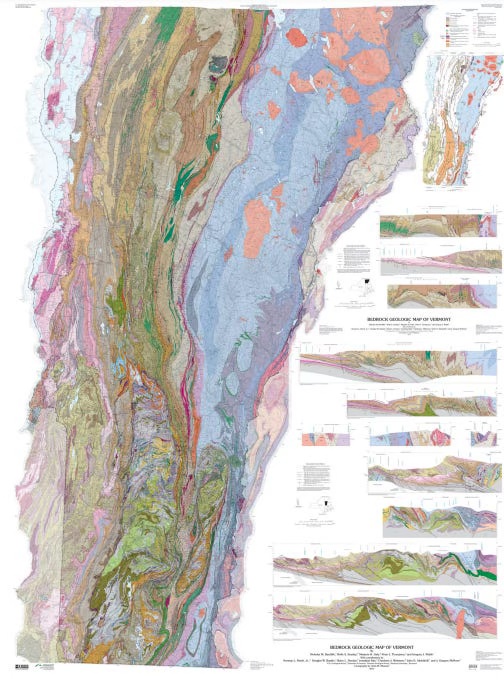
Vermont’s bedrock is a beautiful mosaic of rock types, because of a dynamic geologic past, full of millions of years of tectonic drama and mountain building events. Access a high-res version of the map here.
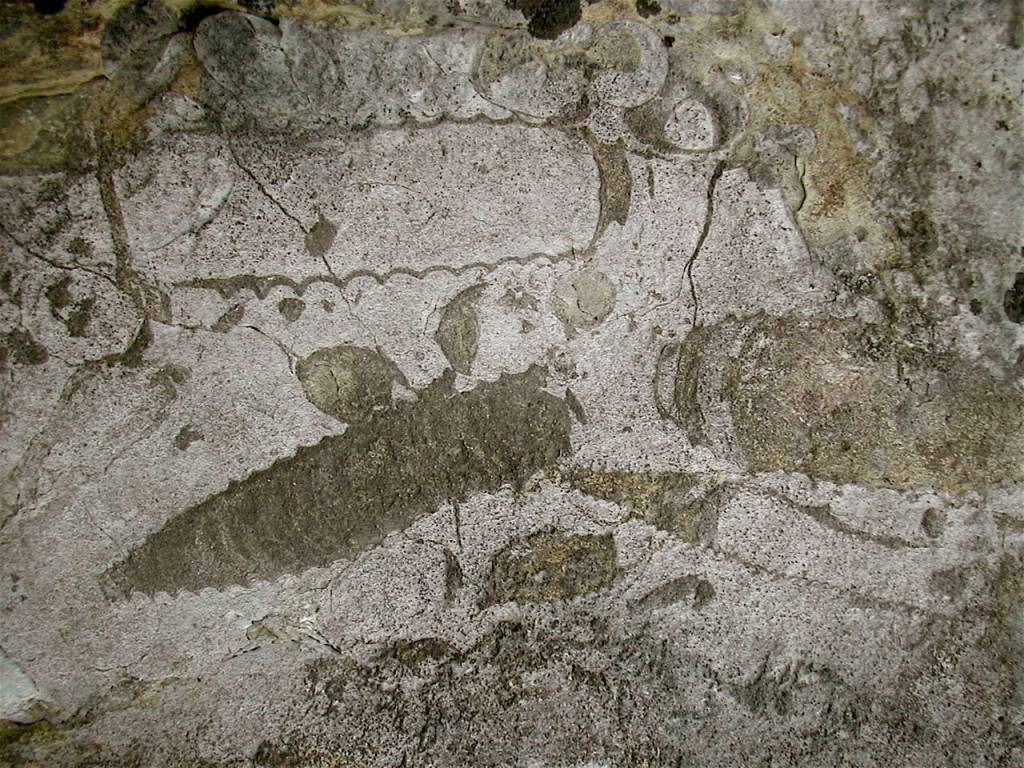
A cephalopod fossil on a rock face in Northwestern Vermont. Learn more here.
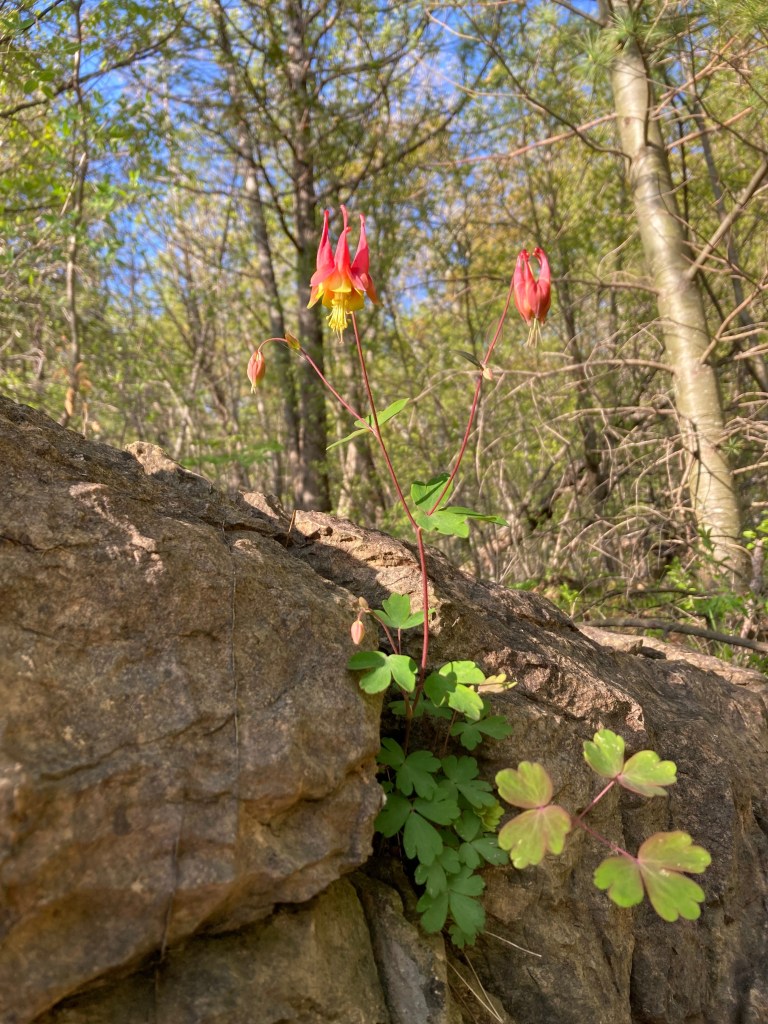
Red columbine (Aquilegia canadensis), my favorite spring wildflower, is found in well-drained, calcium-rich soils like the bluffs at Rock Point in Burlington, Vermont. Here, the bedrock is Dunham Dolomite, which formed from bottom sediments, including ancient sea creatures, in the tropical Iapetus Ocean, about 500 million years ago.
Why does all of this matter?
All of this tectonic plate drama has left us with a fascinating landscape in Vermont, with a mosaic of bedrock types with real, everyday implications:
Natural communities: Over time, bedrock weathers to form soil which support life. For example, we find lots of spring ephemeral wildflowers in areas rich in calcium from bedrock that dates back to being the bottom sediments of the Iapetus Ocean millions of years ago.
Agriculture: The bedrock beneath our feet influences the fertility, permeability, and pH of agricultural soils, impacting what kind of food can be produced in the region.
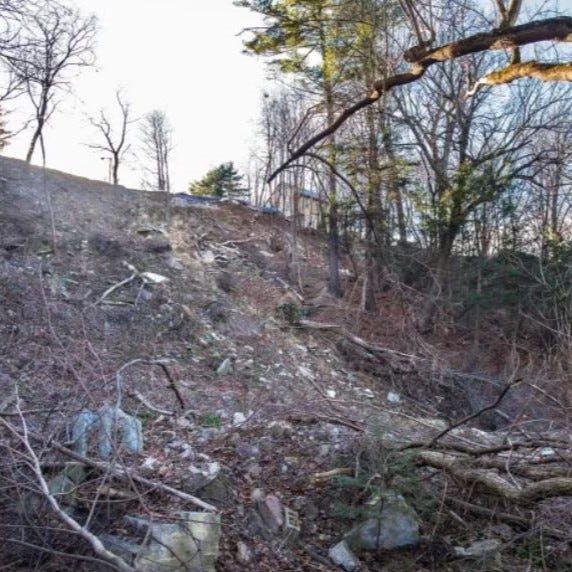
Hazards: Some areas are more vulnerable to hazards than others – like earthquakes and landslides – depending on the bedrock at our feet.
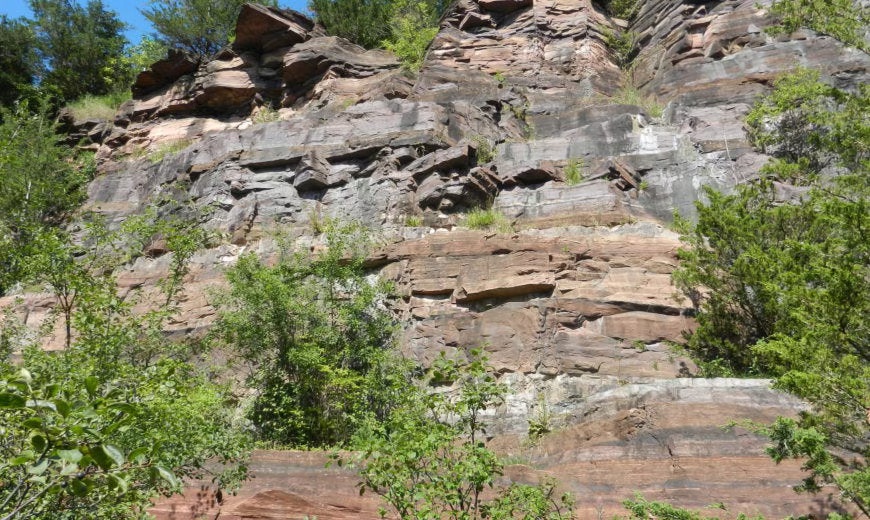
Human infrastructure: Bedrock provides building materials. For example, the Monkton quartzite at Burlington’s Redstone Quarry was originally sediment on the floor of the ancient Iapetus Ocean, too. Today, it’s used in local construction.
By studying Vermont’s complex bedrock geology, we gain a richer perspective on how the land has formed over time and how it continues to shape the natural landscape and the fabric of our community today.
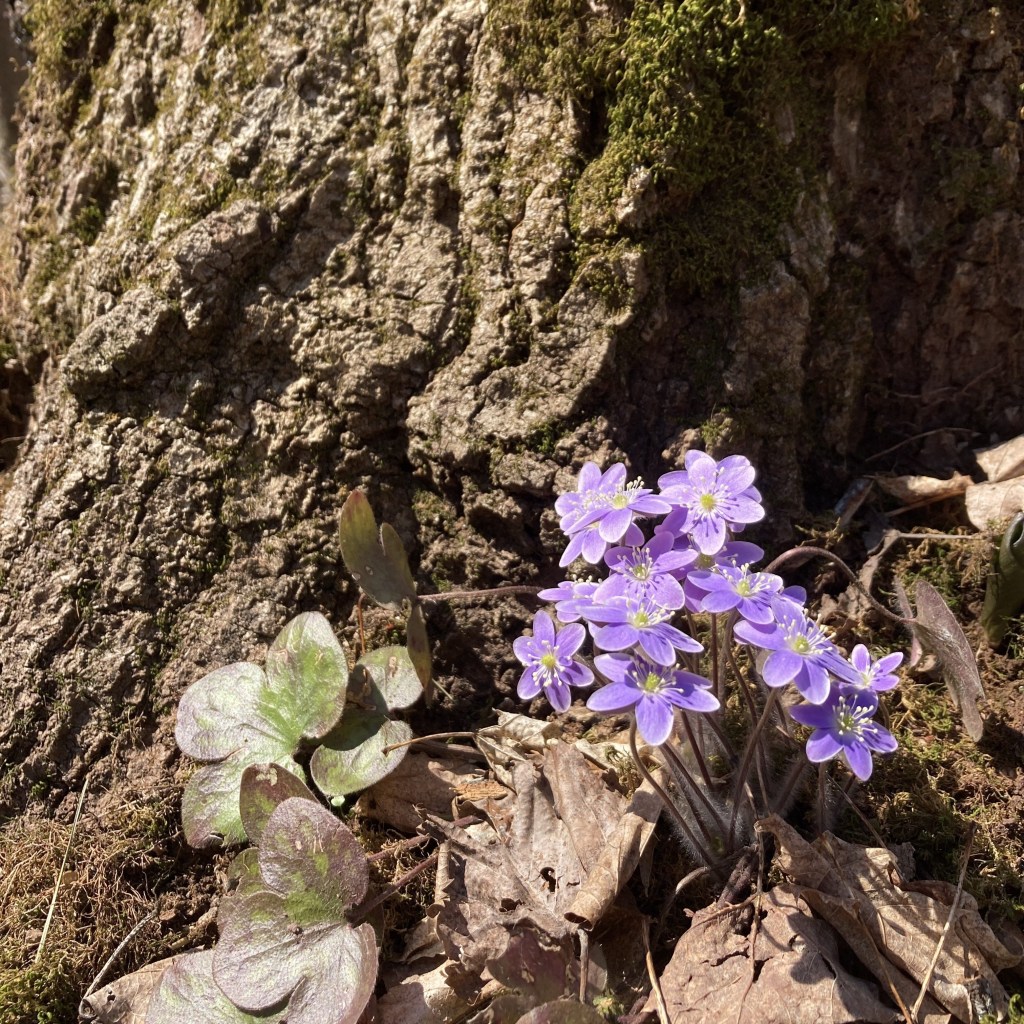
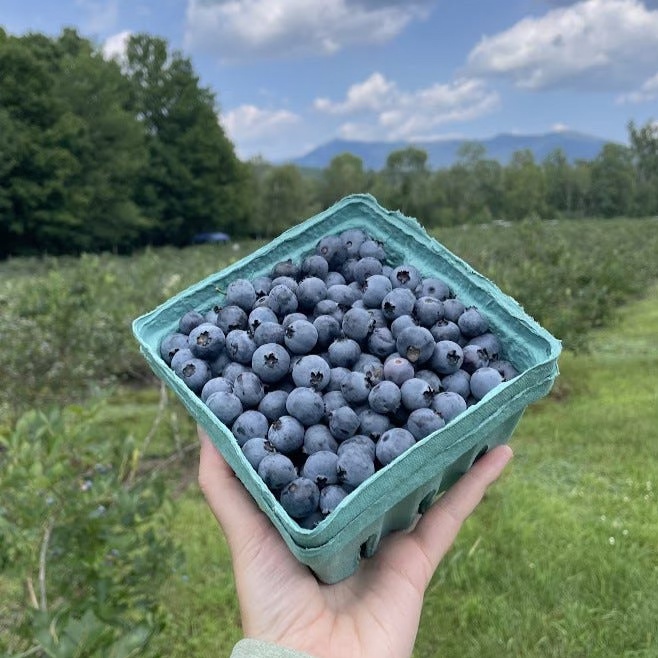
Hepaticas, spring wildflowers that thrive in calcium-rich soils (Leslie Spencer); blueberries, a food crop native to the Northeast (Leslie Spencer); a landslide off of Riverside Ave in Burlington, VT (Glenn Russell/VT Digger); Burlington’s Redstone Quarry (Sean Beckett)
Lessons from bedrock in a changing world
So, what can Vermont’s bedrock geology teach us in a time when the values that ground us as a community, and a nation, feel so shaken?
Diversity & interdependence: Just as Vermont is made up of an amazing variety of bedrock, our communities rely on a diversity of ideas, values, and voices. Each type has a role in creating a resilient whole, and we need them all.
Slow and steady change: Tectonic plates move at the speed our fingernails grow – not fast, but also not imperceptibly slow. To sustain ourselves for the work ahead, we need to think of it as a marathon, not a sprint.
Finding our bedrock: In uncertain times, we will find strength in our communities, our landscapes, and the grounding practices that help us stay sane. Just as bedrock provides the foundation for natural communities to thrive, our “bedrock” people, places, and values will help us push forward into four scary years ahead.
In sum, attention – to the patterns and processes in the natural world – is the beginning of devotion – to a more sustainable, compassionate future, where people and places are treated with respect and compassion, rather than distrust and fear.
Resources
A mélange of resources that came together to inspire this post, if you feel like diving in some more:
Vermont was once the bottom of an ancient tropical ocean: The Longer Story
A tropical ocean and Laurentia: Our bedrock geology story today begins about 500 million years ago, during a time before land plants and animals existed, though they were soon to come (the Cambrian Explosion). Humans were still far in the future (early humans appeared only about 2 million years ago). At this time, most continents were in the southern hemisphere, surrounded by warm, shallow seas. The paleocontinent Laurentia, the precursor to North America, lay sideways along the equator. The red dot on the map below marks where Vermont would have been – completely underwater in the Iapetus Ocean.
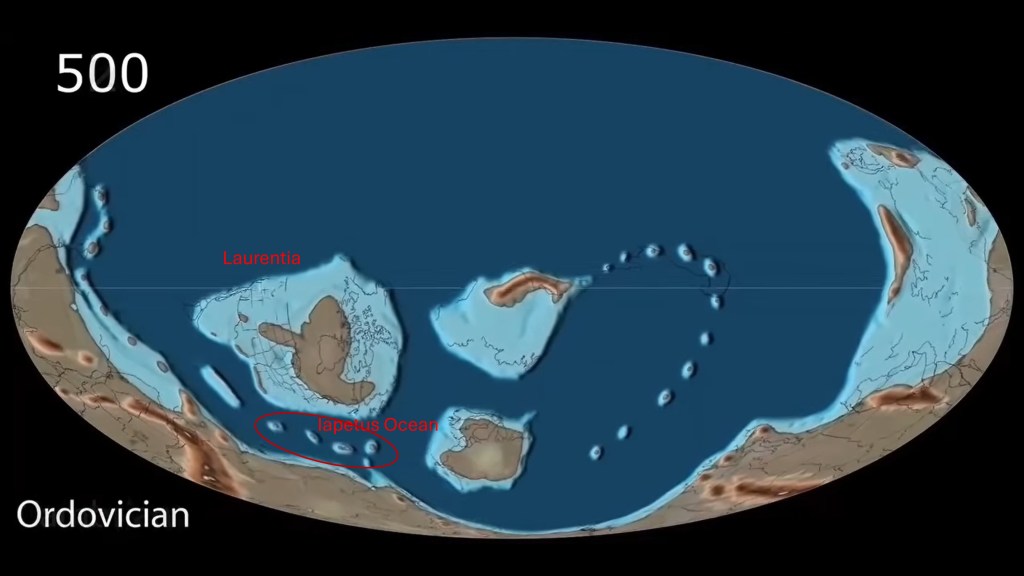
Formation of the Green Mountains (the Taconic Orogeny): Next, we see a chain of volcanic islands beginning to emerge along Laurentia’s edge (circled in red). Think of them as similar to present-day Japan. As tectonic plates converged, the Iapetus Ocean started to close, and these islands slammed into Laurentia, forming the Green Mountains. The Greens now created Laurentia’s eastern edge, and began eroding into the Iapetus Ocean, with sediments from the mountains settling on the ocean floor.
Formation of Eastern Vermont, New Hampshire, and Maine (the Acadian Orogeny): Then, in comes thepaleocontinentAvalonia, bringing in present-day Eastern Vermont, New Hampshire, and Maine. Colliding in a “multi-car pileup”, the sediments from the ocean floor were brought up into the mountains. Vermont then became landlocked, no longer near an active tectonic plate boundary.
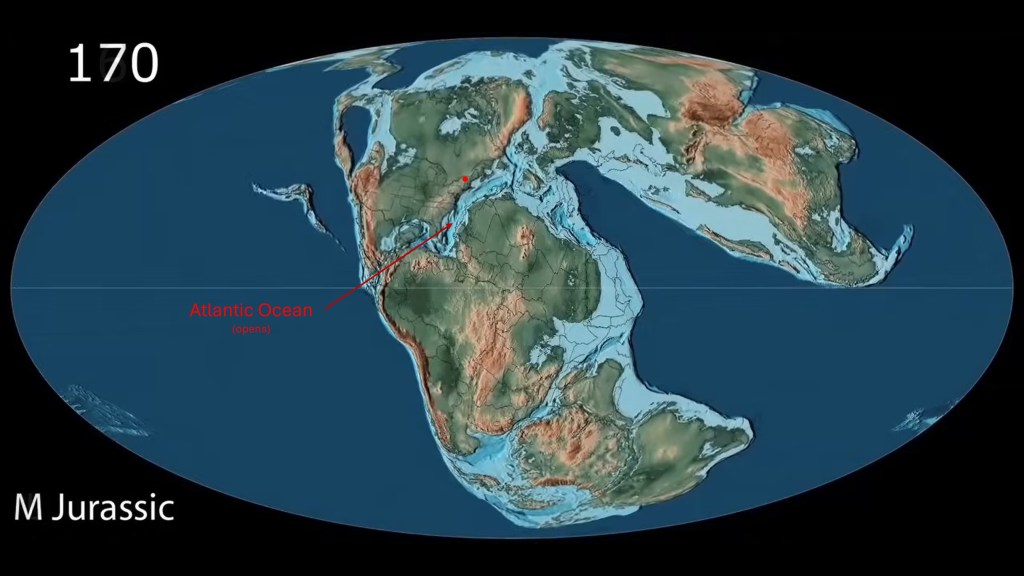
The formation and breakup of Pangea: Over the next few hundred million years, tectonic plates continued to move, but with little effect on Vermont, since it became landlocked. Pangea, the supercontinent, formed about 2-300 million years ago, and then about 150 million years ago, Pangea began to break apart into the continents we know today, forming the Atlantic Ocean as a result.
The end.
You read so far you deserve a ✨fun fact✨: The Atlantic Ocean gets its name from Greek mythology. The titan Iapetus was the father of Atlas. Just as Iapetus preceded Atlas, the Iapetus Ocean was the “parent” ocean to the Atlantic.






















 Vermont Master Naturalist Program