
By Leslie Spencer, VMN Lower Winooski participant
This weekend marked the bittersweet conclusion to my year in the Vermont Master Naturalist (VMN) program. Our cohort has come together for five field days in Burlington, learning to read the “layer cake” of Vermont’s landscape, from bedrock to birds. Each field day made me feel more connected to this place that I am lucky to call home.
We began with bedrock geology, to understand the foundation of our region, which was then followed by glacial geology, where we explored the imprint left by the last glacial maximum, when New England lay beneath a mile of ice. Next came winter tree ID and wildlife tracking, then cultural geography, examining how humans have shaped and used the land over time.
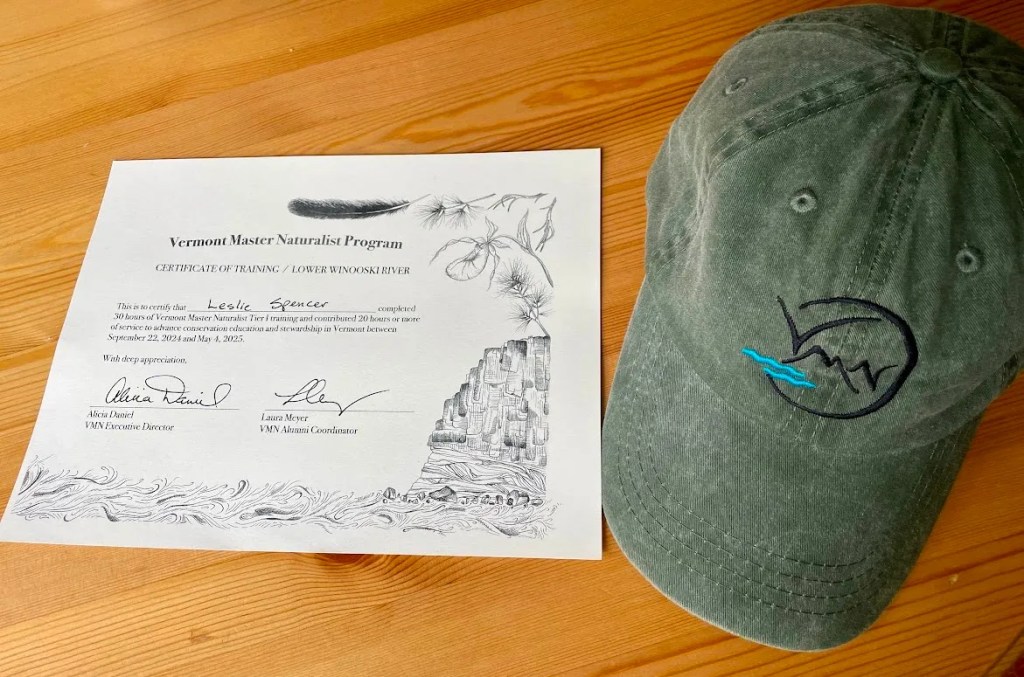
I’m a Vermont Master Naturalist now — woohoo!
For our final gathering, we met in the woods for wildflowers and graduation festivities. Wildflowers are a perfect topic to end this course on, as their story ties together all of the layers of the cake that we’ve studied – both ecological and cultural. Their presence here in the Champlain Valley is rooted in ancient history, in the bedrock story we learned on day one. And their absence in places where they once thrived tells a more recent story—one of development and overharvesting, which have erased these blooms from parts of our landscape.
Our wildflower story begins 500 million years ago, when what would become Vermont lay below the equator, at the bottom of the Iapetus Ocean (which was named for Iapetus, the father of Atlantis, as this ocean was the precursor to the Atlantic that we know today). This was long before humans or flowering plants were in the picture, but the planet was teeming with marine life. Over time, as sea creatures with calcium rich bodies died, they settled at the bottom of the Iapetus and lithified – turned to stone.
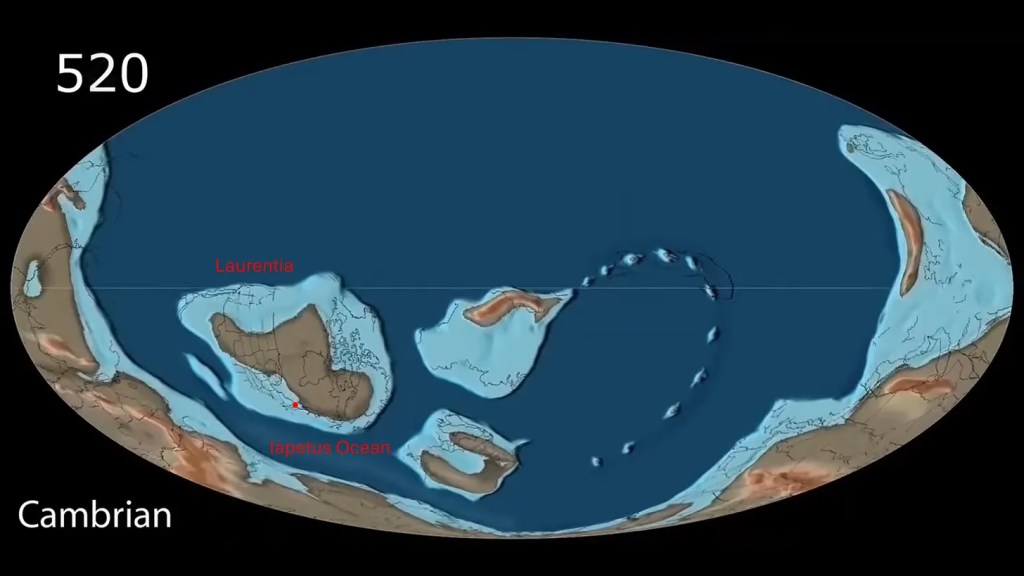
About 500 million years ago, Vermont (the red dot) lay at the bottom of the Iapetus Ocean, on the ancient continent of Laurentia (what later becomes North America). This is an annotated screen shot from this plate tectonics animation.
Fast forward about 50 million years, and the calcium-rich rock from the bottom of the ancient ocean was thrust up high when continents collided as the Iapetus closed (think of it like a multi-car pileup, but with tectonic plates). This event is called the Taconic Orogeny – it’s when the Green Mountains formed.
Today, we have strips of calcium-rich bedrock in Vermont thanks to the ancient ocean (see anything blue in the map below). In places where the glaciers did not bury the bedrock too deeply in sand (a story for another post!), calcium-loving plants, like our spring wildflowers, thrive in rich soils.

Ecological classifications of Vermont’s bedrock. Figure 2 from Wetland, Woodland, Wildland. What’s important? Blue = calcium = wildflowers.
We call many of these wildflowers “ephemerals,” because they bloom briefly right now, while sunshine can reach the forest floor, before the trees leaf out. By the time the summer solstice comes around, many of these flowers will already have disappeared without a trace, storing energy underground (e.g., in rhizomes or corms) so they’re ready to pop up again first thing next spring.

Some of our calcium-loving spring wildflowers in Vermont: hepatica, blood root, dutchman’s breeches, bishop’s cap, jack-in-the-pulpit, red columbine, largeflower bellwort, red trillium, trout lily.
After a beautiful day of admiring wildflowers, we gathered in a circle for one last time to close out the program. Going around, one-by-one, we shared favorite moments and takeaways from the program. Fellow naturalist, Lena, shared their reflection about the connection between ancient history and ephemeral flowers – the amazing duality that something so fleeting comes from something so incredibly old.
I’ve been ruminating on this idea since – how I already loved wildflowers, but now, thanks to VMN, I see them not only as beautiful and fleeting, but also as rooted in a story that is much older and bigger than all of us. That’s so humbling. This program deepened my sense of connection to Vermont, wonder about the world, and responsibility to protect it.
We then closed the day with a sweet treat… layer cake, of course.
To my Vermont friends out there, I can’t emphasize enough how amazing the Vermont Master Naturalist program is and how much everyone should do it. Reach out to me if you have questions about it!
This post was originally published here.

