
Attention is the beginning of devotion
– Mary Oliver
By Alicia Daniel
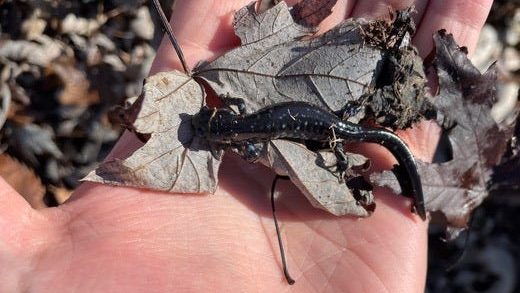
Flipping logs with Vermont Master Naturalists in a floodplain forest on Lewis Creek on November 6, we found not one, but two, blue spotted salamanders, a startling doubling of my lifetime record. These finger-sized salamanders are the soft, secretive, distant cousins of lizards, although they are more closely related to frogs. Like all Vermont salamanders, Blue-spotteds go through the winter underground or in the mud. The inky, velvet blackness of their skin threw their blue constellation of speckles into sharp relief. I found myself staring into a swath of the night sky half buried in the ground.
The flecks of blue in these salamanders is not pigment, a durable color produced in their skin by chemistry. The blue spots are an illusion. Salamander blue is created by scattering light. One of the layers under the salamander’s skin is packed with microscopic, mirror-like purine crystals. When light hits these nanostructures, it triggers a phenomenon called Tyndall scattering, the same physics that makes the sky look blue. The crystals reflect and scatter the short, high-energy wavelengths of light. Waves we see as blue.
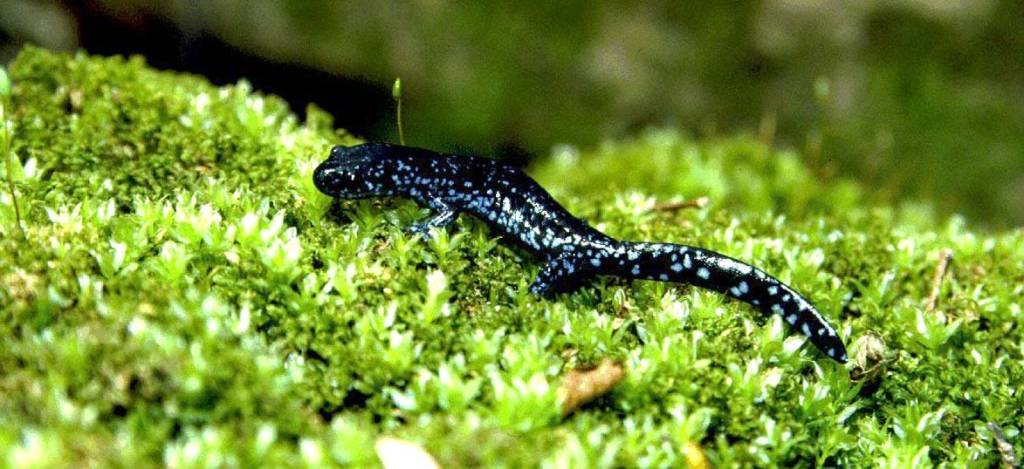
Photo Courtesy of Vermont Fish and Wildlife Department
This spring, I had cataract surgery to remove a yellow haze that was slowly turning my world into a warm, sepia-toned photograph. One of the colors most affected was blue. The day after surgery, blue came roaring back. To suddenly see the richness of blue again was a medical miracle and a gift. I am now curious about all the ways that blue shows up in the world.
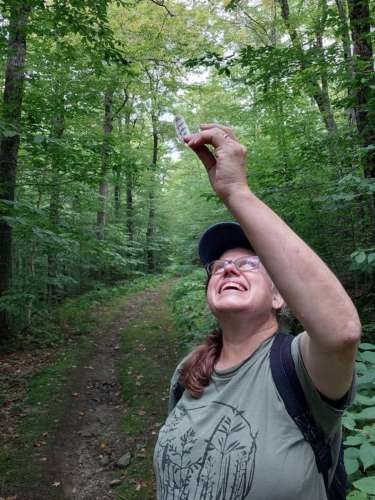
Photo of author by Sophie Mazowita.
Blue jay feathers, in fact all blue feathers, use refraction although the mechanism is different than the one in salamanders. Blue light is thrown to your eye off structures in the feathers.
Each feather barb contains tiny air pockets and a spongy arrangement of keratin that scatters light. Shade any blue feather with your hand or hold it between yourself and the light and it will turn gray. The blue we see in a feather is a mirage, a tiny light show.
Blue pigment is incredibly hard to make because absorbing low-energy red light to reflect high-energy blue light requires highly complex, unstable atomic structures and chemically exhaustive processes. So plants are known to create a structural blue using refraction as well. An African rainforest plant called Marble Berry produces metallic, shiny blue berries that look like small, glossy marbles. It is widely considered to have the most intense, vibrant coloration of any biological material. The skin of the berry contains layers of cellulose microfibrils stacked in a helical (spiral) structure. When sunlight strikes these spiral layers, the spacing between them fractionates the light, refracting and reflecting only the precise wavelengths that produce a bright, iridescent blue.
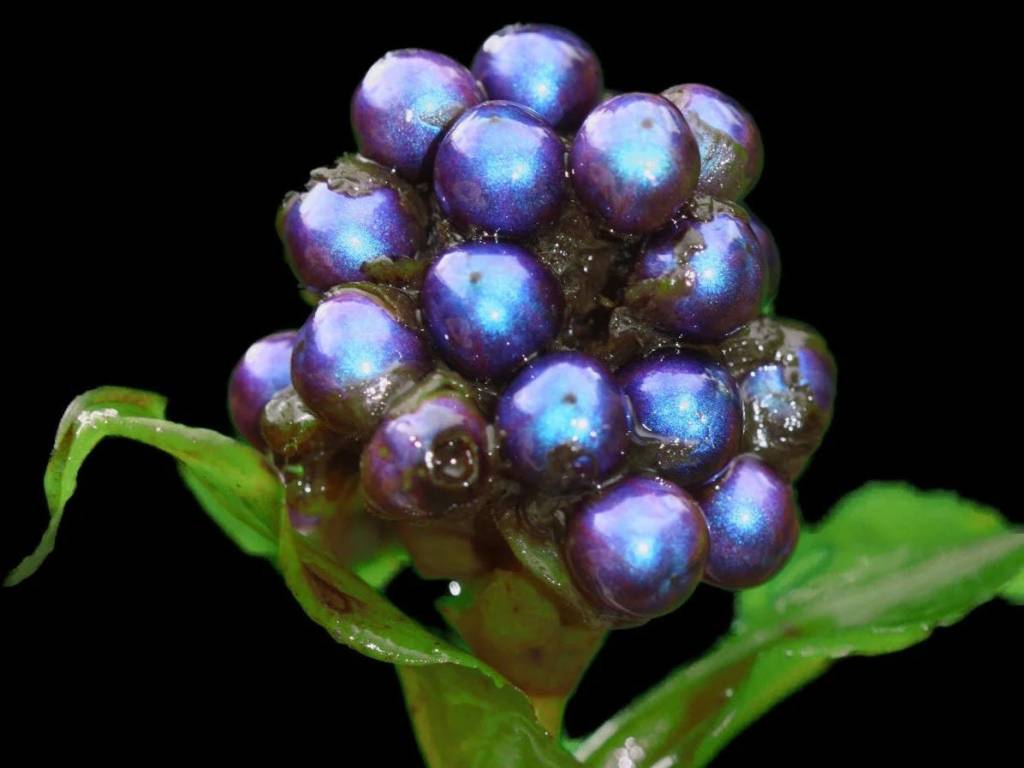
Photo from: Silvia Vignolini et al. via PNAS
Last month in a yoga studio, I chose a gemstone card at random. I picked Labradorite, a dark gray rock. In the light, it turns blue, green, pink, gold, and purple. According to legend, Inuit people believe that Labradorite contains the Northern Lights in its depths. As I sit at my desk rotating a Labradorite stone, it does flash and shimmer as if filled with miniature Northern Lights. The colorful flashes are called labradorescence, which is the result of light interacting with microscopic, layered structures inside the feldspar crystals. As molten rock cooled slowly deep underground, the feldspar separated into extremely thin, alternating microscopic layers that are either calcium or sodium rich. These alternating layers reflect the rainbow of colors. Labradorite, I am told, also symbolizes a quest—a spiritual journey. To find hope in our modern day relationship to nature feels like an endless spiritual journey.
On November 1, I gathered with women around a fire to mark a cross-quarter day, the one falling midway between the September equinox and the December solstice. It is a time when darkness comes full upon us. After making cordage to tie up offerings for the fire, we sang a children’s song.
This Pretty Planet by Tom Chapin and John Forster
This pretty planet,
Spinning in space,
You’re a garden, a harbor, a holy place.
Golden sun going down,
Gentle blue giant spin us around.
All through the night,
Safe ‘til the morning light.
The stars rotated above us, brilliant sparkles in the still, dark sky. I couldn’t see the constellation Lacerta, the lizard, but I knew it was up there. Lacerta reminds me of the blue spotted salamanders–on earth as they are in heaven.
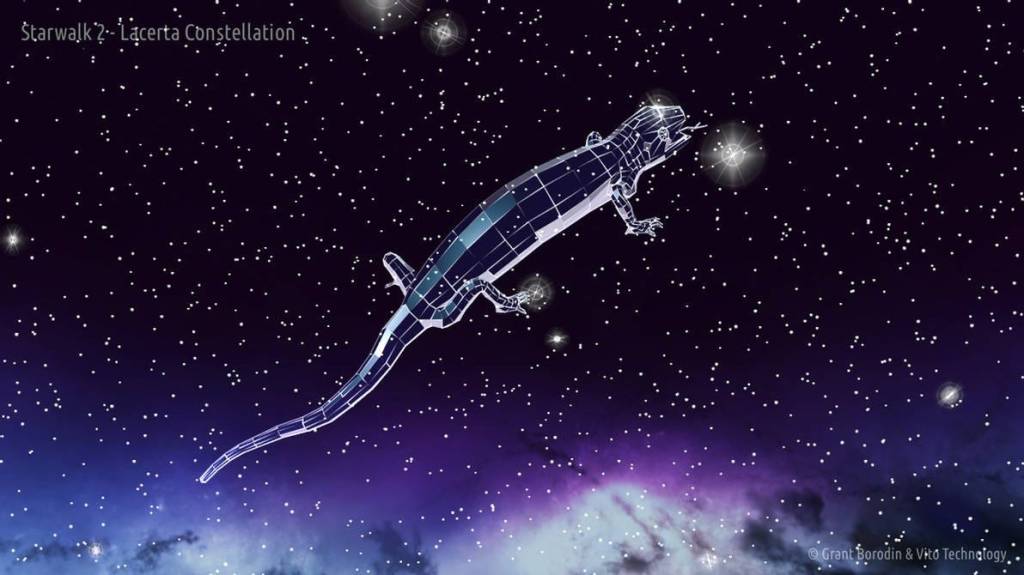
Lacerta Constellation
The night of the fire circle, we were in between the Hunter’s Moon and the Beaver Moon, seven months away from the next blue moon. A blue moon is a rare occurrence when two full moons appear in the same month. “Once in a blue moon” describes events such as red states flipping to blue for the first time in decades. On election night the blue washed across the U.S. map from east to west, the same way the pale flesh of an Inkstain Bolete mushroom will turn a blue in seconds when broken open and exposed to oxygen.
There’s a Mayan language that has no word for blue. The closest concept to blue is “far green,” the blue that mountains turn in the distance. And while I do love blue, I find myself hoping for a far green wave. One that will sweep us into a future where we practice greater attention and devotion to the natural world.
This post was originally published here.
Read our Substack to share in the joy and awe that Vermont Master Naturalist is built on. We tell ecological stories centered on the magic feeling of being part of the natural world.

