
By Leslie Spencer
The Vermont Master Naturalist (VMN) program has changed many a life. The program seems to come into your life when you need it most. For me, I was connected to VMN in 2022 by, at the time, my random new roommate, just after I had moved to Burlington and was looking for kindred spirits. Several alums that I know have gone on to change the course of their personal and/or professional lives after completing a VMN program.
For Alicia Daniel, VMN’s Founder and Director, the program is a dream realized. A few weeks ago now, on Sunday, September 13, the VMN community gathered to celebrate 10 years of the program — a dream that Alicia described as beginning as a “conversation at a picnic table” that has now become a community of hundreds of naturalists over the course of the decade. 💚
VMN programs teach people to read the landscapes around them using a layer cake approach, from “bedrock to birds.” It might sound intimidating to learn about all the layers of a landscape, but it’s not when you do it through stories, wonder, and a whole lot of fun. You can learn more about the VMN magic here (thanks, Gordon!).
Ten years in, enough people have completed a VMN program and still want more that Alicia has started building “Tier 2” programs for those of us (🙋♀️) who can’t get enough. Back in May of this year, I joined a new cohort of naturalists in the Winooski River Corridor Tier 2 program, where we’ve been diving even deeper into reading Vermont landscapes.
As part of each program, cohorts undertake a volunteer project. For our Tier 2 cohort, that meant taking on a mighty task: becoming the teachers ourselves and leading field walks for other naturalists as part of VMN’s 10th birthday celebration on September 13. At the beginning of this program back in May, I was paired with two strangers to lead a walk in a place none of us had ever been before. What could go wrong?
Turns out: nothing. Ha! But, let me rewind a bit.
Introducing: Turtlehead Pond
Standing in a circle with my fellow Tier 2 program naturalists in May, Alicia handed each of us a small, colorful scrap of paper with a few words scribbled on it. She told us to find our matches. My little yellow scrap read, “Turtlehead Pond.” I waved it around and scanned the circle until I found two kind faces holding matching slips of yellow paper. We introduced ourselves, and just like that, the three of us were a team with the task of leading a walk at this new-to-us place on September 13.
In June, the three of us met up for a scouting mission to get a sense of what we had gotten ourselves into. We got to know the area a bit, made a plan for leading our upcoming field walk, and divided it up into pieces. Learning the human history of the Turtlehead Pond area became my task.
Summer then whizzed by, as it does, and before I knew it, it was after dinner on September 12, the night before our big day (oops!). I knew the broad strokes: Turtlehead Pond is in Marshfield, Vermont, and sits along a rail trail that used to be a functioning railroad. Other than that, I needed to do some serious homework before leading my part of our walk the following morning. I am glad I did… because let me tell you, I uncovered some stories to share with our group the following morning.
Marshfield, Vermont
On that scouting mission in June, we explored Turtlehead Pond and some of the surrounding area in Marshfield, Vermont. A common thread everywhere we went was water: the Winooski River, Marshfield Falls, Bailey Pond, Turtlehead Pond, and lots of beaver wetlands. We naively assumed that all this water contributed to the area’s “marshy” character and, therefore, that it was named Marshfield. Makes sense, right? Oh, how we were wrong.
In my late night prep the night before the walk, I started researching Marshfield and stumbled into a rabbit hole. First, I learned that Marshfield was chartered in 1790 and is named for Isaac Marsh, not for its abundance of water features. What did Isaac Marsh do to become the town’s namesake? Here’s the short version:
Following the Revolutionary War, Marsh owned a tavern in Stockbridge, MA. According to this account from the Bidwell House Museum, “Marsh gave everyone credit to buy items from his store, including the Stockbridge Mohicans, very likely knowing they would be unable to pay.”
Several tribes in the area, including the Stockbridge Mohicans, aligned with the colonists in the fight for American independence and formed the Stockbridge Militia. As a thank you for their support in the war, in 1782, the Vermont General Assembly granted the Stockbridge Mohicans land east of Montpelier, present day Marshfield, Vermont. But, still in debt from their Stockbridge tavern days, they soon sold their claim to the Vermont land to Marsh to settle those debts, and they were as a result, displaced. Today, the Stockbridge Mohican community is based on a reservation in Wisconsin, far west of their ancestral home in the Hudson River Valley.
We were some naïve naturalists, thinking Marshfield was named after its various water features. This is instead a story of many layers of land dispossession (and I’ve only started to scratch the surface). For example, it’s important to note that this was not Vermont’s land to give to the Stockbridge Mohicans in the first place, as the Abenaki people are Vermont’s original inhabitants. By this point, however, many Abenaki people had been pushed out of Vermont through settlement and warfare. All of this is to say that there is much more to the story than Marshfield, Vermont, being named after Isaac Marsh, and I’m glad that I went down the rabbit hole.
Through VMN, I’ve gained a much greater appreciation for human history. In addition to stealing land and displacing indigenous communities, settlers deforested much of New England for farming (especially sheep) in the 19th century which still informs our landscapes today. Understanding their actions, which displaced other humans, wildlife, and traditional ways of knowing, is fundamental to understanding Vermont today. We can’t understand the layers of a place without first going back in time.
Field notes from September 13 at Turtlehead Pond
With history covered, now onto the present. On the morning of September 13, a gaggle of naturalists gathered at Turtlehead Pond ready to read the landscape. Here’s some of what we noticed and learned.
Intrusive rocks
Although the clouds hung heavy that morning at Turtlehead Pond, across the way, we were treated to the view of the granite cliffs in the distance, dappled with early fall colors. This spot is known as “Marshfield Ledge” and is well known to climbers. Of particular interest to our group, however, was how this rock formation seems to pop up out of “nowhere” in a landscape that is generally made up more gentle, rolling hills.
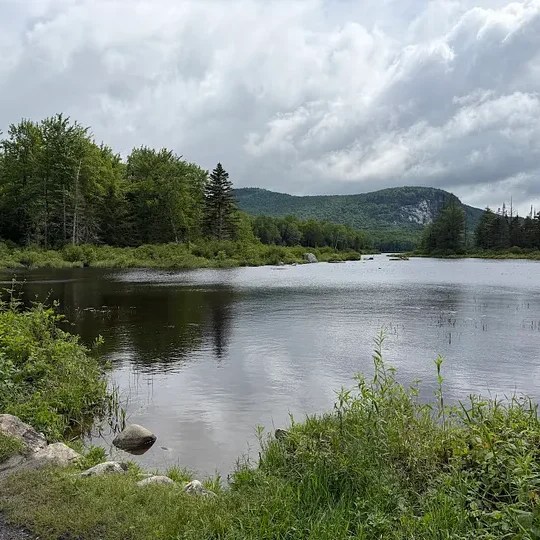
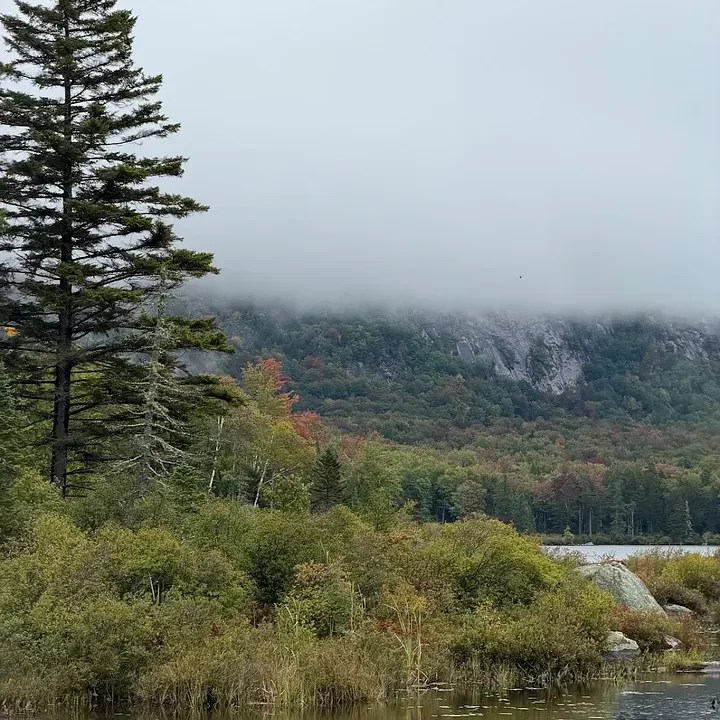
Turtlehead Pond in the foreground and Marshfield Ledge in the background in June 2026 (left) and September 2026 (right).
Much of the bedrock in Vermont is sedimentary, originating from the bottom sediments of ancient oceans that were laid on the Earth’s surface and slowly lithified, i.e., turned to stone. Granite here is a clue that something else is at play, as granite is an igneous rock, forming from molten rock deep underground — a very different process.
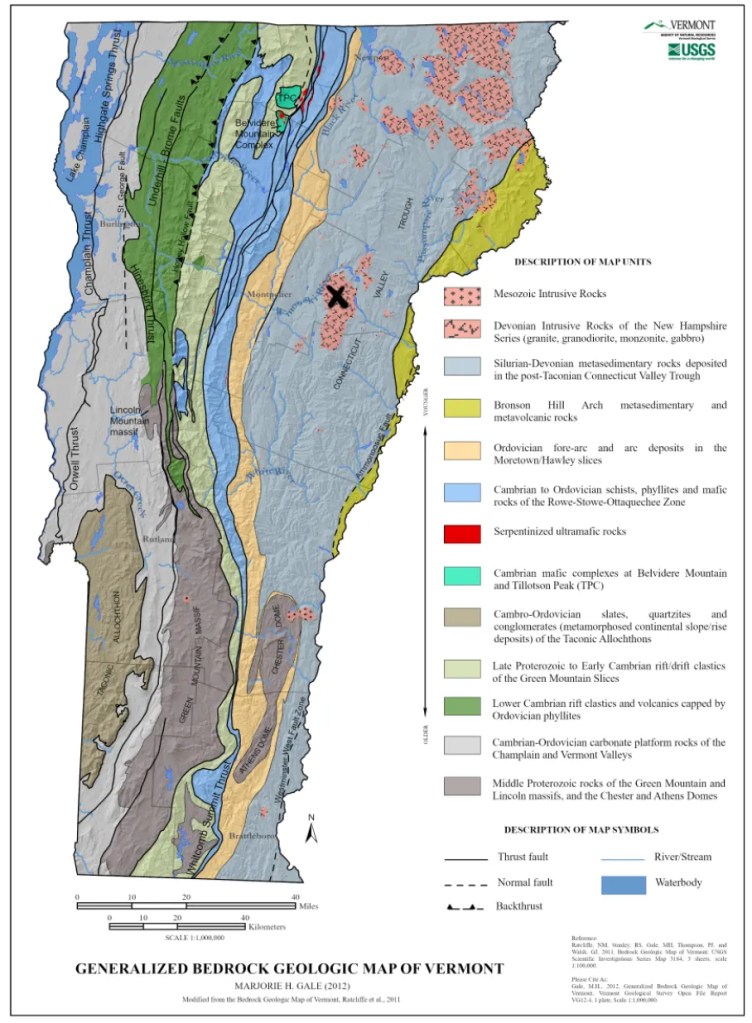
We were looking at part of a pluton: an intrusion of igneous rock. The granite here formed from melted rock deep down in the Earth and over time, it ended up at the surface as the sedimentary rock around it slowly eroded, creating this “mountain out of nowhere” effect. This pluton is part of a larger group of plutons in Northeast Vermont — see where “x” marks the spot on the map below. You can also see plutons between Montreal and Quebec City, which I wrote about here.
Where is the mama oak?
Following the geology lesson next to the pond, into the woods we went, on a trail that approached the base of the granite cliffs. All along the trail, we encountered a puzzle: we noticed acorns and oak saplings (red oaks, I believe, correct me in the comments if I am wrong!). Seeing a red oak in northern Vermont is unusual, because it’s the northern extent of the species’ range.
We set out on a mission to find the mama oak. At the turnaround point of our hike, at the base of the cliffs, we found her! Our suspicion was that the south-facing cliffs create a warm microclimate for this red oak to thrive, despite being at the top of its range. Others seem to agree (read more about oaks in Vermont here).
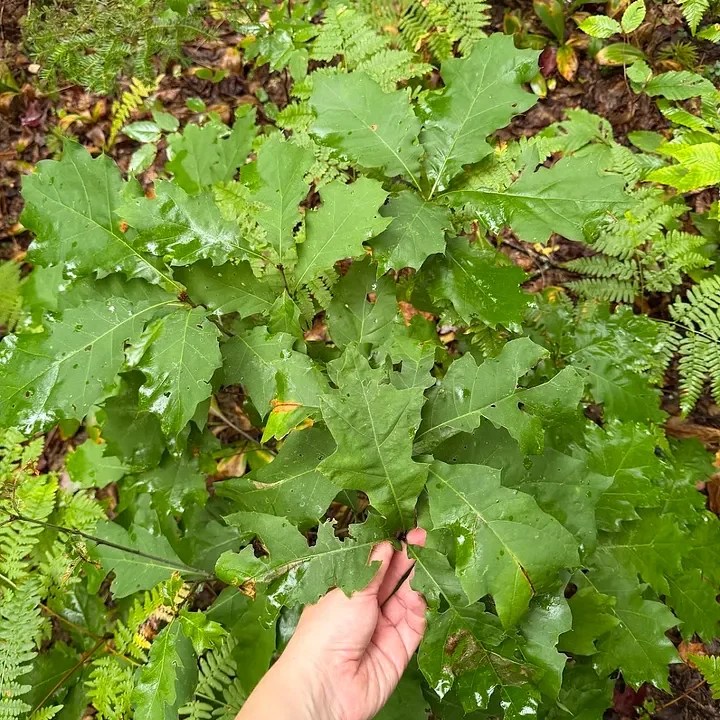
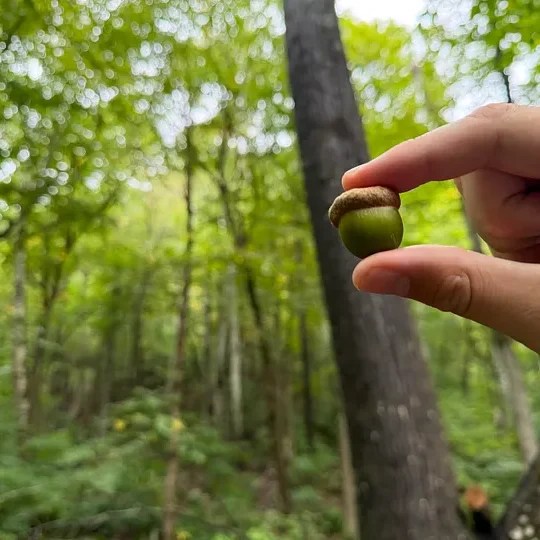
Oak sapling (left) and acorn in front of mama oak (right).
Gray soils
The Bible for naturalists in Vermont is a book called Wetland, Woodland, Wildland. It divides Vermont into natural communities, outlining the flora, fauna, soils, bedrock, etc., that you can expect in different habitats across the state. It has really helped me build intuition about what to find, and where.
In the woods around Turtlehead Pond, we were exploring a “Boreal Acidic Cliffs” natural community (p. 222 in WWW for inquiring minds). These ecosystems are known for acidic soils that form above granite bedrock.
Throughout our walk, we noticed a characteristic feature of this natural community: patches of light gray soil poking out in eroded areas of the trail. This gray soil is called the “E” layer, where eluviation — the process by which colorful minerals and organic matter are washed out by the rain — leaves behind this layer of gray, acidic soil, just below the topsoil.
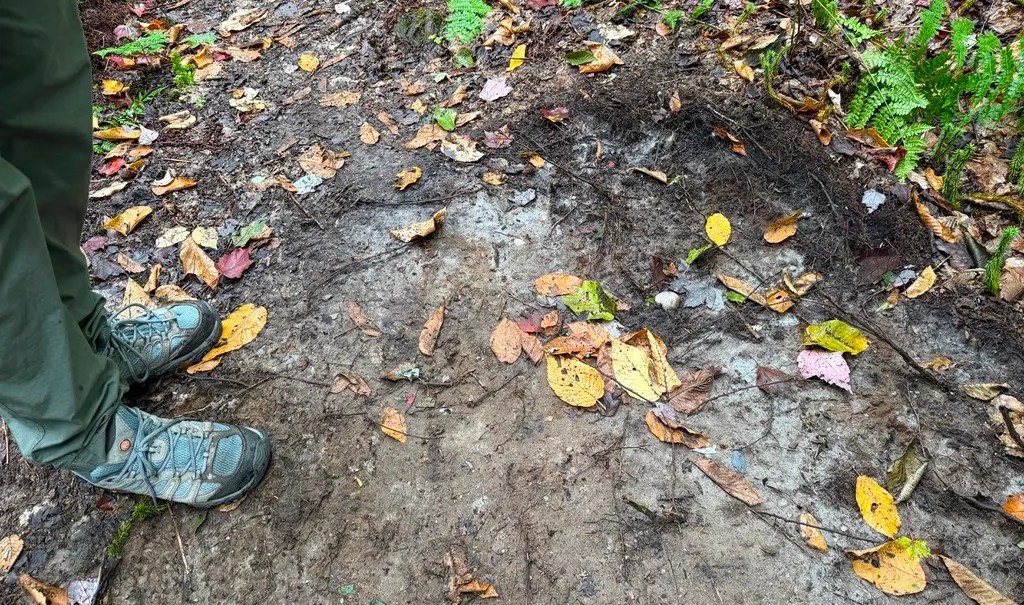
Patches of gray soil poking out at eroded spots along the trail.
Say “clubmoss” on three!
Clubmosses belong to one of the oldest lineages of vascular plants on Earth — they evolved before ferns, which came before flowering plants. They look like tiny conifer trees, although they are not related. Lots of clubmosses line the trails around Turtlehead Pond.
Instead of seeds, clubmosses have spores. Their spores contain a lot of fats and oils, making them highly flammable (when dry), which led to their use as early camera flashes before lightbulbs were invented! (Thanks, Sarah, for sharing this fascinating tidbit on our walk.)
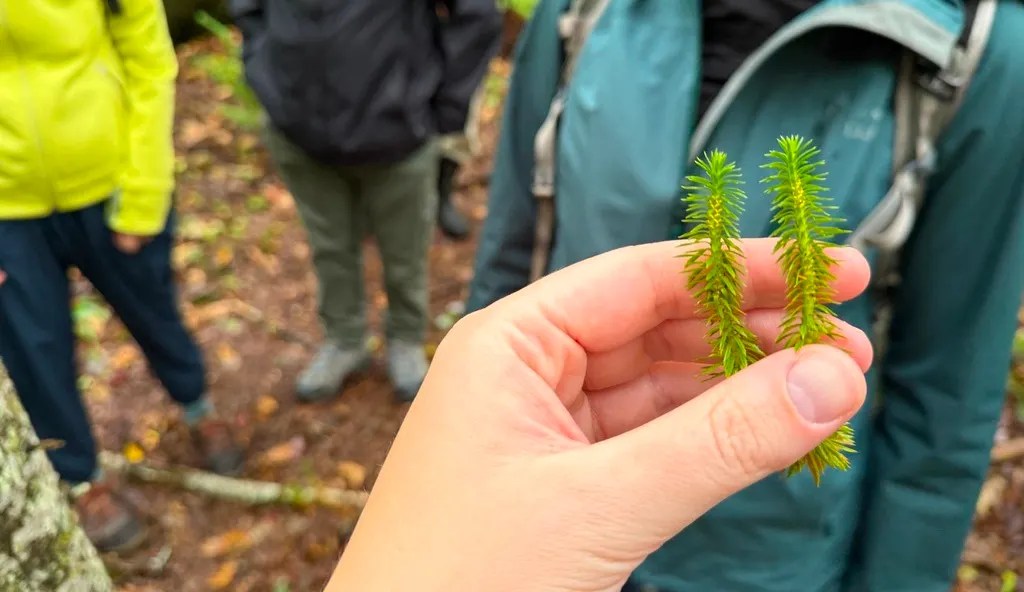
Clubmoss!
I’m grateful for this “roving band of learners”
While my group of naturalists explored Turtlehead Pond that morning, there were several other concurrent VMN groups out exploring other landscapes in Central Vermont. After the walks, we all gathered at North Branch Nature Center to celebrate VMN’s 10th birthday together.
In her remarks, Alicia mused about how wonderful it is to be a part of this “roving band of learners,” and I could not have said it better myself. Thank you, Alicia, for empowering us with the skills and confidence to lead walks in places we’d never been and ensuring us that we have the tools (and community) that we need to make it a rewarding experience. I am so glad that VMN went from dream to reality!
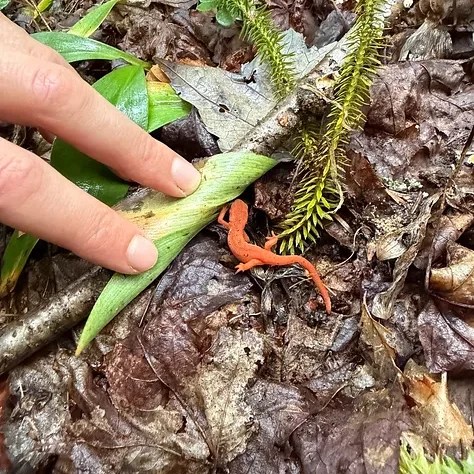
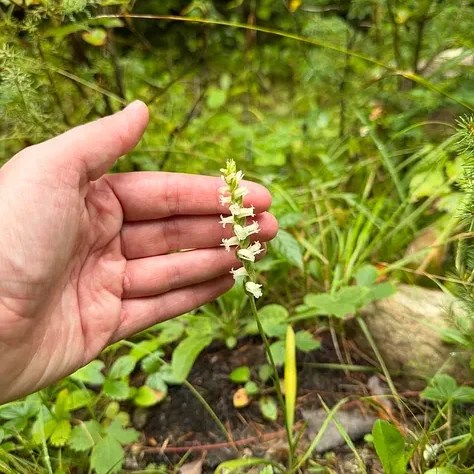
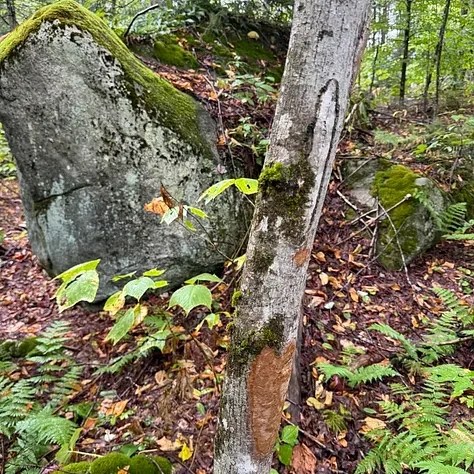
A few other highlights from our Turtlehead Pond adventure. Left to right: red eft, yellow nodding lady’s tresses orchid, a moose rub on a tree!
All photos are my own unless otherwise noted.
This post was originally published here.

