
By Gordon Coates, Field Naturalist Practicum Teaching Style
It was pouring rain for the first class of the program. This Vermont Master Naturalist cohort stood together underneath a two-trunked, sprawling red oak. We all giggled, nervous, and tried to stay sheltered under the oak and inside or “waterproof” shells. Our teacher, Alicia, stood calm, observant, and measured. The rain didn’t bother her or doesn’t seem to. Maybe she drank it through her roots.
Once the giggles were released, and the group was ready for the serious stuff, Alicia pulled out temporary tattoos. It is serious stuff, picking out and putting on a temporary tattoo of a unicorn, or a cartoon bird, or a heart that says “Mom.”
We passed the box of tattoos around and each picked one. I went for a hummingbird on my neck. My neighbor in the circle had to apply it for me. It’s an intimate spot to have a new classmate hold gently for 30 seconds in the pouring rain.
They’re small things, and they’re silly, but the temporary tattoos are a good stand in for the whole class. There’s a little bit of self-expression, a large helping of joy, and immediate intimacy.
Alicia starts a lot of her classes this way, even with adults because it breaks down barriers, lightens the atmosphere, and forces just enough vulnerability to bring people closer together. It takes vulnerability and openness to allow someone else to put a kid’s toy on you. The same vulnerability enables an opening to the land.
After the tattoos, we stood around a topographic map of the United States with the political borders removed. We each thought of a place that felt like home, and we tried to find it on the map.

One by one, we knelt and slid our fingers along the ridges and valleys and stopped when our finger found the home place. From there we told a story of this spot. We heard stories of rivers and mountains, of family and friends, of relationships.
Everyone found their spot by following coastlines and rivers and the shape of the earth, by going from the broadest scale to the smallest until we were at the personal level.
In these two actions lie the magic of the class. Many naturalist classes or environmental programs are academic and rigid.
Go out with a fern specialist and learn about ferns. Meet with an expert birder and go listen to birds. They can be almost transactional. Go to the woods, get the information. This class and its teaching style contrast the transactional by emulating the natural world where relationships are key, context is imperative, and the plants and animals are shaped by the beings around them.
Where other classes might be definition driven or motivated by identification, this class is relationship driven and motivated by story. Touch my neck, tell me where you came from.
In other classes, there is a clear instructor-student relationship. One person is the expert. Their job is to teach, and it’s everyone else’s job to learn. In this class, everyone is teacher, everyone is student. We learn from each other and from the land. It’s obvious that Alicia has more knowledge, more stories, more familiarity with the places we go, but that only adds to the way everyone else can connect to a place.
The Vermont Master Naturalist classes are led by four concepts: connection, reverence, experience, and story. Mix those things together, with a group of willing participants and magic happens.
Back out in the rain under the oak tree, we started walking. Our day was going to be spent at Rock Point, studying and understanding bedrock to birds and the stories all those beasts and beings have to tell. We made it 30 feet before we paused on top of a flat sandy cliff that looked out over the lake and Rock Point. Clouds rolled in from the west and shrouded the point, but we could still see far back in time. This flat sandy spot was likely an ancient delta of an ancient stream that flowed into the ancient lake that still waves and breaths and bursts today as Lake Champlain.
But Alicia didn’t tell us it was a delta. We had to guess and grope and dig in our heads and in the sand before she gently guided us to the explanation. Then, without much other prompting, she led us down and around the sandy cliff and we looked up to where we had just been. There was a mystery here, birches at odd angles, the steep cliff, a pile of sand. We had the clues, and Alicia let us discover them. We roamed the base of the cliff, touched the sandy precipice, admired the beauty, and speculated aloud. We built off each other’s observations and followed our own threads until we were called back together to present the evidence we had found. “These trees are at a weird angle. Maybe they’re reaching for the sun from under the cliff?” “The trees seem to be the same age as the ones on top.” “There’s a lot of sand.”
Alicia asked probing questions until one of us had the epiphany. “A landslide!” Of course, now it was impossible to unsee, the slanted trees had grown on top of the cliff until a large rain event cut out enough of the sand to make the whole thing topple.
Alicia knew from the beginning. She had come check out this event as Burlington’s city naturalist, but she let us discover it with our own experience, our own intimacy with the place, our own stories.
The human brain is so adept at creating stories. It does it to make sense of the world, to make connections, to make predictions. The classes teaching style harnesses the need for story. We often spread out and do our own investigating of a place before coming together and sharing. “There is a barbed wire fence over that hill, maybe this land was grazed.” “I see no young cedar trees in this forest, perhaps there is an abundance of deer eating them.” Each observation is accompanied by an explanation, and as we put our observations and explanations together, we begin to see the shape of the land and come to a truth of what the place is, was, and will be.
We continued the day repeating this sort of exercise, spreading out investigating and sharing. We explored the human use of Rock Point, ate berries and apples picked from the tree, and walked along the thrust fault. We talked about human history, geological time, orogenies, how bedrock influences natural communities, and the specifics of it all. I left each all-day class with more information and understanding of the world than semester long college classes, but instead of textbooks, we read the land, instead of monologue lectures, we heard collective ideas.
There is no one right way to teach. Lectures work for some folks and some topics, but to learn the eye of the naturalist, to understand the pieces, patterns, processes, and relationships that are happening in the world around us, nothing compares to collective experiential storytelling.
Everything builds and connects and flows into the other. The relationships between people open doors for vulnerable stories. The vulnerability opens to door for connection to land. The connection to land leads to the deeper understanding and respect of the world on a biological, human, and spiritual level.
This aspect of spirituality and reverence is woven throughout the class, sometimes explicitly in a piece of art, or a recitation of a prayer, and sometimes in a more nuanced way in the silent exploration of a landscape or the invitation to observe without naming. Spirituality is an element of the human-nature experience that is frequently ignored, especially in scientific, academic, western dominated experiences.
This class acknowledges that something unexplained, something emotional that happens to people in the natural world is inherent to the human experience. It is, in fact, crucial to the understanding of how we as individuals and a species fit in the broader system of life.
…
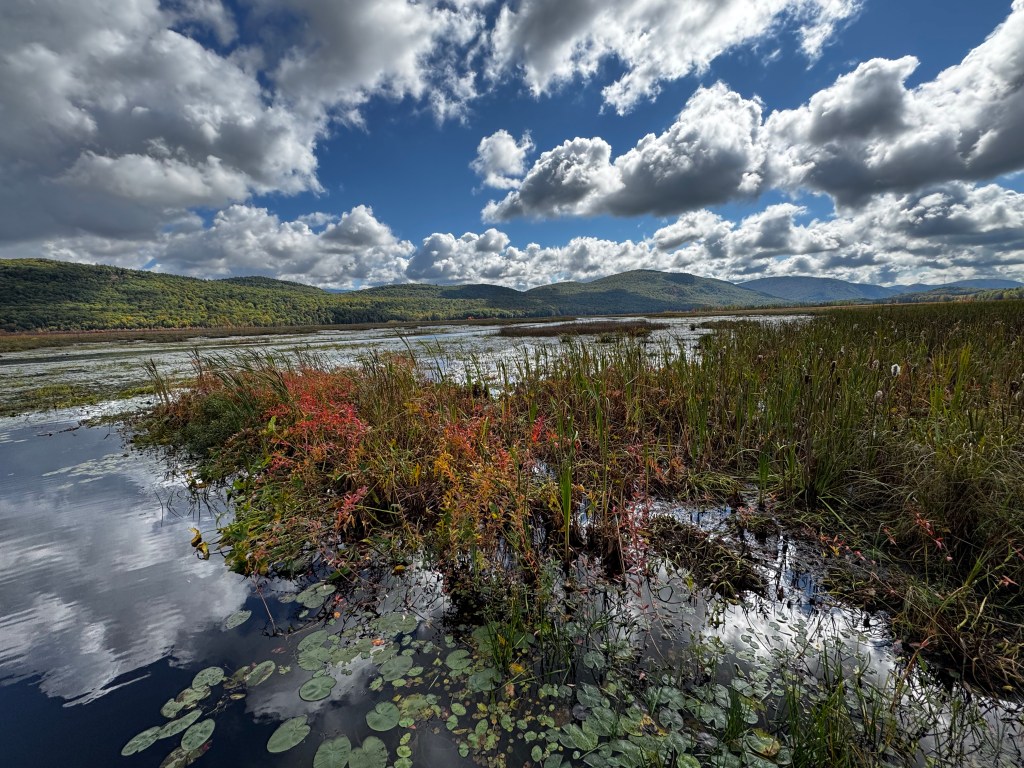
On a different day, we went to a kettle hole bog that has been around for thousands of years. Kettle hole bogs are created by leftover glacial ice creating a depression where water enters through rain and cannot leave. They are a unique bog construction, with concentric rings of vegetation, tough conditions, slow growth, and even slower decay where peat builds up meters deep, carbon is stored, and otherworldly life forms thrive.

Before we entered, we stood outside the woods, next to a Christmas tree farm, and closed our eyes. Alicia recited a prayer to the four cardinal directions, centering gratitude, the seasons of life and the animals that represented them, all the while shaking a rattle made of elk hide and local wood. It is a prayer and a practice taught to her by indigenous folks that she acknowledged and credited beforehand.
When the prayer was over, she rattled over each of us, starting from our bellies, rising over our heads and descending to the small of our backs. Rattling the whole time. Rhythmic rattling. It was like a river. It was like the wind. I felt chills all over my body and my awareness opened. I was elated. Christians might call that the holy spirit. I call it the acceptance of our place in the world, the buzzing connection between all living things. Afterwords we walked into the woods in silence, experiencing everything on the physical and metaphysical level.
Some balk at including spirituality into a naturalist class. They might say, “Learn the plants and the animals. Know the Latin. Understand the biology and chemistry. Learn the birdcalls and the mammal tracks. But don’t tell me how you feel.” I say, impossible.
That spiritual connection, that reverence, is why we seek understanding. We delve into the woods like theologians delve into religious texts, pulling out the facts, making the meaning, and finding the miracles. It just so happens, that in the woods, the miracle is life, animacy, and intimacy with the world around you.
Once we emerged out of the dense black spruce forest and onto terra firma, Alicia asked us to explore the bog, being careful not to get sucked in, and write a few words or phrases down that described what we were observing.

We wrote things like rebound, Ericaceae, Dr. Seuss trees, carex galaxies, sphagnum, peat, other-worldly, pitcher plants. After our exploration, we came together to discuss what we found, but we didn’t share our observations yet. Each of us had done research on a key aspect of bogs, and we presented on the importance of moss, pitcher plants, cotton sedge, and cranberries.
Zoë taught us about the creation of the bog. We were teachers. We were students. We were explorers. We taught ourselves and each other the science, and Alicia added where necessary making connections and adding crucial facts if necessary. In a 20-minute period, we practiced our public speaking and science communication, we learned about the ecology of bogs, and we got to play in a new magical place. We took the lead in our own education and we learned from each other.

At the end of the day, we were lying on the matt of sphagnum moss, waiting to become bog bodies, when a poem drifted over us that described our experience.
It talked about rebound and cranberries, about puffball trees and puffball sedges, about galaxies and other worldly beauty. It repeated some of the same sentiments each slightly differently. Each difference adding to the whole.
They were our observations from the beginning of the day, organized and connected by Alicia into a piece of art. We wrote an accidental poem. We created collective magic.
Through intentional observation of the scientific, we touched on something spiritual that captured the essence the feeling of the bog.
When the ecology of a place and a deeper understanding of how it works is tied with an emotional/spiritual connection, a profound relationship is built. This class not only built those relationships over and over again, but it taught us how to build those connections for other people.
This program is a special place. Yes, we learned the intimacies of the geologic histories of Vermont, and the ecology of all sorts of places, and how to recognize the natural world like you recognize a friend, but there was so much more than ecology. Every day was teaching and listening and discovery and play. Every day we had the time and the space to explore on our own, tell our own stories, and in sharing them create a collective story of a place. Every day we were reminded that the natural world is animate and inextricably linked to our humanity. Every day the alchemy of relationship turned scientific understanding into emotional connection into spiritual exploration for every one of us.
 Vermont Master Naturalist Program
Beautiful writing and thinking Gordon !
LikeLike